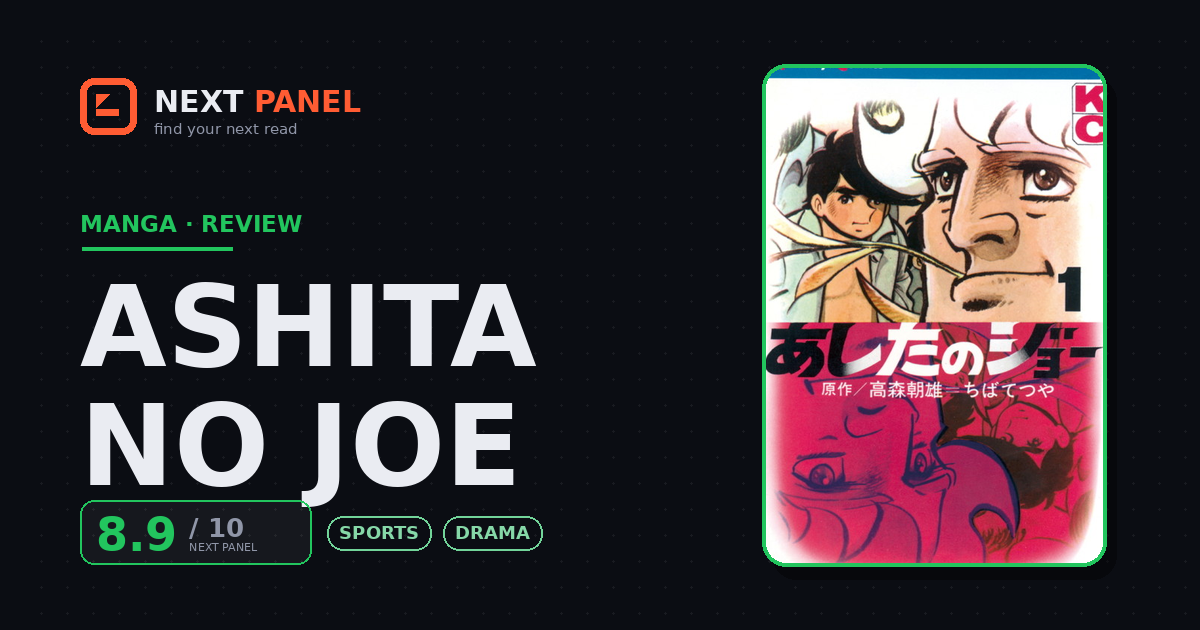
Is Ashita no Joe Worth Reading? Review & Where to Read
Quick Answer
Yes, if you care about manga history or want a boxing story with real weight. Ashita no Joe is a foundational classic — the tale of a drifter who channels his rage into the ring, his legendary rivalry, and a famously devastating arc about burning yourself out for a dream. It's emotionally powerful and hugely influential. The 1960s-70s art is dated and it's heavy going, but it finally has an official English release, and it earns its legend.
Quick Verdict
“One of the most influential manga ever made, and still a gut-punch — a boxing tragedy that burns brighter than almost anything since, dated art and all.”
Best for: Readers who want a foundational, emotionally devastating boxing classic and don't mind dated 1960s-70s art.
Not for: Readers who want modern art, a light read, or a happy, low-stakes sports story.
- Type
- Manga
- Genres
- Drama, Sports
- Status
- Completed
- This review
- Minor Spoilers
- Author
- Asao Takamori
- Artist
- Tetsuya Chiba
- Publisher
- Kodansha
- Platform
- Kodansha (EN: Fighting for Tomorrow)
| Quick facts | |
|---|---|
| Format | Manga (shōnen), 171 chapters, 20 volumes |
| Run | 1968–1973 · completed |
| Community score | AniList 8.9 · MAL 8.9 · MangaUpdates 8.7 |
| Content | Violence and intense, tragic themes |
Overview
Ashita no Joe is one of the foundational works of manga — a boxing epic that's also a tragedy about ambition, rage, and burning yourself to ash for a dream. Joe Yabuki is a rootless, brawling young drifter who turns up in a Tokyo slum with a chip on his shoulder and fists that don't quit. There he's spotted by Danpei Tange, a ruined alcoholic ex-trainer who sees raw genius under the bravado and resolves to make Joe a champion. Through a stretch in juvenile detention, a defining rivalry, and a brutal climb through the professional ranks, the series follows Joe as boxing becomes both his salvation and the thing that consumes him. It's written by Asao Takamori, drawn by Tetsuya Chiba, and it ran in Weekly Shonen Magazine from 1968 to 1973.
What it does well
Its emotional power is the reason it's a legend. Ashita no Joe hits with a force most modern manga can't touch — the rivalry at its heart is one of the genre's all-time greats, the losses land like body blows, and the whole thing builds toward an ending so iconic it became a piece of Japanese cultural history. This is sports manga as genuine tragedy, and it earns every tear.
Joe is a magnetic, complicated lead — angry, self-destructive, charismatic, impossible to look away from — and the supporting cast, especially the broken-down Danpei, are vivid and deeply human. The series cares about its poor, struggling, marginalized characters in a way that gives it real social weight beyond the ring.
And Chiba's art, for its era, is superb — expressive, kinetic, and brilliant in the ring, where every punch carries impact and exhaustion. You can see why generations of artists studied it.
Where it falls short
It is a product of its time, and you'll feel that. The 1960s-70s art and storytelling — the linework, the melodrama, the pacing conventions — take real adjustment for a modern reader, and some stretches feel slow or stagy by today's standards. This is a historical classic, and it reads like one.
It's also heavy and often bleak. The poverty, violence, and tragedy are relentless, and the self-destructive core of the story makes it a genuinely tough, sometimes punishing read — rewarding, but not comfortable. Newcomers expecting a fun, breezy sports manga will get something far darker.
Verdict
Ashita no Joe is a towering classic for a reason — one of the most influential and emotionally devastating manga ever made, anchored by a legendary rivalry and an ending that still echoes decades later. Its dated style and heavy, tragic tone are real barriers, and it asks you to meet it on its own historical terms. But now that it finally has an official English release, there's no better time to read one of the works that built the medium. For serious manga fans, it's essential.
Strengths & Weaknesses
Strengths
- Its emotional power is legendary — the central rivalry is one of the genre's all-time greats and the tragedy lands like body blows.
- Joe is a magnetic, complicated lead, and the supporting cast (especially the broken-down Danpei) are vivid and deeply human.
- It cares about its poor, marginalized characters, giving it real social weight beyond the ring.
- Chiba's expressive, kinetic art is superb for its era, with real impact and exhaustion in every punch.
Weaknesses
- It's a product of its time — the 1960s-70s art, melodrama, and pacing take real adjustment for a modern reader.
- It's heavy and often bleak: relentless poverty, violence, and tragedy make it a tough, sometimes punishing read.
- It reads like the historical classic it is, so newcomers expecting breezy sports fun will get something far darker.
Similar Titles
The other great boxing manga — longer and more crowd-pleasing, but the same love of the sport.
Takehiko Inoue's wheelchair-basketball drama — modern, but the same emotional heft and respect for struggle.
Rainbow: Nisha Rokubo no Shichinin
Gritty post-war story of marginalized youth in detention, sharing Joe's raw, bleak intensity.
Frequently Asked Questions
Is Ashita no Joe finished?
Yes. It ran from 1968 to 1973 and is complete in 20 volumes. Kodansha released the first official English edition, 'Ashita no Joe: Fighting for Tomorrow,' starting in 2024.
Why is it so famous?
It's one of the most influential manga ever — a cultural touchstone in Japan whose intensity, tragedy, and iconic ending shaped sports and seinen manga for generations.
Is the old art a problem?
It's very much of its era — 1960s-70s linework and pacing — so it takes some adjustment. But Chiba's expressive, kinetic art still hits hard once you settle in.