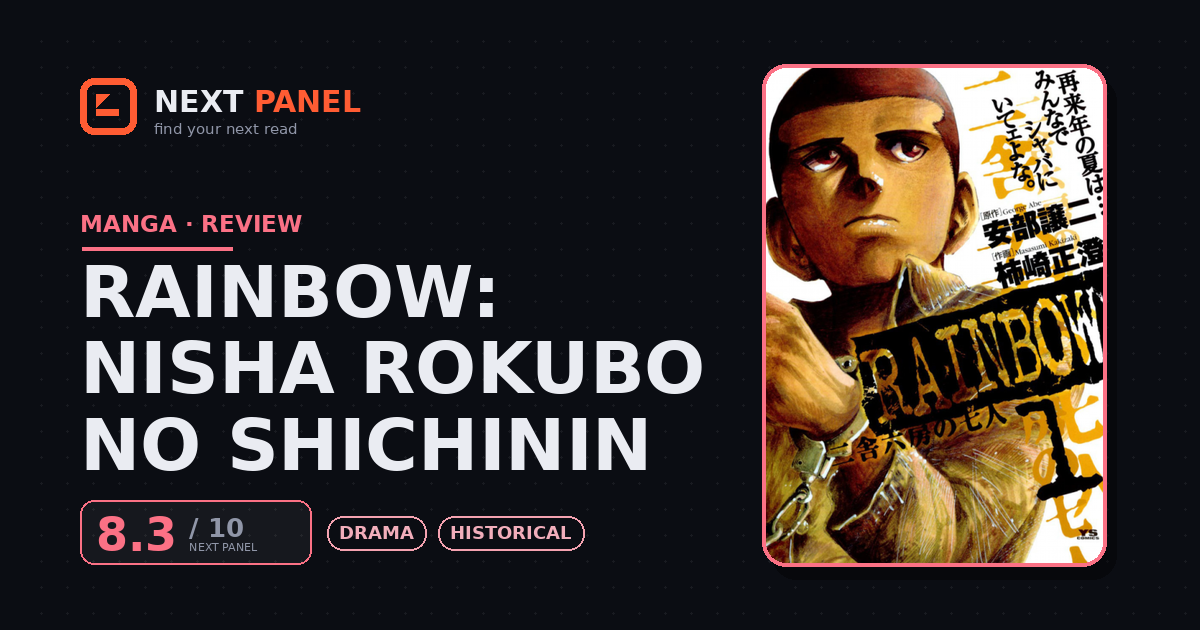
Is Rainbow: Nisha Rokubo no Shichinin Worth Reading? Review & Where to Read
Quick Answer
If you want an intense, emotional drama about brotherhood under brutal conditions, Rainbow hits hard. The first half, set inside the reformatory, is some of the most gripping manga out there — just know it's heavy, the villains are over-the-top, and the second half loses some focus.
Quick Verdict
“Brutal, tender, and unflinching — a post-war prison story about seven kids holding onto each other while everything else tries to break them.”
Best for: Readers who want an intense emotional drama about brotherhood and survival and can stomach real darkness.
Not for: Readers who want subtle villains, a lighter tone, and a tightly plotted story.
- Type
- Manga
- Genres
- Drama, Historical
- Status
- Completed
- This review
- Minor Spoilers
- Author
- George Abe
- Artist
- Masasumi Kakizaki
- Publisher
- Shogakukan
| Quick facts | |
|---|---|
| Format | Manga (seinen), 25 chapters, 5 volumes |
| Run | completed |
| Community score | MangaUpdates 8.0 |
| Content | Graphic violence, sexual abuse, torture |
Overview
Rainbow: Nisha Rokubo no Shichinin opens in 1955, a decade after the war, with six teenage boys arriving at the Shonan Special Reformatory. Inside, they find a seventh — An-chan, an older boy and ex-boxer who becomes their leader, their protector, and their moral compass. Written by George Abe and drawn by Masasumi Kakizaki, it's a story about what it takes to stay human in a place built to grind you down, and about the kind of loyalty that forms when seven people have nothing left but each other.
What it does well
The brotherhood is everything, and the manga earns it. These seven boys aren't friends because the plot says so; they're bound together by shared cruelty, shared meals, shared survival. Abe takes the time to make each one a person — their crimes, their fears, the families that failed them — so that when they stand up for one another, it lands. The first stretch, set entirely inside the reformatory, is gripping in a way few dramas manage: claustrophobic, tense, and genuinely moving when a moment of kindness breaks through.
A lot of that power comes from An-chan. He's the kind of mentor figure who could easily be a cliche, but the writing keeps him grounded — flawed, tired, but unshakeable in the way that matters. He gives the boys, and the reader, something to hold onto, and the whole story bends around his quiet strength.
Kakizaki's art is the other pillar. It's grimy and physical, perfect for the sweat and bruises of the setting, but it can turn delicate when the moment calls for it. He draws suffering without glamorizing it and tenderness without going soft, and that balance is exactly what a story like this needs. The reformatory feels real — cold, cramped, dangerous — which makes the boys' small victories feel real too.
Above all, Rainbow understands that hope only means something against a believable darkness. It doesn't pull punches about the violence and abuse its characters endure, so when they refuse to give up, it doesn't read as naive. It reads as defiance.
Where it falls short
The darkness is also where the cracks show. The antagonists — a sadistic guard, a predatory prison doctor — are pure, cackling evil, with no inner life beyond cruelty. That works in the moment but flattens the conflict over time. The bigger issue is structure: once the boys leave the reformatory, the latter half of the series spreads across years and subplots, leaning harder on melodrama, coincidence, and reversal. It's still compelling, but it never recaptures the focus of those early volumes. And the sheer volume of misery can wear you down; Rainbow sometimes seems to test how much its characters (and you) can take.
Verdict
Rainbow is a powerful, harrowing drama with one of the strongest opening acts in the medium. Its villains are thin and its second half loses some discipline, but the bond at its core and Kakizaki's superb art carry it a long way. If you want a story about holding onto your humanity in the worst circumstances, and you can handle how dark it's willing to go, it's well worth seeking out.
Strengths & Weaknesses
Strengths
- The bond between the seven boys is the heart of it, and their loyalty feels earned rather than sentimental.
- Kakizaki's gritty, expressive art sells both the squalor of the reformatory and the rare moments of warmth.
- It refuses to flinch from the cruelty of its setting, which makes the hope the boys hold onto actually mean something.
- An-chan, the older boxer who mentors the group, is a magnetic figure whose steadiness anchors the whole story.
Weaknesses
- The villains are cartoonishly evil — more engines of misery than believable people.
- The second half, after the boys leave the reformatory, sprawls into melodrama and unlikely coincidences.
- It piles on suffering so relentlessly that it can tip from powerful into punishing.
Similar Titles
A post-war underdog story with the same grit, boxing, and bruised hope.
Beautifully drawn historical drama about violent men searching for something better.
Another harsh historical journey about brotherhood and the long climb out of violence.
Frequently Asked Questions
Is there an official English release?
Not yet. Rainbow has official Spanish, Italian, and French editions, but no English one as of now. We'll update this page if that changes.
How dark is it really?
Very. It's set in a 1955 reformatory and deals frankly with violence, abuse, and despair. It's ultimately about hope, but it earns that hope through a lot of brutality.
Is it finished?
Yes, it's complete in 22 volumes, and it won the Shogakukan Manga Award in 2006.