Is Chobits Worth Reading? Review & Where to Read
Quick Answer
Yes, if you want a CLAMP classic with beautiful art and a genuinely tender core romance — but go in knowing some of the side material has aged badly and hasn't been softened for a modern audience.
Quick Verdict
“CLAMP's linework is still gorgeous two decades later; the central romance is sweeter than the premise sounds, but a few subplots haven't aged well and the show doesn't apologize for them.”
Best for: Readers who want a CLAMP art showcase and a slow-building, sincere romance about loneliness and connection.
Not for: Readers who want their sci-fi to interrogate its own premise hard, or who have zero tolerance for early-2000s harem-manga side material.
- Type
- Manga
- Genres
- Romance, Sci-Fi
- Status
- Completed
- This review
- Minor Spoilers
- Author
- CLAMP
- Publisher
- Kodansha
- Platform
- Kodansha
| Quick facts | |
|---|---|
| Format | Manga, 88 chapters, 8 volumes |
| Run | 2000–2002 · completed |
| Community score | AniList 7.5 · MangaUpdates 7.9 |
| Where to read | Kodansha — official |
Overview
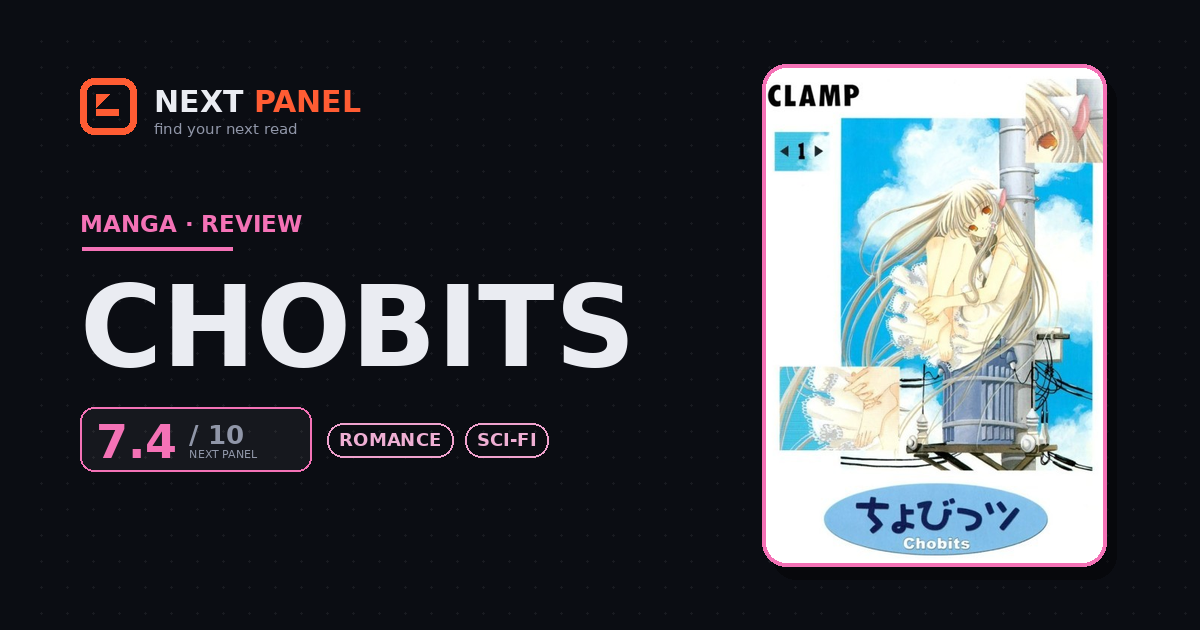
Chobits starts from a simple hook: Hideki Motosuwa is a broke, lonely college student in a world where everyone has a persocom, a human-shaped computer that doubles as a companion. He finds one thrown out with the trash, brings her home, and names her Chi. What follows is CLAMP doing what CLAMP does best — turning a high-concept premise into an extended meditation on loneliness, dependency, and what it means to actually connect with someone, wrapped in some of the cleanest character art the studio has produced.
What it does well
The art carries a lot of the early chapters, and it's worth the price of admission on its own. CLAMP's linework is precise without feeling stiff, and the character designs — especially Chi's — are instantly recognizable for a reason. But the manga earns more credit than "pretty art carries a thin story" gives it. The Hideki/Chi relationship develops slowly, with real awkwardness and real tenderness, and CLAMP resists the urge to rush the payoff. By the time the story reaches its emotional peak, it's built up enough goodwill that the sentimentality actually lands instead of feeling unearned.
The persocom concept also gives the story a genuine question to chew on: what happens when the person who loves you unconditionally was, in some sense, built to? CLAMP doesn't answer that with hard science-fiction rigor, but they use it to explore loneliness and inequality in relationships in a way that's more thoughtful than the cute cover suggests. And when the ending finally comes, it commits — no joke-cop-out, no unearned reset. It picks a direction and follows through.
Where it falls short
The honest weak point is the side material. Several supporting characters and subplots exist mostly to ogle or be ogled, and those chapters read as dated filler more than twenty years on — they don't add much to the central story and they're the parts most likely to make a modern reader wince. Chi herself spends a long stretch of the story acting childlike, which works thematically but also means the central romance skews more caretaker-and-dependent than equal partnership for a lot of its runtime, and not every reader will be comfortable with that framing.
The sci-fi elements stay thin, too. Persocoms are everywhere in this world, but CLAMP doesn't do much with the wider social or technological implications — it's a backdrop for the romance, not something interrogated in its own right. If you're hoping for a rigorous exploration of AI and personhood, this isn't that book.
Verdict
Chobits is a product of its era in both good and bad ways — gorgeous CLAMP art and a genuinely sincere central romance, sitting next to side material that hasn't held up. If you can take the rough edges as a sign of when it was made rather than a dealbreaker, there's a tender, well-drawn love story here worth reading.
Strengths & Weaknesses
Strengths
- CLAMP's art is the draw and it delivers — clean, expressive character work and some genuinely striking full-page compositions.
- The core relationship between Hideki and Chi builds slowly and earns its sentimentality instead of rushing it.
- The persocom concept gives CLAMP room to ask real questions about loneliness, dependency, and what makes a relationship one-sided, even when the answers are simple.
- The ending commits to its themes instead of dodging them with a joke or a shrug.
Weaknesses
- Several side characters exist mainly to ogle or be ogled, and those chapters haven't aged gracefully.
- Chi's arc leans hard on her being childlike for long stretches, which undercuts some of the romance for readers looking for an equal partnership.
- The sci-fi worldbuilding stays pretty thin — persocoms are a vehicle for the love story, not something CLAMP explores rigorously.
Similar Titles
another quiet, sincere romance built around an unconventional couple learning to open up to each other
Wotakoi: Love Is Hard for Otaku
same gentle, low-drama take on adult loneliness and connection
if you want the bittersweet, art-forward end of this same emotional register
Where to Read Officially
| Platform | Format | Pricing | Region notes | Link |
|---|---|---|---|---|
| Kodansha | Print & digital volumes | Paid | Region availability varies | Open |
Frequently Asked Questions
Is Chobits appropriate for younger readers?
It's aimed at an older teen/adult audience — there's fan service and some mature subplot material, so it's not a kids' book despite the cute cover art.
Do I need to watch the anime first?
No. The manga tells its own version of the story and actually ends somewhere different and more satisfying than the anime does.
How long is it?
It's a complete, relatively compact series — you can read the whole thing in a couple of sittings.