Is CITY Worth Reading? Review & Where to Read
Quick Answer
Yes, if Nichijou's brand of surreal gag comedy clicked for you — CITY does the same thing at a bigger scale, with more characters and, eventually, an actual through-line connecting the chaos.
Quick Verdict
“Denser and stranger than Nichijou, and better for having an actual plot underneath the noise.”
Best for: Readers who like rapid-fire absurdist comedy and don't mind a big, loosely connected cast of weirdos.
Not for: Readers who want a tight, focused story with a small cast and a clear emotional arc from chapter one.
- Type
- Manga
- Genres
- Slice of Life, Comedy
- Status
- Completed
- This review
- Minor Spoilers
- Author
- Keiichi Arawi
- Publisher
- Kodansha
- Platform
- Kodansha
| Quick facts | |
|---|---|
| Format | Manga (seinen), 210 chapters, 15 volumes |
| Run | 2016–2025 · completed |
| Community score | AniList 7.9 · MangaUpdates 7.2 |
| Where to read | Kodansha — official |
Overview
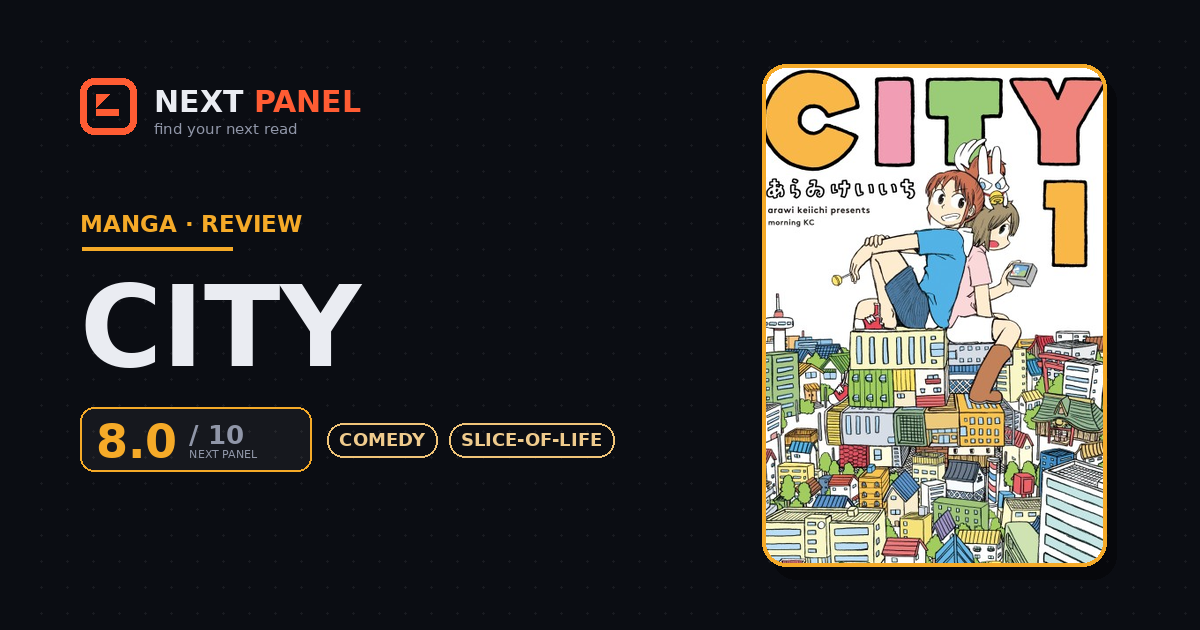
CITY is Keiichi Arawi's follow-up to Nichijou, and it's built on the same comedic DNA — deadpan characters reacting to escalating absurdity — but stretched across an entire town instead of a single school. The loose center is Midori Nagumo, a perpetually broke college sophomore scheming her way through rent payments, but the manga treats her as just one node in a sprawling web of shopkeepers, cops, robots, and assorted lunatics who all cross paths in increasingly ridiculous ways.
What it does well
What makes CITY work is sheer density. Arawi packs nearly every page with a joke, a sight gag, or a strange visual beat, and the hit rate stays high even as the cast balloons. Rather than centering one or two leads, the manga treats its whole ensemble as fair game, and it commits to giving even minor background characters a distinct look and a running bit, so the sprawl reads as generous instead of overstuffed once you're a few volumes in.
The art does a lot of the comedic lifting. Arawi's character designs are simple and expressive, and he's especially good at letting a character's blank, deadpan expression sit next to something completely unhinged happening around them — that contrast is where most of the laughs land. And unlike a strict gag-a-day format, CITY slowly threads its running jokes and recurring characters into something with actual shape; by the later volumes, payoffs from early chapters start clicking into place in a way that rewards readers who stuck with it.
Where it falls short
The first stretch is a genuine hurdle. Arawi introduces a large cast fast, jumps between subplots without much signposting, and leans on comic rhythms that take a volume or two to click. Readers expecting a clear protagonist and throughline from page one may bounce off before the manga finds its footing.
Some of the humor is also culturally specific — gags built on Japanese convenience-store culture, local media tropes, or very Japan-specific absurdist comedy traditions don't always translate their full impact, even with a solid English localization. And if you want a manga with real emotional stakes or a driving plot, CITY isn't that — its structure stays loose and episodic even when it's at its most connected, which will frustrate readers looking for forward momentum.
Verdict
CITY is a bigger, weirder, and ultimately more ambitious version of what made Nichijou work, and it earns the extra scale once it gets past its chaotic opening stretch. If dense, deadpan absurdist comedy is your thing, this is one of the better examples of the genre currently available in English.
Strengths & Weaknesses
Strengths
- The gag density is relentless — almost every page has a joke, a visual bit, or a running reference paying off.
- The cast is huge but distinct; even one-off characters get a memorable visual hook so the sprawl never feels like clutter.
- Arawi's line work sells the absurdity — deadpan character designs against increasingly unhinged scenarios is where the comedy lives.
- Recurring gags build into a loose, satisfying structure by the later volumes instead of just repeating themselves.
Weaknesses
- The opening volumes throw a lot of characters and running jokes at once, and it takes a while to get oriented.
- Some humor depends on familiarity with Japanese pop culture and local absurdist comedy conventions, which can land softer in translation.
- Readers looking for emotional depth or a clear central plot will find the structure loose almost to the point of formlessness.
Similar Titles
Arawi's earlier series and the clearest reference point — same gag rhythm, smaller school setting.
Another deadpan absurdist ensemble comedy that thrives on escalating nonsense.
Saiki Kusuo no Psi-nan
For readers who want a similarly dense, character-driven gag comedy with a big supporting cast.
Where to Read Officially
| Platform | Format | Pricing | Region notes | Link |
|---|---|---|---|---|
| Kodansha | Digital chapters | Print & digital volumes | Free + Paid | Region availability varies | Open |
Frequently Asked Questions
Do I need to read Nichijou first?
No. CITY is a separate story with its own cast — Nichijou fans will recognize the sense of humor, but there's no plot connection required.
Is CITY finished?
It's had two separate endings — the first run wrapped in 2021, then Arawi brought it back for a continuation that concluded with a 15th volume in December 2025.
How is the English translation?
Kodansha (formerly Vertical) has released it in full, and the translation does a solid job carrying over the deadpan comic timing.