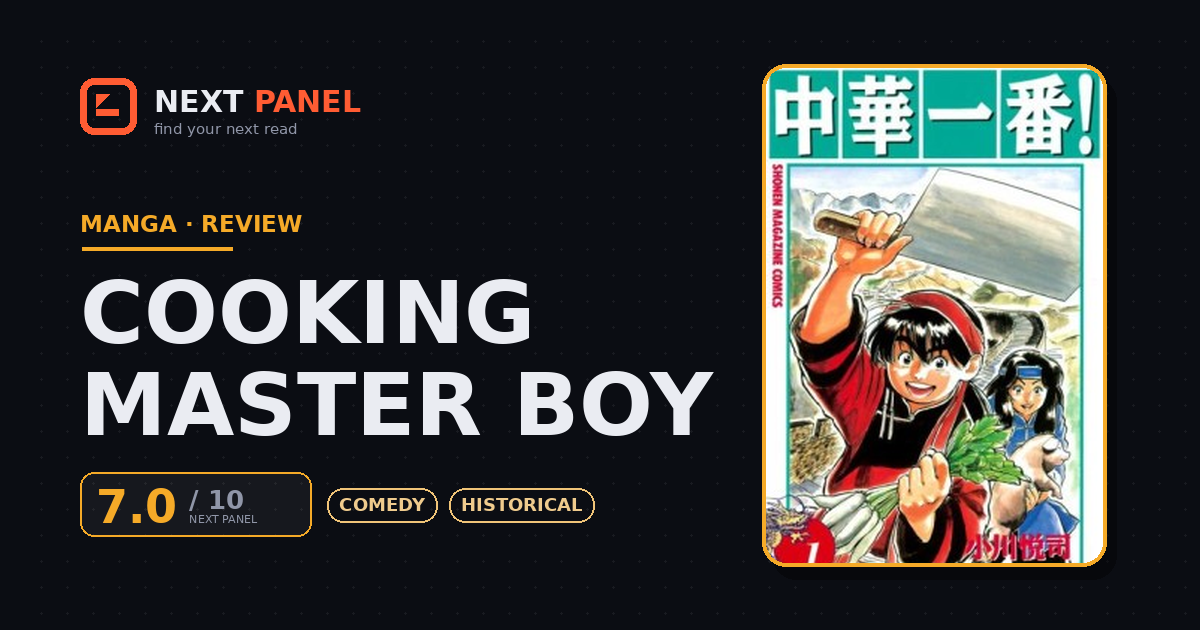
Is Cooking Master Boy Worth Reading? Review & Where to Read
Quick Answer
Yes, if you want a quick, old-school cooking-duel story. It's short, briskly paced, and charming, even if it's simpler than the genre it helped popularize.
Quick Verdict
“Short, sharp, and a little corny -- a fast, old-school cooking-duel manga that wraps up in well under a year's worth of chapters.”
Best for: Readers who like short, tightly structured competition stories and don't mind a dated art style.
Not for: Readers who want a long-running battle series with a big, evolving cast.
- Type
- Manga
- Genres
- Comedy, Historical
- Status
- Completed
- This review
- Minor Spoilers
- Author
- Etsushi Ogawa
- Publisher
- Kodansha
| Quick facts | |
|---|---|
| Format | Manga (shōnen), 5 volumes |
| Run | completed |
| Community score | MangaUpdates 7.4 |
Overview
Cooking Master Boy is the English title for Chuka Ichiban! (中華一番!), Etsushi Ogawa's cooking-duel manga that ran in Kodansha's Weekly Shonen Magazine from 1995 to 1996. It follows Liu Mao Xing -- Mao, for short -- a teenage chef traveling a fantastical version of China to earn a place among the country's best cooks, one increasingly outlandish cooking duel at a time. It's an early, influential entry in the genre that would later produce shows like Yakitate!! Japan and Food Wars!, and it got a 52-episode anime adaptation not long after it wrapped.
What it does well
The duels are the whole show, and they're built with real care. Every competition has clear rules -- a theme ingredient, a panel of judges, a time limit -- so when Mao wins or loses, it's because of something specific he did with the food in front of him, not just narrative convenience. That structure makes the manga easy to follow and genuinely tense in short bursts, which suits its brisk pace: chapters move quickly, duels resolve within a few installments, and there's almost no padding between them.
Mao himself carries the story well. He starts out arrogant and undisciplined, and the manga uses each duel to chip away at that, forcing him to actually listen to more experienced chefs instead of coasting on talent. It's a simple arc, but it's a clean one, and it gives the short run an actual sense of forward motion rather than just being a string of unconnected contests.
The food art also holds up better than you'd expect from a mid-90s shonen. Ogawa draws dishes with a level of detail and enthusiasm that makes the stakes of each duel feel real -- you can tell which dish is supposed to be the better one before the judges even say so, which is harder to pull off than it sounds.
Where it falls short
The flip side of being short and tightly plotted is that it's also thin. Rivals show up, get a duel, and disappear -- a handful get a bit of a backstory, but most exist purely to lose to Mao once and never return. If you're used to modern cooking or battle manga building out a whole rotating cast, this will feel sparse by comparison.
The judging can also strain credibility here and there. A few duels land on the outcome the plot clearly needs rather than the dish that actually sounds better described on the page, which undercuts the sense of the rules deciding the outcome instead of the author, that the better chapters build up.
Verdict
Cooking Master Boy is a quick, well-constructed cooking-duel story that doesn't overstay its welcome -- you can read the whole thing in a weekend. It's simpler and rougher than the genre it helped popularize, but the central format still works, and Mao's growth gives it a satisfying enough shape to be worth the short time it asks for.
Strengths & Weaknesses
Strengths
- The cooking duels are genuinely well-built: each one has clear judging criteria, ingredient limits, and stakes, so the outcome feels earned instead of arbitrary.
- Mao's arc from cocky teenager to disciplined chef gives the manga a clean, satisfying shape across its short run.
- It moves fast -- short chapters and quick escalation mean there's almost no filler dragging the story down.
- The food itself is drawn with real specificity and love, which still reads as charming decades later.
Weaknesses
- It's short and simple next to the battle-shonen and cooking manga that followed it -- don't expect deep power-scaling or long-term character growth.
- A few of the judging outcomes feel convenient, landing on whichever result the plot needs rather than the stronger dish.
- The rival cast thins out fast -- several competitors exist for exactly one duel and then vanish.
Similar Titles
a later, sillier take on the same cooking-competition format
takes the food-as-combat idea and turns it into a full battle shonen
a separate, more abrasive cooking-duel manga from the same era
Frequently Asked Questions
Is Cooking Master Boy the same as Iron Wok Jan?
No, they're different series. Cooking Master Boy is Chuka Ichiban! by Etsushi Ogawa; Iron Wok Jan is a separate, unrelated cooking-duel manga by Shinji Saijyo. They just came out in the same era with a similar hook.
Is there an official English translation right now?
Not currently -- there's no active official digital or print release at the moment, so this is one to recheck down the line rather than one to track down through unofficial sources.
Does the story continue past this manga?
The original run wraps up on its own in under two years, but creator Etsushi Ogawa later returned to the world with the sequel Shin Chuka Ichiban! and, much later, Chuka Ichiban! Kiwami.