Is Crying Freeman Worth Reading? Review & Where to Read
Quick Answer
Yes, if you want a hard-boiled 1980s crime classic with gorgeous art and don't mind that it's currently out of print in English. It's a genre landmark worth tracking down.
Quick Verdict
“Ikegami draws Yo Hinomura like a photograph and Koike writes him like a myth, and the gap between those two approaches is exactly what makes this work.”
Best for: Readers who want pulpy, hard-boiled crime fiction rendered in gorgeous, photorealistic art.
Not for: Readers who want a currently-in-print series or who are uncomfortable with heavy violence and explicit content.
- Type
- Manga
- Genres
- Romance, Action
- Status
- Completed
- This review
- Minor Spoilers
- Author
- Kazuo Koike
- Artist
- Ryoichi Ikegami
- Publisher
- Shogakukan
- Platform
- Dark Horse Comics (out of print)
| Quick facts | |
|---|---|
| Format | Manga (seinen), 103 chapters, 9 volumes |
| Run | 1986–1988 · completed |
| Community score | AniList 6.3 · MangaUpdates 7.1 |
| Content | Graphic violence, explicit sexual content |
| Where to read | Dark Horse Comics (out of print) — official |
Overview
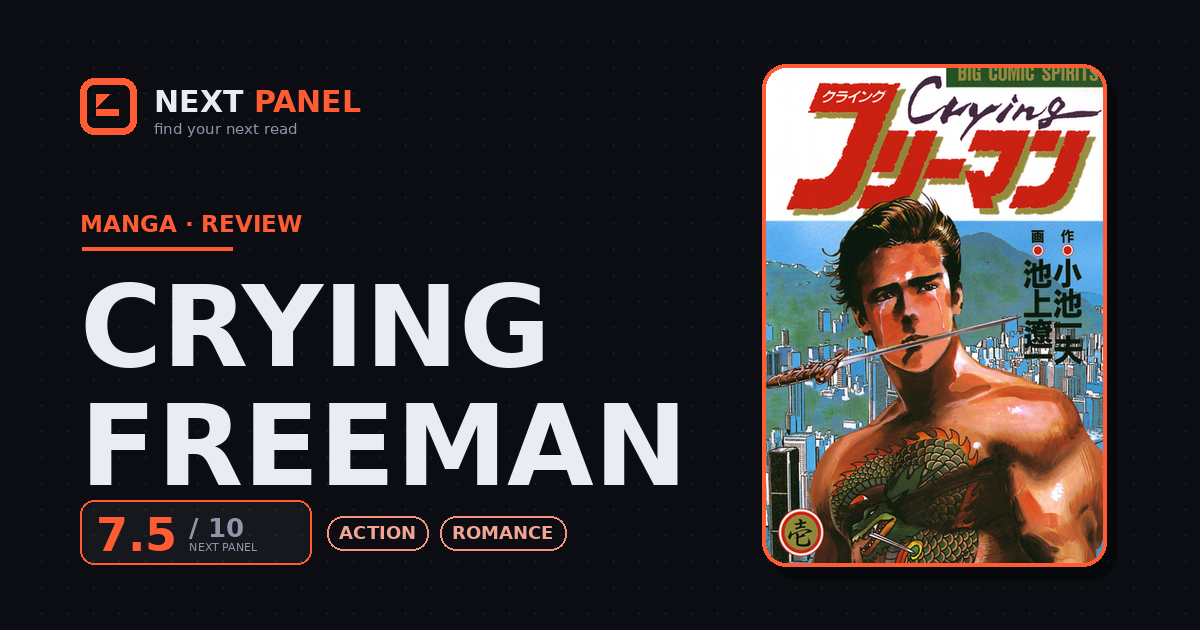
Crying Freeman follows Yo Hinomura, a gentle potter kidnapped and brainwashed by a Chinese crime organization into becoming their perfect assassin. He carries out his kills with total precision and skill, but a fragment of his old self survives: he weeps, without fail, after every job. The story follows his assassinations, his growing entanglement with a witness-turned-lover named Emu Hino, and the criminal power struggles that keep pulling him back into violence.
It's a 1980s seinen classic, pairing Kazuo Koike's pulpy crime plotting with Ryoichi Ikegami's strikingly realistic art.
What it does well
Ikegami's art is the reason this manga is still discussed decades later. His character work is photorealistic in a way that gives every scene a physical weight — faces, bodies, and settings all carry a grounded presence that most action manga of the era, stylized and exaggerated, don't attempt. Combined with Koike's confident pulp plotting, the combination makes even the wildest crime-syndicate melodrama feel tangible.
The central conceit of Yo Hinomura is genuinely effective. He's an unstoppable killer, but the crying-after-every-kill hook keeps the story from treating his violence as simple cool-factor spectacle — every job costs him something, even if he can't stop doing it. That tension gives the manga an emotional throughline that a lot of similarly pulpy action stories skip entirely.
Koike's plotting doesn't waste time. Assassination contracts, rival crime families, and international intrigue move at a brisk pace, and the story clearly knows what kind of pulp thriller it wants to be and commits to it fully rather than hedging its tone.
Where it falls short
The plotting prioritizes momentum over plausibility — twists arrive fast and conveniently, and readers looking for airtight internal logic will find plenty to pick at. This is pulp fiction, and it plays by pulp rules.
It's also currently out of print in English. Dark Horse's 2006-2007 edition is the most recent release, and finding a copy now generally means the secondary market rather than a straightforward purchase.
The content itself is heavy — frequent graphic violence and explicit sexual content — which limits its audience by design, but is worth knowing going in.
Verdict
Crying Freeman is a genre landmark for a reason: Ikegami's art and Koike's confident pulp plotting make for one of the more distinctive hard-boiled seinen classics of its era. Being out of print is a real barrier, but for readers willing to track it down, it's worth the effort.
Strengths & Weaknesses
Strengths
- Ryoichi Ikegami's photorealistic art gives every character weight and presence that stylized action manga rarely achieves.
- Yo Hinomura's central hook — a gentle potter brainwashed into a killer who weeps after every job — gives the violence a genuine emotional undercurrent instead of pure spectacle.
- Kazuo Koike's plotting moves fast and commits fully to pulp crime-thriller conventions: assassination plots, criminal syndicates, and femme fatales handled with total confidence.
- The central romance between Yo and Emu gives the story a consistent emotional throughline across its many self-contained arcs.
Weaknesses
- It's currently out of print in English, so getting a copy means hunting the secondary market rather than buying new.
- The plotting is pure pulp — twists and reveals prioritize momentum over plausibility, which won't work for readers who want tighter internal logic.
- The violence and sexual content are frequent and explicit, aimed squarely at an adult audience rather than a general readership.
Similar Titles
Lady Snowblood
Another Kazuo Koike classic mixing pulp revenge plotting with striking, adult-oriented art.
Shares the hard-boiled, hyper-competent assassin framework, from the same era of seinen action manga.
A more modern take on stylish, morally gray crime action if Crying Freeman's pulpier plotting appeals to you.
Where to Read Officially
| Platform | Format | Pricing | Region notes | Link |
|---|---|---|---|---|
| Dark Horse Comics (out of print) | Print volumes (currently out of print; secondary market only) | Paid | Region availability varies | Open |
Frequently Asked Questions
Is Crying Freeman currently in print?
No. Dark Horse's 2006-2007 edition is the most recent English release, and it's currently out of print — copies are found through the secondary market.
Is it finished?
Yes, the original series is complete at 9 volumes, serialized from 1986 to 1988.
Is it very graphic?
Yes — it includes frequent violence and explicit sexual content, so it's intended strictly for adult readers.