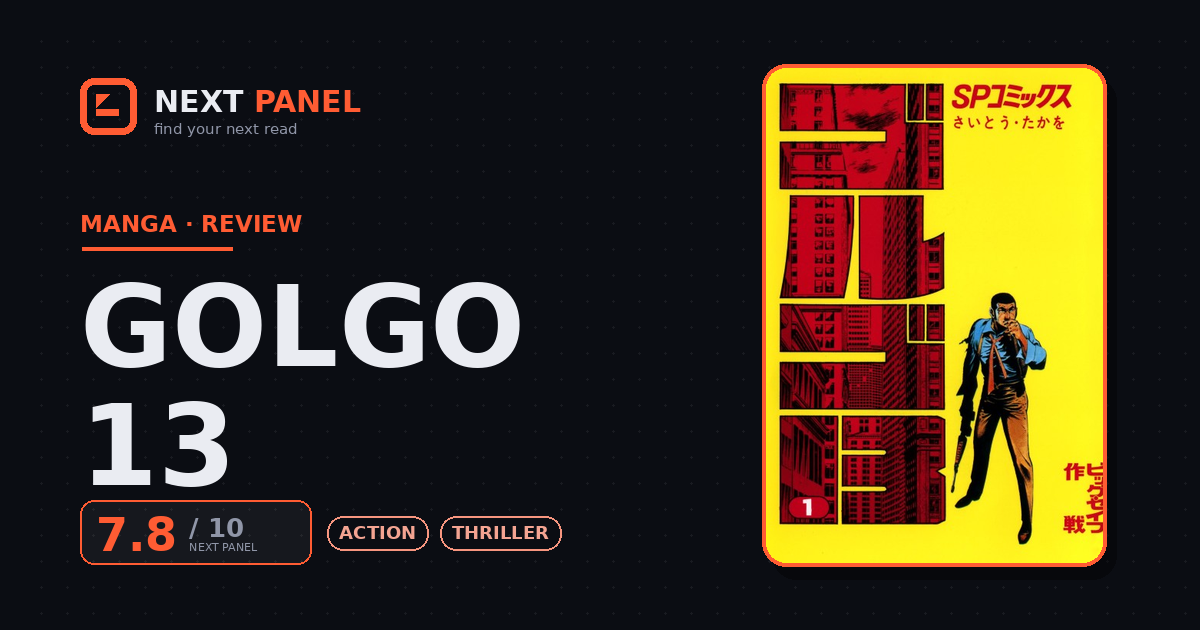
Is Golgo 13 Worth Reading? Review & Where to Read
Quick Answer
Yes, as an anthology rather than a binge — individual arcs are sharp, tense, procedural thrillers, even if the central character is deliberately a blank slate and the sheer size of the series makes "finishing it" beside the point.
Quick Verdict
“Treat this like a long-running anthology of tight assassination thrillers instead of one continuous story, and it's one of the most influential action manga ever put on paper.”
Best for: Readers who want tense, procedural spy-thriller stories and don't need a serialized plot or character growth to stay invested.
Not for: Readers who want an evolving protagonist, ongoing character relationships, or a story built to be read start to finish in order.
- Type
- Manga
- Genres
- Thriller, Action
- Status
- Ongoing
- This review
- Minor Spoilers
- Author
- Takao Saito
- Publisher
- Shogakukan
- Platform
- Viz Media
| Quick facts | |
|---|---|
| Format | Manga (seinen), 218 volumes |
| Run | 1968–present · ongoing |
| Community score | AniList 7.3 · MangaUpdates 7.3 |
| Content | Graphic violence, sexual content, mature political themes |
| Where to read | Viz Media — official |
Overview
Golgo 13 has been running in Japan since 1968, following Duke Togo — codename Golgo 13 — the world's most feared and most expensive assassin. He doesn't miss. He doesn't explain himself. He barely speaks. Each arc drops him into a new contract, usually tangled up in real-world politics, corporate espionage, or historical events, and the story is less interested in who he is than in how, precisely, he's going to pull off the impossible this time.
Created by Takao Saito and produced through his namesake studio, the series is one of the longest-running manga ever published, with over 200 volumes and more than 55 years of continuous serialization — a run that has outlasted its own creator, who passed away in 2021 with the series continuing under Saito Production.
What it does well
The procedural detail is the series' calling card. Individual arcs are built around real weapons, real tactics, and real political situations, researched with a seriousness that most action fiction doesn't bother with, and that groundedness makes even the most outlandish contracts feel plausible while they're unfolding.
Golgo's blankness is a deliberate design choice, and it works better than it sounds. Because he has no arc, no backstory doled out over time, and no relationships that carry forward, any given story can drop a new reader in without homework. He's less a character than a fixed point the plot revolves around, and that constancy is what's let the series run for over five decades without running out of new stories to tell.
That same willingness to fold itself into real history is where the best arcs shine — contracts tangled up in actual geopolitical flashpoints give the tension a grounding that purely invented spy-thriller plots usually can't match. And visually, Saito Production's clean, detailed linework and confident, almost cinematic paneling have influenced generations of action manga that came after it.
Where it falls short
Golgo's refusal to change is the whole point, but it also means there's no accumulating character investment across the story's enormous length — you're reading for the craft of each individual contract, not for where Golgo himself is headed.
The Cold War-era politics that shaped many classic arcs can read as dated today, and the series' treatment of women, particularly in its frequent seduction-and-betrayal subplots, hasn't aged well by modern standards. And with over 200 volumes and no end in sight, there's no realistic way to read the whole thing — picking a good entry point matters more here than with almost any other manga.
Verdict
Golgo 13 is less a single story than a decades-long anthology of tense, well-researched assassination thrillers built around one of manga's most iconic blank slates. Go in treating it like a procedural anthology you can dip into arc by arc, and it's one of the most influential action manga ever made; go in expecting a character-driven story with an ending, and you're reading it wrong.
Strengths & Weaknesses
Strengths
- Each arc is a self-contained, tightly plotted thriller built around research into real weapons, tactics, and political situations, which gives the series a procedural credibility most action manga don't bother with.
- Golgo's total silence and lack of backstory turn him into a genuine constant — a fixed point the reader can drop into any arc, any decade, without needing prior context.
- The series' willingness to weave itself into real historical and political events gives individual stories a grounded tension that pure fiction usually can't match.
- As a showcase for Saito Production's clean, detailed art and shot-composition-like paneling, it's genuinely influential on how action manga stage a scene.
Weaknesses
- Golgo himself never changes, which is the point, but it also means there's no character arc to invest in across the story's massive length.
- Individual chapters can lean heavily on Cold War-era politics and attitudes that read as dated, especially around its treatment of women.
- With over 200 volumes and counting, there's no real way to "complete" the series, which makes picking an entry point more important than usual.
Similar Titles
Another stylish, mature assassin thriller from the same manga generation, with a tighter overall story.
A faster, more explosive modern take on the mercenary-thriller genre if Golgo's slow-burn procedural pace isn't quite what you want.
A very different kind of mature seinen thriller, for readers who want more Tezuka-adjacent ambition in their next read.
Where to Read Officially
| Platform | Format | Pricing | Region notes | Link |
|---|---|---|---|---|
| Viz Media | Digital chapters & volumes | Paid | Region availability varies | Open |
Frequently Asked Questions
Where should I start reading Golgo 13?
There's no required order — most arcs are self-contained, so Viz's early digital volumes are a fine starting point, or you can jump to an arc covering a historical period that interests you.
Is Golgo 13 still being published?
Yes. Takao Saito passed away in 2021, but Saito Production has continued the series, keeping it one of the longest-running manga ever published.
Do I need to read it in order to understand it?
No. Golgo himself doesn't change or develop, and most stories are standalone contracts, so you can read arcs in almost any order.