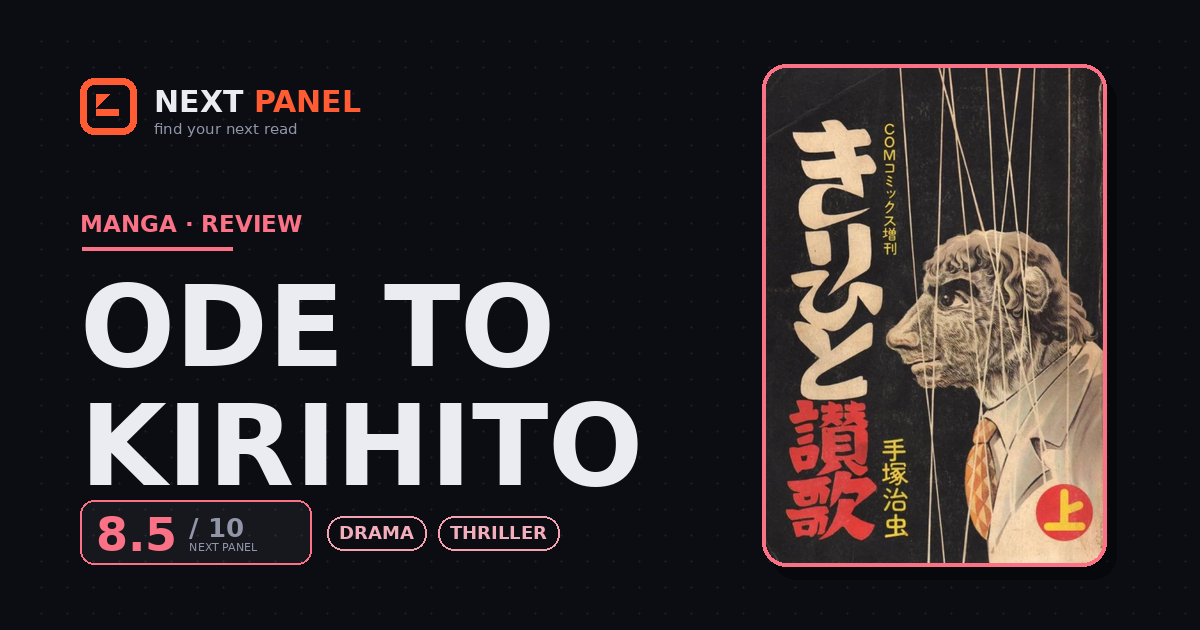
Is Ode to Kirihito Worth Reading? Review & Where to Read
Quick Answer
Yes, if you want one of Osamu Tezuka's most ambitious, mature works — a sprawling, globe-trotting medical odyssey about prejudice and survival. It asks patience for its scale and detours, but it's one of the most substantial seinen manga ever made.
Quick Verdict
“Tezuka uses a body-horror premise to interrogate exactly how fast people stop treating you as human, and the result is uncomfortable in all the ways it means to be.”
Best for: Readers who want an ambitious, mature medical drama with real philosophical weight and don't mind a sprawling, globe-hopping structure.
Not for: Readers who want a tightly focused story in one setting and a gentler, less graphic take on medical drama.
- Type
- Manga
- Genres
- Drama, Thriller
- Status
- Completed
- This review
- Minor Spoilers
- Author
- Osamu Tezuka
- Publisher
- Shogakukan
- Platform
- Vertical, Inc.
| Quick facts | |
|---|---|
| Format | Manga (seinen), 20 chapters, 4 volumes |
| Run | 1970–1971 · completed |
| Community score | AniList 7.5 · MangaUpdates 7.8 |
| Content | Body horror, disturbing medical content, mature themes |
| Where to read | Vertical, Inc. — official |
Overview
Dr. Kirihito Osanai is a promising young physician assigned to investigate Monmow disease, a mysterious condition that gradually reshapes its victims to look dog-like before killing them. Sent to a remote village to study a suspected case, Kirihito starts to suspect the prevailing theory about the disease is wrong — and then contracts it himself. What follows is a sprawling odyssey as Kirihito, now transformed and stripped of the credibility and respect he once had, is passed between hospitals, exploited by the curious and the cruel, and dragged across continents while his former colleagues fight their own battles back home over what his case means for their careers.
Osamu Tezuka wrote and drew this for Big Comic in 1970 and 1971, later in his career and well outside the all-ages register most associated with his name, and it's regularly cited as one of his most ambitious, mature accomplishments.
What it does well
The central premise does exactly what great high-concept fiction should: it turns an abstract question into something the reader has to sit with directly. By making his protagonist a doctor who studies a dehumanizing disease and then lives it, Tezuka gets to show, scene by scene, exactly how fast professional respect and human decency evaporate once someone looks different enough. It's a blunt device, but Tezuka doesn't let it become simplistic — Kirihito's odyssey keeps finding new institutions, new countries, and new kinds of people willing to exploit or protect him, and each stop complicates the story's central question rather than repeating it.
The art is doing serious work here too. Tezuka draws the transformation and its physical consequences in unflinching detail, and because it's rendered in his familiar rounded, expressive style, the contrast between the friendly linework and what's actually happening on the page keeps the horror from ever feeling distant or abstract.
The medical and institutional politics around Kirihito's case are also sharply observed — the colleagues who protect their own careers over the truth, the researchers who see him as a specimen rather than a person, and the rare few who don't. That specificity keeps the book's bigger ideas tethered to believable, petty, human behavior instead of floating off into pure allegory.
Where it falls short
The globe-spanning structure that gives the book its scope also makes it baggy in places — some detours, however thematically relevant, run longer than the story strictly needs, and a reader looking for tighter plotting may feel the sprawl.
Several side characters and subplots get set up with real weight and then don't fully pay off, a common side effect of a story this large trying to cover this much ground. And the body horror and some of the book's darker turns are genuinely disturbing by design — appropriate to what Tezuka's going for, but worth knowing before you start.
Verdict
Ode to Kirihito is Tezuka working at the furthest reach of what people expect from the creator of Astro Boy, and it holds up as one of the most substantial, uncomfortable, and rewarding manga of its era. Go in ready for a long, sprawling, occasionally upsetting odyssey, and it delivers something few other manga attempt at this scale; go in wanting something tighter or gentler, and it will wear on you.
Strengths & Weaknesses
Strengths
- The central premise — a doctor investigating a dehumanizing disease who then contracts it himself — gives Tezuka a direct, uncomfortable way to dramatize how quickly people withdraw their empathy from anyone who looks different.
- The globe-spanning structure keeps finding new angles on the same core question, moving from rural Japan to the Middle East to Europe without ever losing the thread connecting them.
- Tezuka draws the disease's transformation and its consequences with unflinching detail, and the contrast with his familiar, rounded cartoon style makes it land harder rather than softer.
- The medical politics and institutional cowardice around Kirihito's diagnosis feel sharply observed rather than exaggerated for effect.
Weaknesses
- The sprawling, episodic structure means some detours run long relative to what they add to the central story.
- A handful of side characters and subplots get introduced with real weight and then fade out without full resolution.
- The body horror and some of the story's darker turns are genuinely upsetting by design, which won't be what every reader wants from a Tezuka work.
Similar Titles
Another mature, ambitious Tezuka epic, this one trading medicine for wartime politics.
A shorter-form, more episodic take on Tezuka's fascination with medicine and the ethics surrounding it.
A different kind of unflinching, serious historical manga, for readers who want more of that register.
Where to Read Officially
| Platform | Format | Pricing | Region notes | Link |
|---|---|---|---|---|
| Vertical, Inc. | Print omnibus (single volume) | Paid | Region availability varies | Open |
Frequently Asked Questions
Is Ode to Kirihito based on a real disease?
No. Monmow disease is fictional, though Tezuka — himself trained as a physician — grounds the medical detail and institutional politics around it in real-world plausibility.
How long is it?
The English edition from Vertical collects the whole story into a single, roughly 800-page volume.
Do I need medical knowledge to follow it?
No. The medical elements are explained clearly enough for a general reader, and the story's real focus is on prejudice and institutional politics rather than clinical detail.