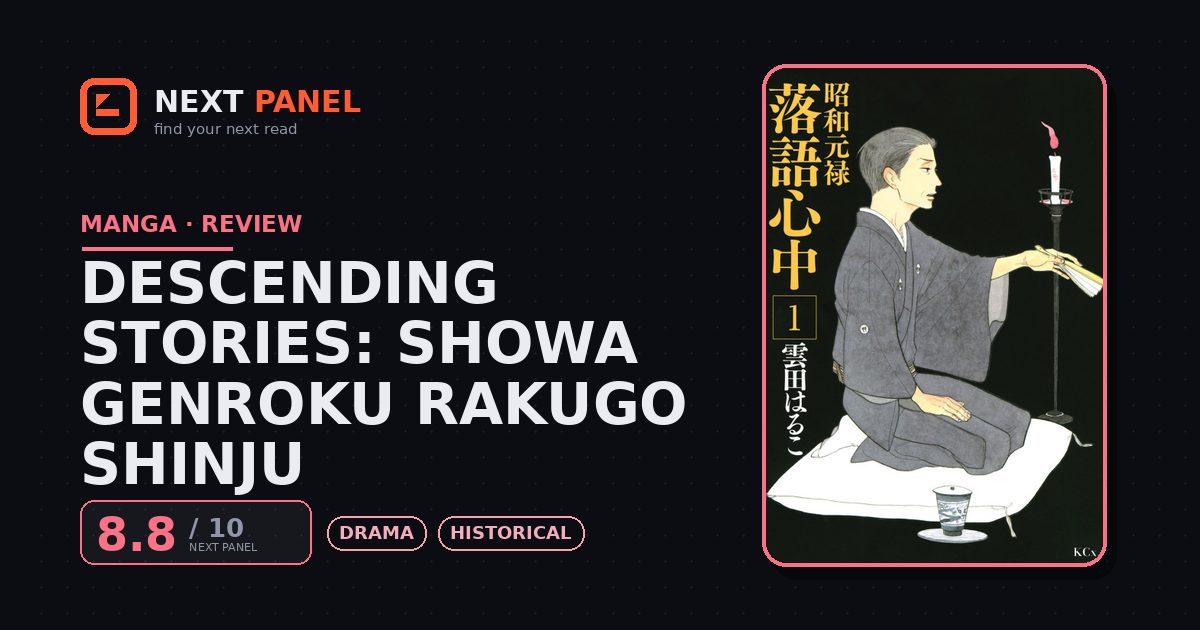
Is Descending Stories: Showa Genroku Rakugo Shinju Worth Reading? Review & Where to Read
Quick Answer
Yes, especially if you want a manga that treats a niche art form seriously without turning into a lecture. It's a slow build, but it pays off.
Quick Verdict
“You don't need to know anything about rakugo going in — by the end you'll understand exactly why these characters gave their whole lives to it.”
Best for: Readers who like character-driven dramas that unfold over decades and don't mind a slow, patient build to the payoff.
Not for: Readers who want a fast plot with clear villains and quick resolutions.
- Type
- Manga
- Genres
- Drama, Historical
- Status
- Completed
- This review
- Minor Spoilers
- Author
- Haruko Kumota
- Publisher
- Kodansha
- Platform
- Kodansha
| Quick facts | |
|---|---|
| Format | Manga (josei), 32 chapters, 10 volumes |
| Run | 2010–2016 · completed |
| Community score | AniList 8.2 |
| Where to read | Kodansha — official |
Overview
Yotaro gets out of prison with nothing to his name and one very specific plan: track down Yakumo Yurakutei, the rakugo master whose performance he saw during his sentence, and beg to become his apprentice. Yakumo doesn't take students. He takes Yotaro anyway, mostly out of curiosity, and gives him the nickname "the fool." From there the manga splits its attention between Yotaro's clumsy, sincere climb through the world of rakugo and the story of how Yakumo became who he is — a decades-old rivalry and friendship with a fellow performer named Sukeroku, and a love triangle involving Yakumo's ward Konatsu that still shapes everything happening in the present.
Rakugo itself is a traditional Japanese storytelling art: a single performer, sitting on a cushion, acting out an entire cast of characters using nothing but voice, timing, and a fan. It's a hard thing to sell to a reader who's never seen it, and the manga knows that, so it doesn't try to explain rakugo up front. It shows you a performance, lets you feel what it does to a room, and builds from there.
What it does well
The performances are the obvious centerpiece, and they work. Kumota draws a rakugo routine the way you'd want a comic to draw a piece of theater: full attention on posture, hands, and the tiny shifts in a performer's face between the setup and the punchline. You come away understanding why an audience would sit still for twenty minutes watching one person tell a story, which is not an easy thing for a static medium to pull off.
What keeps the manga from being just "a manga about a cool art form," though, is Yakumo. He's proud, closed-off, and hard to like at first, and the story takes its time explaining why. His history with Sukeroku — a more naturally gifted, more reckless performer who Yakumo both resented and needed — gives the whole final stretch of the story its weight. By the time you understand what Yakumo actually lost, his coldness in the present reads completely differently.
The structure helps a lot here. Bouncing between Yotaro's apprenticeship and Yakumo's past could easily feel like padding, but both threads are doing real work: the present-day scenes show you what rakugo currently costs Yakumo to keep performing, and the flashbacks show you why he's still doing it at all.
Where it falls short
The opening volume asks for patience. It's mostly table-setting, and if you're the kind of reader who needs a hook in the first chapter, this one takes a while to show its hand. Yotaro, meanwhile, works fine as an audience surrogate but doesn't carry his own scenes as well as the rest of the cast — he's likable and earnest, but next to Yakumo and Konatsu he can feel like the simplest person in the room.
The central romance also stays quiet for a long time, closer to a slow ache than a dramatic arc, which is clearly intentional but won't land for readers who want their love triangles to actually go somewhere fast.
Verdict
Descending Stories earned its awards by taking a niche, almost forgotten art form and making its stakes feel completely real — not through exposition, but by building characters who've staked their whole lives on it. It's patient and it asks you to sit with a proud, difficult man for a long time before it lets you understand him, but that's exactly the same demand rakugo itself makes of its audience. If you're willing to slow down for it, it's one of the better character dramas manga has to offer.
Strengths & Weaknesses
Strengths
- The rakugo performances on the page actually land — Kumota draws the storytellers' expressions and body language so the jokes and tragedies of each tale come through even in a silent medium.
- Yakumo is one of the more complicated leads in manga: proud, guarded, and shaped by a rivalry and loss he still hasn't made peace with decades later.
- The structure jumps between Yotaro's present-day apprenticeship and Yakumo's past, and both timelines earn their space instead of one just padding out the other.
- It treats a dying traditional art form with real affection without turning into a history lecture — you learn what rakugo is by watching people who love it, not by being told.
Weaknesses
- The pacing is deliberate almost to a fault early on; the first volume is mostly setup before the story shows its hand.
- Yotaro himself is a fairly simple, upbeat foil next to the more complex cast around him, so he can feel thin in scenes without Yakumo or Konatsu.
- The love triangle at the center of the flashback arc moves slowly and stays understated, which won't satisfy readers who want a more dramatic romance.
Similar Titles
Another josei about people who've built their whole identity around a performing art, told with the same patient character focus.
Same idea of chasing mastery in a performance craft, though this one centers on theater instead of rakugo.
Different art form, same core pull: watching someone become genuinely great at something over the long haul.
Where to Read Officially
| Platform | Format | Pricing | Region notes | Link |
|---|---|---|---|---|
| Kodansha | Digital & print volumes | Paid | Region availability varies | Open |
Frequently Asked Questions
Do I need to know what rakugo is before reading?
No. The manga introduces the art form through Yotaro's own outsider perspective, so you learn the basics alongside him.
Is Descending Stories licensed in English?
Yes, Kodansha publishes all 10 volumes digitally and in print.
Is this the same story as the anime?
Yes, the Studio DEEN anime adapts the manga fairly closely across two seasons, so the reading experience won't feel radically different if you've seen it.