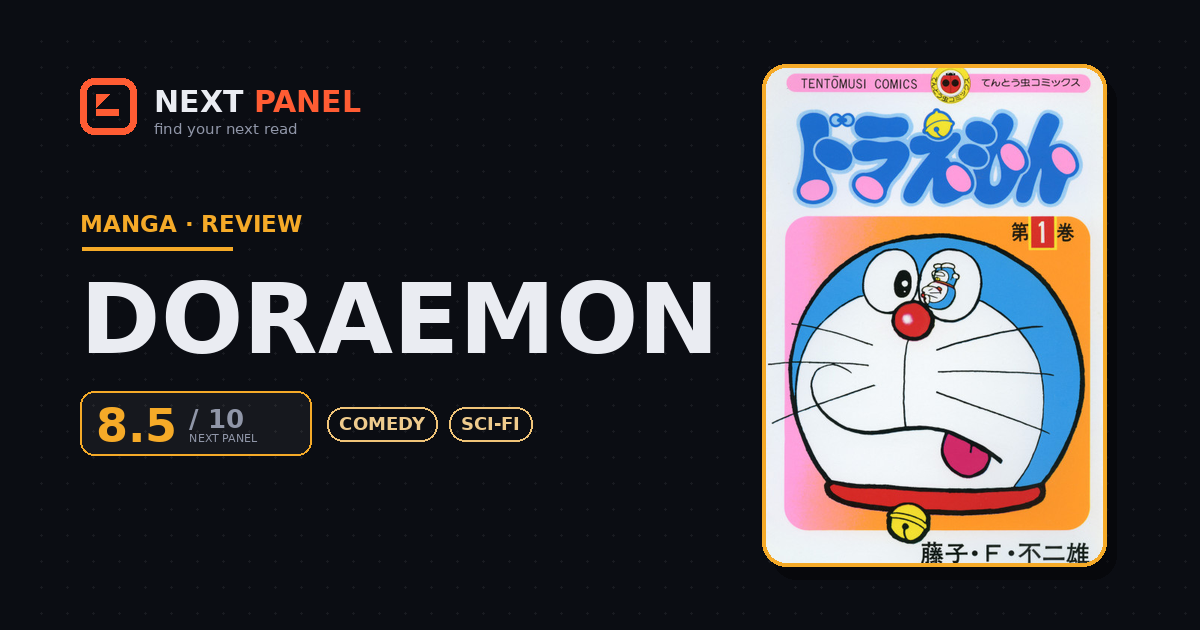
Is Doraemon Worth Reading? Review & Where to Read
Quick Answer
For short, inventive comedy with real heart, yes. It's not a story you binge for plot — it's a formula so good it basically invented its own subgenre, and it still works.
Quick Verdict
“Almost nothing happens across any single chapter, and somehow that's exactly why it's been running for over fifty years.”
Best for: Readers who want short, self-contained, gadget-driven comedy they can pick up in any order.
Not for: Readers who want serialized plot, escalating stakes, or a story that builds toward something.
- Type
- Manga
- Genres
- Sci-Fi, Comedy
- Status
- Completed
- This review
- Minor Spoilers
- Author
- Fujiko F. Fujio
- Publisher
- Shogakukan
- Platform
- Amazon Kindle (Shogakukan) / Shogakukan Asia
| Quick facts | |
|---|---|
| Format | Manga, 821 chapters, 45 volumes |
| Run | 1969–1996 · completed |
| Community score | AniList 8.0 · MangaUpdates 8.7 |
| Where to read | Amazon Kindle (Shogakukan) / Shogakukan Asia — official |
Overview
Doraemon needs almost no introduction in Japan, where it's less a manga than a cultural fixture: a robotic cat sent back from the 22nd century to help Nobita Nobi, an underachieving, easily bullied kid, survive childhood using gadgets pulled from his bottomless 4D pocket. Created by Fujiko F. Fujio and running from 1969 until his death in 1996, it's one of the most influential comedy manga ever made, and reading it today as an adult is a genuinely different experience than reading it as a kid — which is part of what makes it worth revisiting.
What it does well
The format is deceptively simple and endlessly flexible: Nobita gets into trouble, Doraemon pulls out a gadget to fix it, the gadget causes new problems, and the chapter resolves with a small lesson that never feels like it's lecturing you. Across dozens of volumes, Fujiko F. Fujio rarely repeats himself, and the sheer inventiveness of the gadgets — time-travel doors, size-changing sprays, memory bread — is a big part of why so much modern sci-fi comedy still borrows from this well.
What keeps it from feeling like a random gag machine is Nobita himself. He's lazy, bad at tests, and gets pushed around constantly, but he's specific and human enough that his failures land as funny rather than mean, and his occasional moments of real courage mean something because you've watched him fail so often. Doraemon isn't just a gadget dispenser either — the friendship between the two of them, prickly and affectionate in equal measure, is the actual emotional core holding together thousands of otherwise disconnected chapters.
Where it falls short
The biggest adjustment for adult readers is the format itself. There's essentially no ongoing plot; you can read chapters in almost any order and lose nothing, which also means there's no larger story to get invested in beyond the day-to-day. Read in a long sitting, the structure starts to show its seams and can feel repetitive. Some of the older material also carries attitudes about gender roles and discipline that were unremarkable in the 1970s and read as noticeably dated now. None of this makes individual chapters worse, but it does mean Doraemon rewards dipping in over binge-reading.
Verdict
Doraemon isn't trying to be a serialized epic, and judged as what it actually is — a gag-a-day comfort read with real warmth underneath — it's about as good as that format gets. Fifty-plus years of imitators haven't managed to replace it.
Strengths & Weaknesses
Strengths
- The gadget-of-the-week structure keeps generating fresh premises across dozens of volumes without ever feeling like it's repeating itself.
- Nobita's specific, believable flaws — lazy, bad at tests, easily bullied — give every episode's little moral something to land on without turning preachy.
- The gadgets themselves are inventive enough that the series basically created an entire subgenre of sci-fi wish-fulfillment other creators still borrow from.
- Doraemon and Nobita's friendship gives even the silliest one-off chapters a real emotional anchor.
Weaknesses
- The episodic format means there's almost no serialized plot, so reading long stretches back to back gets repetitive by design.
- Some of the older chapters carry dated gender and social attitudes that read as pretty old-fashioned now.
- The simplicity that makes it work for its intended young readers means adult readers hoping for more complex plotting won't find much here.
Similar Titles
Another foundational, kid-friendly sci-fi classic built around a lovable non-human hero.
Doctor Slump
Same gag-driven, inventive comedy energy from a legendary creator working in a similar register.
Shares the gentle, low-stakes, feel-good comedy pitched at any age.
Where to Read Officially
| Platform | Format | Pricing | Region notes | Link |
|---|---|---|---|---|
| Amazon Kindle (Shogakukan) / Shogakukan Asia | Digital volumes (Kindle) | Print volumes | Paid | Region availability varies | Open |
Frequently Asked Questions
Is Doraemon finished?
Yes, the core manga is complete — Fujiko F. Fujio wrote it until his death in 1996, and the main series stands at 45 collected volumes.
Do I need to read Doraemon in order?
No. Most chapters are self-contained gadget-of-the-week stories, so you can jump in almost anywhere — the longer 'Doraemon's Long Tales' are the exception.
Where can I read Doraemon officially in English?
The Amazon Kindle Store carries the official English digital edition from Shogakukan, and Shogakukan Asia has released English print volumes.