Is Dragon Quest: The Adventure of Dai Worth Reading? Review & Where to Read
Quick Answer
Yes, and it's aged remarkably well. What starts as a straightforward Dragon Quest tie-in turns into one of the most creative power-scaling shōnen fantasies of its era, with a supporting cast — Popp especially — that earns every bit of its reputation.
Quick Verdict
“Popp's arc alone justifies the read; the rest of the cast and the spell-based power system just make the case stronger.”
Best for: Readers who want a classic shōnen fantasy with a clever, spell-based power system and a supporting cast that gets real arcs.
Not for: Readers who want a short story and a hero who carries every major moment himself.
- Type
- Manga
- Genres
- Fantasy, Action
- Status
- Completed
- This review
- Minor Spoilers
- Author
- Riku Sanjo
- Artist
- Koji Inada
- Publisher
- Shueisha (Weekly Shōnen Jump)
- Platform
- Viz Media / Shonen Jump
| Quick facts | |
|---|---|
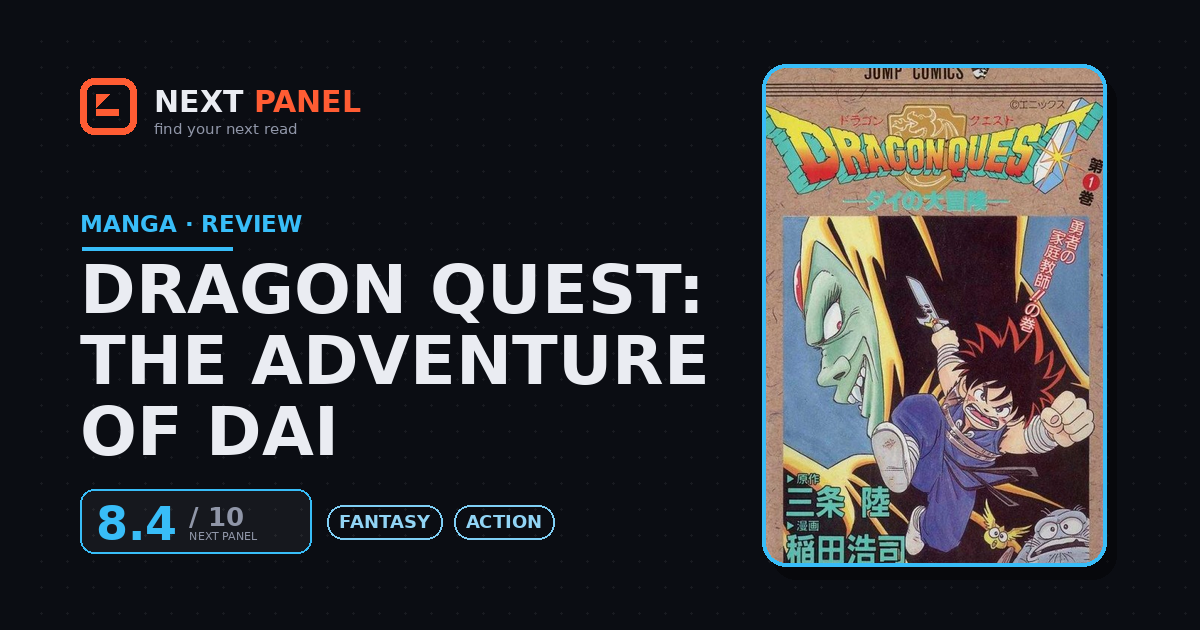
| Format | Manga (shōnen), 349 chapters, 37 volumes |
| Run | 1989–1996 · completed |
| Community score | AniList 7.6 |
| Content | Fantasy violence |
| Where to read | Viz Media / Shonen Jump — official |
Overview
Dragon Quest: The Adventure of Dai starts as exactly what it sounds like — a tie-in manga built around Square Enix's flagship RPG, with slimes, familiar monster designs, and a plucky kid named Dai who dreams of becoming a hero. It doesn't stay that simple for long. Riku Sanjo and Koji Inada use the Dragon Quest license as scaffolding for a genuinely inventive shōnen fantasy about inherited power, found family, and a demon king who isn't what he first appears to be.
What it does well
The manga's spell-tier system is its best idea: every character's magic is ranked, so when someone masters a higher-tier spell, you understand exactly what that means for the fight ahead. It turns power growth into something you can track and get excited about, rather than a vague sense that a character got "stronger." That structure pays off best with Popp, introduced as a cowardly, self-serving comic-relief mage who spends dozens of chapters earning real competence and courage — it's one of the most satisfying supporting-character arcs in classic shōnen, and it's not close.
Dai himself works because the manga doesn't let his optimism come cheap. He loses fights, loses people, and has to actually grow into the hero he wants to be rather than simply willing it into existence. The villains help too: Hadlar and Vearn get enough backstory and internal logic that their fights feel like ideological clashes as much as power battles.
Where it falls short
Thirty-seven volumes is a long haul, and the manga's midsection stretches some tournament-style arcs past the point where the stakes still justify their length. Dai, for all his charm, is also a fairly conventional never-give-up shōnen lead — he's the engine of the plot, but he's rarely the most interesting person on the page next to Popp, Maam, or Hyunckel. And because the setting leans so hard on Dragon Quest's world, some stretches feel more like a tour through familiar game monsters than a fully independent fantasy universe.
Verdict
Dragon Quest: The Adventure of Dai earns its reputation as a genre classic, mostly on the strength of its power system and its supporting cast. Popp's arc alone is worth the read; everything else here just builds a stronger case.
Strengths & Weaknesses
Strengths
- The spell-tier power system gives every fight clear rules and real tension instead of vague power-ups.
- Popp's transformation from cowardly comic relief into one of the cast's most competent fighters is genuinely one of the better character arcs in classic shōnen.
- Dai's optimism reads as earned rather than naive, because the manga keeps giving him real losses to push through.
- Villains like Hadlar and Vearn get enough motivation and menace that fights feel like more than obstacles to clear.
Weaknesses
- At 37 volumes, the pacing stretches in the middle stretch, with some tournament-style fights running longer than the stakes justify.
- Dai himself is a fairly standard never-give-up shōnen protagonist, and he's less interesting on his own than the cast built around him.
- The video-game-inspired setting occasionally feels like a checklist of Dragon Quest references rather than a fully original world.
Similar Titles
Beet the Vandel Buster
Same writer-artist team, same inherited-power shōnen fantasy DNA.
Similar found-family fantasy adventure with a large, distinct cast of specialists.
Another spell-based power-fantasy built around escalating tiers and a scrappy underdog cast.
Where to Read Officially
| Platform | Format | Pricing | Region notes | Link |
|---|---|---|---|---|
| Viz Media / Shonen Jump | Digital chapters | Print & digital volumes | Free + Paid | Region availability varies | Open |
Frequently Asked Questions
Do I need to have played the Dragon Quest games to enjoy this?
No. The manga uses Dragon Quest's world and monster designs as a backdrop, but it tells its own self-contained story that doesn't require any game knowledge.
Is Dragon Quest: The Adventure of Dai finished?
Yes — it originally ran from 1989 to 1996 and is a complete story across 37 volumes.
Where can I read it in English?
Viz Media officially licensed the series, based on the 2020 full-color edition, with digital chapters and print volumes available through Viz and the Shonen Jump platform.