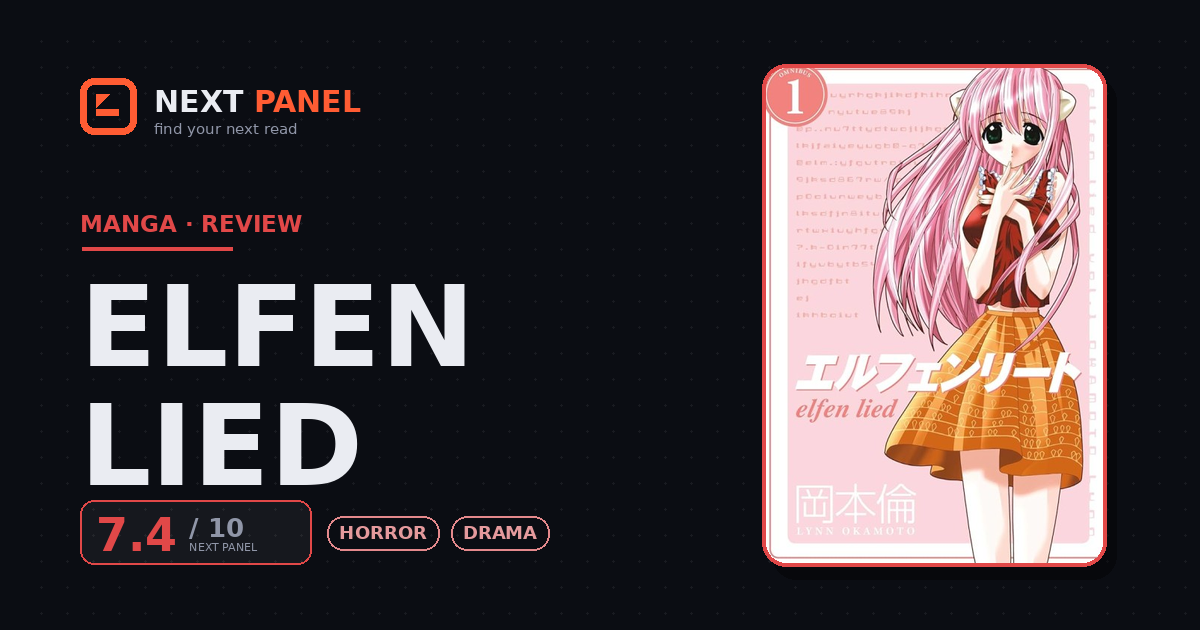
Is Elfen Lied Worth Reading? Review & Where to Read
Quick Answer
Worth reading if you can handle extreme, frequent gore — the violence is the most notorious part of Elfen Lied, but it's in service of a genuinely affecting story about cruelty and belonging, not gore for its own sake.
Quick Verdict
“Take away the bloodshed and you're left with a sincere, sometimes clumsy story about outcasts trying to be loved — the manga just makes you wade through a horror show to get there.”
Best for: Readers who want extreme horror-violence paired with real emotional stakes and don't mind a story that earns its darkness through tragedy rather than shock alone.
Not for: Readers who want their horror without explicit gore, or who are sensitive to abuse and self-harm content.
- Type
- Manga
- Genres
- Drama, Horror
- Status
- Completed
- This review
- Minor Spoilers
- Author
- Lynn Okamoto
- Publisher
- Dark Horse Comics
- Platform
- Dark Horse Digital
| Quick facts | |
|---|---|
| Format | Manga, 113 chapters, 12 volumes |
| Run | 2002–2005 · completed |
| Community score | AniList 7.0 · MangaUpdates 7.9 |
| Where to read | Dark Horse Digital — official |
Overview
Elfen Lied opens with Lucy, a Diclonius — a mutant with horn-like nubs and invisible telekinetic arms capable of tearing a person apart — escaping a research facility in a bloodbath. She's shot in the head during the escape, washes up on a beach with amnesia, and is taken in by two ordinary people who have no idea what she is. In this state she goes by Nyu, a gentle, childlike personality with none of Lucy's memories or violence. The manga alternates between this fragile domestic setup and flashbacks revealing exactly how much horror Lucy is capable of, and why the world fears her.
Written and drawn by Lynn Okamoto, the manga is best known for its extreme, explicit violence, but that reputation undersells what the story is actually doing underneath it.
What it does well
The violence in Elfen Lied isn't random shock — it's consistently tied to the manga's real subject, which is how cruelty and rejection turn people into monsters, and how rare and fragile real kindness is once that's happened. Lucy/Nyu's split identity is the clearest expression of this: an innocent, affectionate personality sharing a body with a traumatized killer who was made that way by years of institutional abuse. The manga keeps returning to that tension in ways that actually complicate how you feel about her rather than just using it as a twist.
The supporting cast around the house reinforces the theme. Nearly everyone gathered there has been discarded or hurt by the people who should have protected them, and their backstories, while grim, tie directly back into what the story is trying to say about who gets treated as human and who doesn't. It's a manga willing to commit fully to a dark, uncomfortable tone once it decides to go there, and that commitment is part of what makes the quieter, gentler chapters land as hard as they do by contrast.
Where it falls short
The violence is genuinely extreme and frequent — limbs and heads come off in detail, repeatedly, and no amount of thematic justification changes that this will be an immediate dealbreaker for a lot of readers. Some of the trauma backstories also pile on more tragedy than the point strictly requires, to the point where it can start to feel like misery for its own sake rather than in service of the theme. The tonal balance between the horror and the more sitcom-ish domestic comedy chapters is also uneven — the shifts between the two registers aren't always handled smoothly.
Verdict
Elfen Lied earns its reputation as one of the more brutal manga out there, but it's not empty shock value — there's a real, sad story about cruelty and belonging underneath the gore. If you can handle the violence, it delivers a genuinely affecting horror-drama; if extreme gore is a hard limit for you, this isn't the exception worth pushing through.
Strengths & Weaknesses
Strengths
- The horror is used to make an actual point about cruelty and dehumanization instead of existing purely for shock — the violence and the tragedy are directly linked.
- Lucy/Nyu's split identity, an amnesiac innocent sharing a body with a traumatized killer, gives the manga a genuinely compelling central hook that the story keeps circling back to with real consequences.
- The side cast of outcasts gathered around the main house each get a real backstory that ties back into the manga's core theme of people being discarded or abused for being different.
- It commits fully to its tone — this isn't a manga that pulls punches once it decides to go dark.
Weaknesses
- The violence is extreme and frequent enough that it will be a hard stop for a lot of readers regardless of how it's justified narratively.
- Some of the trauma and abuse backstories lean on shock value more than the story strictly needs, piling tragedy on top of tragedy in a way that can feel excessive.
- The romance and comedy beats in the quieter chapters sit awkwardly next to the horror, and the tonal shifts aren't always smooth.
Similar Titles
Where to Read Officially
| Platform | Format | Pricing | Region notes | Link |
|---|---|---|---|---|
| Dark Horse Digital | Digital & print omnibus volumes | Paid | Region availability varies | Open |
Frequently Asked Questions
Is Elfen Lied more violent than the anime?
The manga covers the same story as the anime plus additional material, and is generally considered at least as graphic, if not more so in places.
Is the manga complete?
Yes, it ran for 12 volumes in Japan and is fully translated into English by Dark Horse.
Is this appropriate for teen readers?
No — it's intended for mature adult readers due to graphic violence, sexual content, and depictions of abuse.