Is Existence Worth Reading? Review & Where to Read
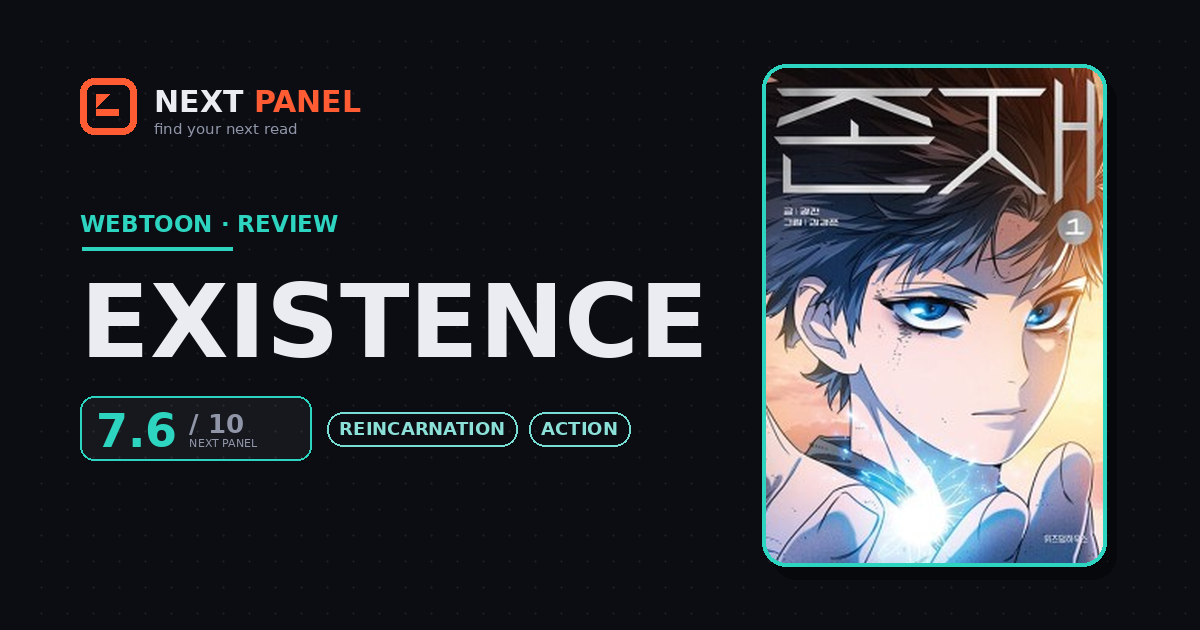
Quick Answer
Yes, if a premise this big appeals to you. Existence takes a genuinely massive hook — a being who's lived as thousands of species over billions of years — and grounds it in a smaller, more personal question about whether any one person deserves to be judged for their whole species. It occasionally overreaches, but the ambition mostly pays off.
Quick Verdict
“Big, strange premise; surprisingly intimate execution — a story more interested in whether Jain can still change than in how strong he is.”
Best for: Readers who want a power-fantasy premise used in service of a real moral question, with a lead whose growth is emotional as much as physical.
Not for: Readers who want a straightforward action series without philosophical baggage, or who find revenge-premise leads with a soft heart underneath too familiar a shape.
- Type
- Webtoon
- Genres
- Reincarnation, Action
- Status
- Completed
- This review
- Minor Spoilers
- Author
- Kwang Jin
- Artist
- Kim Kyungjun
- Publisher
- Kakao Webtoon Studio / Supercomix Studio
- Platform
- Tapas
| Quick facts | |
|---|---|
| Format | Webtoon, 73 chapters, 4 volumes |
| Run | 2022–2023 · completed |
| Community score | AniList 7.3 |
| Where to read | Tapas — official |
Overview
Jain has been alive, in one form or another, for 3.5 billion years. He's been born and died as countless species — animals, plants, whatever came next — and in his final life, he's reborn as the species he hates most: human. He's inherited abilities from every past life, and he's arrived with a mission: wipe out humanity for what it's done to the planet and every other living thing on it. Then a car accident wipes his memory, and the story turns from a clean revenge plot into something messier — Jain keeps meeting people who complicate the simple verdict he arrived with, and the question of whether he'll go through with his original plan stays genuinely open.
What it does well
The scale of the premise is the immediate hook, and Existence earns it by using Jain's accumulated lifetimes as more than a power-up list. His instincts, his grudges, and his alien read on human behavior all come from somewhere specific, and the story leans into that instead of treating billions of years of memory as a shortcut to raw strength. It makes Jain feel genuinely non-human in his reactions, even while he's stuck living among people.
The emotional core works because Kwang Jin — also the writer of Itaewon Class — keeps finding small, specific relationships to ground the enormous premise in. Jain's slow, reluctant reconsideration of his mission doesn't happen because the plot needs it to; it happens because individual people keep giving him reasons to doubt his own certainty, and the story lets that doubt sit rather than resolving it too quickly.
The action holds up its end too. Because Jain's abilities come from specific animal lives, fights have a distinct physical logic instead of feeling like generic power exchanges, and the art gives those sequences real clarity and impact.
Where it falls short
A premise this philosophical occasionally tips into telling instead of showing — Jain's internal debate about humanity's worth gets stated outright often enough that it can feel like the story doesn't trust its own scenes to make the point. The memory-loss subplot, while it adds a mystery layer, also means his motivations get re-explained more than once, which costs the story some momentum in the middle stretch.
The sheer size of the setup — billions of years, thousands of lives — also creates expectations the story doesn't always have room to satisfy before it moves on to the next arc. Some threads that seem set up to matter get less follow-through than their introduction promises.
Verdict
Existence takes a premise big enough to collapse under its own weight and mostly keeps it under control by staying focused on Jain as a specific, conflicted character rather than a walking thesis statement. It stumbles when it over-explains its own themes, but the central question — whether one person can be judged for an entire species, and whether Jain himself deserves the same mercy he's questioning — stays compelling all the way through.
Strengths & Weaknesses
Strengths
- The premise commits fully to its scale — Jain isn't just powerful, he's carrying the accumulated instincts and grudges of thousands of prior lives, and the story uses that history instead of treating it as a gimmick.
- Jain's arc from wanting to erase humanity to questioning that goal is handled with real ambivalence rather than a quick, easy change of heart.
- Kwang Jin, who also wrote Itaewon Class, brings the same instinct for grounding a big premise in specific, human-scale relationships, which keeps the story from floating away into abstraction.
- The action sequences make good use of Jain's animal-derived abilities, giving fights a distinct physicality instead of generic power-versus-power exchanges.
Weaknesses
- The central question — is humanity worth saving — gets stated fairly directly at times, and the story occasionally tells you what to feel about it rather than trusting the scenes to carry the weight themselves.
- Jain's memory-loss subplot, while it adds mystery, also means some of his motivations reset or get re-explained partway through, which can slow the momentum.
- A premise this large sets up expectations of scope that the story doesn't always spend enough time paying off before moving to the next beat.
Similar Titles
Different tone entirely, but shares an interest in animal instinct colliding with something more human.
Itaewon Class
Kwang Jin's other major work — worth reading to see the same knack for grounding a big premise in specific, personal stakes.
Similar interest in whether a being built for destruction can choose otherwise, told with the same mix of action and philosophical weight.
Where to Read Officially
| Platform | Format | Pricing | Region notes | Link |
|---|---|---|---|---|
| Tapas | Digital chapters | Free + Paid | Region availability varies | Open |
Frequently Asked Questions
Do I need to know Itaewon Class to read this?
No. Existence is a completely separate story from Kwang Jin's other major work — the connection is just the writer, not the setting or characters.
Is Existence finished?
Yes. It's a completed series, 73 episodes, officially available in English on Tapas.
Is this more of an action series or a drama?
Both, roughly evenly split — the animal-power action sequences are frequent, but the story spends just as much time on Jain's internal conflict about humanity and his fading memories.