Is Beast Complex Worth Reading? Review & Where to Read
Quick Answer
Yes, especially if you already like Beastars and want more of its world without committing to another long-form story. Each chapter stands alone and hits fast.
Quick Verdict
“Short stories don't usually get to be this sharp — Itagaki uses the format to land ideas Beastars didn't have room for.”
Best for: Beastars fans who want more of that world in bite-sized form, and readers who like allegory-driven short fiction.
Not for: Readers who want a single continuous plot or haven't read Beastars and want deep emotional investment in returning characters.
- Type
- Manga
- Genres
- Drama, Slice of Life
- Status
- Completed
- This review
- Minor Spoilers
- Author
- Paru Itagaki
- Publisher
- Akita Shoten
- Platform
- VIZ Media
| Quick facts | |
|---|---|
| Format | Manga (seinen), 4 volumes |
| Run | 2016–present · completed |
| Community score | AniList 7.4 · MangaUpdates 7.2 |
| Where to read | VIZ Media — official |
Overview
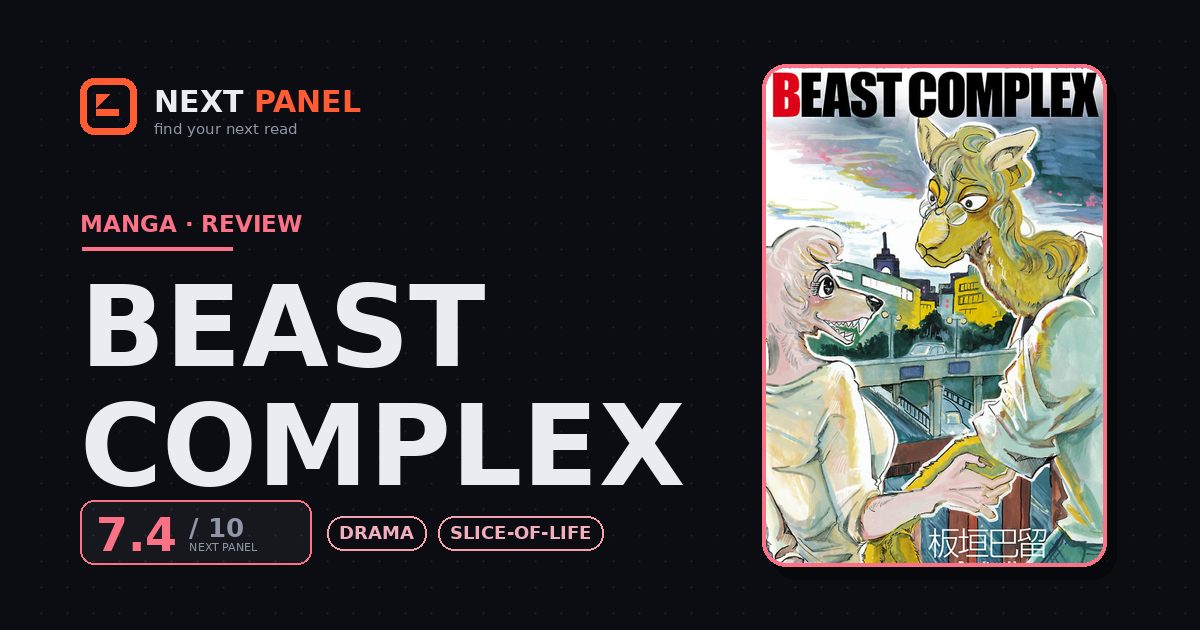
Beast Complex is Paru Itagaki's short story collection set in the same predator-prey society as Beastars, but built entirely out of standalone chapters instead of one continuous plot. Each story picks a different pair or small group of characters, an original friendship that defies peer pressure, a workplace, a chance encounter, and uses them to explore some specific facet of what it actually means to live in a world where carnivores and herbivores coexist under constant, low-grade tension.
The anthology format is the whole point. Rather than building toward a single resolution the way Beastars does, Beast Complex treats its predator-prey premise like a toolkit, applying it to a new situation every few chapters and seeing what falls out.
What it does well
The biggest strength here is how well the short-story structure suits Itagaki's central idea. Beastars is, at its core, a story about the gap between instinct and social norms, but a single long narrative can only explore that idea through its specific cast. Beast Complex gets to reset that experiment over and over: a carnivore and herbivore forced into an uneasy alliance, a predator trying to pass as harmless, a herbivore who's built an entire identity around performing fearlessness. Some of these ideas are things Beastars only had room to gesture at; here they get a full story of their own.
Because each arc is short, the collection moves fast and rarely overstays its welcome. A story makes its point, lands an emotional or thematic gut-punch, and moves on to the next premise. That density means the collection's hit rate matters more than usual, and Beast Complex clears that bar more often than not, particularly in its stronger back-half stories.
Visually, it's unmistakably Itagaki's world. The character designs carry the same slightly off, expressive quality that made Beastars distinctive, and the art handles both the mundane social interactions and the occasional violent flashpoint with the same steady hand.
Where it falls short
The anthology structure is a trade-off, not a pure upgrade. You don't get the slow-building investment in a specific cast that a longer story provides, and nothing here approaches the emotional weight of Beastars' central relationships because there simply isn't time to build it.
Not every story is equally sharp. A handful feel like rougher ideas that didn't get the same polish as the collection's best entries, which is a fairly normal anthology problem but noticeable here given how strong the high points are.
Readers coming in cold, without Beastars context, will follow the stories fine but will miss some of the shorthand around how this particular predator-prey society actually functions day to day.
Verdict
Beast Complex isn't trying to be Beastars in miniature, it's using the same world to ask different, smaller questions, and mostly succeeding. If you've read Beastars and want more of that world without another long commitment, or you just like sharp, allegory-driven short fiction, this is a quick, worthwhile read.
Strengths & Weaknesses
Strengths
- The short-story format lets Itagaki explore predator-prey social dynamics from angles Beastars never had time for.
- Each story is self-contained and lands its point within a handful of chapters, making the whole collection easy to dip into.
- The animal-society allegory stays sharp rather than repetitive, finding a new emotional angle almost every arc.
- Itagaki's linework and character design carry the same distinct, slightly unsettling texture that made Beastars visually memorable.
Weaknesses
- Because it's anthology-structured, there's no throughline or cumulative character investment the way a longer story builds.
- Some stories land harder than others — a few entries feel like rougher sketches next to the collection's best chapters.
- Readers who haven't read Beastars will miss some of the shorthand around how this world's predator-prey society actually works.
Similar Titles
Where to Read Officially
| Platform | Format | Pricing | Region notes | Link |
|---|---|---|---|---|
| VIZ Media | Print & digital volumes | Paid | Region availability varies | Open |
Frequently Asked Questions
Do I need to read Beastars first?
It helps but isn't required — most stories explain enough of the predator-prey premise to stand alone.
Is this connected to the Beastars anime?
It's set in the same world but isn't adapted into the Beastars anime; it's a separate manga collection.
How many volumes are there?
Four volumes, all released in English by VIZ Media.