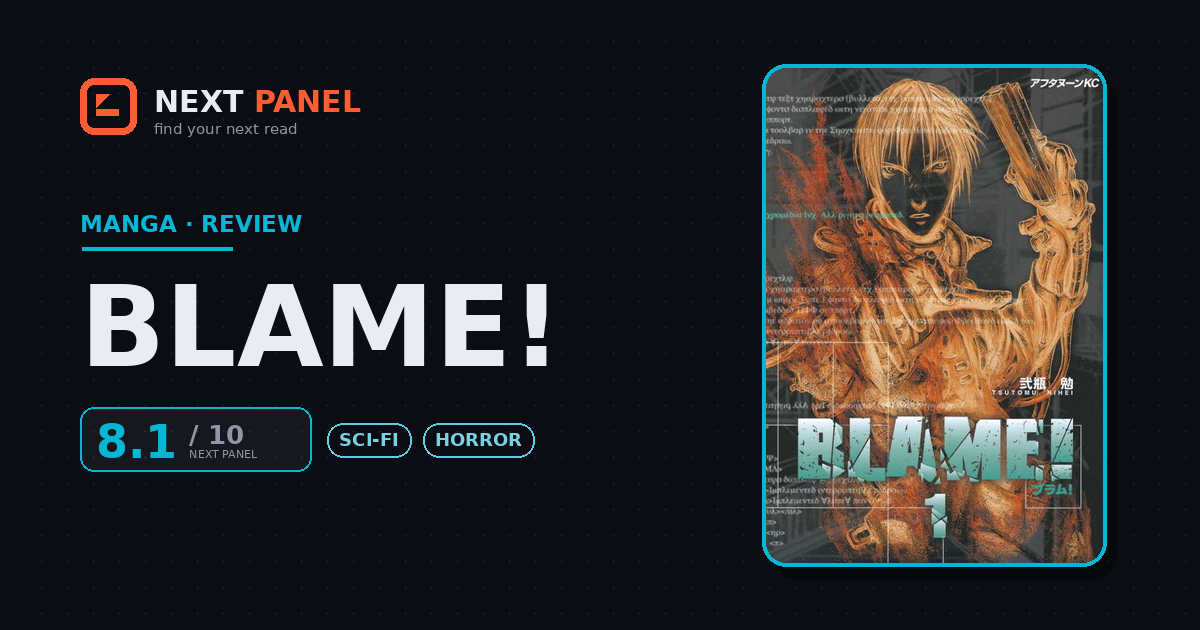
Is BLAME! Worth Reading? Review & Where to Read
Quick Answer
Yes, if you want atmosphere and scale over plot clarity. BLAME! barely explains itself, but the sheer scope of Tsutomu Nihei's linework makes the confusion feel like part of the experience rather than a flaw.
Quick Verdict
“You will not understand what's happening for long stretches, and that's the point — few manga make an endless, hostile structure feel this genuinely vast.”
Best for: Readers who want dense, atmospheric sci-fi horror art carrying the story, with minimal dialogue and a lot left to interpretation.
Not for: Readers who want clear plot explanations and character motivations spelled out as the story goes.
- Type
- Manga
- Genres
- Horror, Sci-Fi
- Status
- Completed
- This review
- Minor Spoilers
- Author
- Tsutomu Nihei
- Publisher
- Kodansha
- Platform
- Vertical Comics
| Quick facts | |
|---|---|
| Format | Manga (seinen), 66 chapters, 10 volumes |
| Run | 1997–2003 · completed |
| Community score | AniList 8.1 · MangaUpdates 8.2 |
| Content | Violence, body horror, disturbing imagery |
| Where to read | Vertical Comics — official |
Overview
BLAME! drops you into a City that has been expanding on its own, without human oversight, for so long that its scale is effectively incomprehensible — a megastructure of endless levels, brutalist architecture, and hostile automated defenses. Killy, a near-silent wanderer armed with a weapon capable of leveling city blocks, searches this structure for someone carrying the Net Terminal Gene, the only thing that can restore humanity's lost connection to the system controlling it all. Tsutomu Nihei wrote and drew BLAME! for Kodansha's Monthly Afternoon from 1997 to 2003; it's complete, and Vertical Comics collects the full run in English across six Master Edition volumes.
What it does well
The art is the story here, and it's worth the reputation. Nihei draws the City as a genuinely vast, alien space — corridors and structures that dwarf every character, rendered with an architectural precision that makes the setting feel like it actually could keep building itself forever. Because dialogue is so sparse, you're left to piece together what's happening from what you see rather than what anyone explains, and that approach turns exploration into something closer to dread than curiosity. It's a rare case where withholding information is the technique, not a shortcoming.
Killy himself barely speaks, and the series is better for it — his blankness makes him a lens for the environment rather than a personality competing with it. The Safeguard units and the biomechanical horrors populating the City are inventive in a way that still reads as fresh decades later; you can trace their influence across a lot of sci-fi manga and games that came after. The whole thing has a meditative, dread-soaked mood that very few action manga even attempt, let alone sustain across a full series.
Where it falls short
The same qualities that make BLAME! distinctive will lose some readers. Plot and character motivation are often genuinely unclear as you're reading — not vague in a stylish way, but actually hard to parse without outside context or a second read. If you need to understand what's happening scene to scene, this is going to be a rough ride.
The pacing has real dead spots too. Long stretches of Killy walking through similar-looking corridors, or fighting similar-looking enemies, pass before the story offers a new piece of the puzzle, and the repetition can wear on you well before the ending pulls things together. And because the whole approach prioritizes atmosphere over character, there's not much emotional throughline to hold onto between the bigger set pieces.
Verdict
BLAME! isn't interested in being easy, and that's exactly why it's held onto a cult following for over two decades. If you want a manga that makes scale and silence do the heavy lifting, and you're willing to stay a little lost, this is one of the most singular sci-fi horror comics out there.
Strengths & Weaknesses
Strengths
- Tsutomu Nihei's linework renders a megastructure of genuinely incomprehensible scale — the environments do as much storytelling as any character, and nothing else in manga looks quite like it.
- The minimal dialogue forces you to piece the world together from implication and imagery, which makes exploring it feel disorienting and awe-inspiring instead of like a lecture.
- Killy's near-silent, unstoppable design and the slow drip of stakes give the whole series an eerie, meditative sci-fi horror mood that's rare in action manga.
- The Safeguard units and biomechanical horror designs are genuinely inventive and still visibly influential on sci-fi manga and games made after it.
Weaknesses
- The sparse storytelling means plot and character motivation are often unclear in the moment — that's by design, but it will frustrate readers who want a legible plot as they go.
- Pacing can feel repetitive, with long stretches of Killy moving through similar-looking corridors and fights before the next real story beat lands.
- Emotional throughlines are thin by design; this is a series about scale and atmosphere, not character drama.
Similar Titles
Knights of Sidonia
Nihei's later series, same bleak sci-fi scale with a slightly more conventional narrative
shares a bleak, body-horror-inflected sci-fi violence and a similarly unforgiving tone
similar interest in body horror and characters caught inside a system bigger than they understand
Where to Read Officially
| Platform | Format | Pricing | Region notes | Link |
|---|---|---|---|---|
| Vertical Comics | Print & digital volumes | Paid | Region availability varies | Open |
Frequently Asked Questions
Is BLAME! finished?
Yes. It ran in Monthly Afternoon from 1997 to 2003 and is complete at 67 chapters, collected in English across six Master Edition volumes from Vertical Comics.
Is BLAME! hard to follow?
Yes, intentionally — dialogue is sparse and the plot is told mostly through imagery and implication, so don't expect much hand-holding.
Do I need to read anything else by Tsutomu Nihei first?
No, BLAME! stands alone. It's actually his earliest major work, and later series like Knights of Sidonia are a good next stop if you like his style.