Is Fire Force Worth Reading? Review & Where to Read
Quick Answer
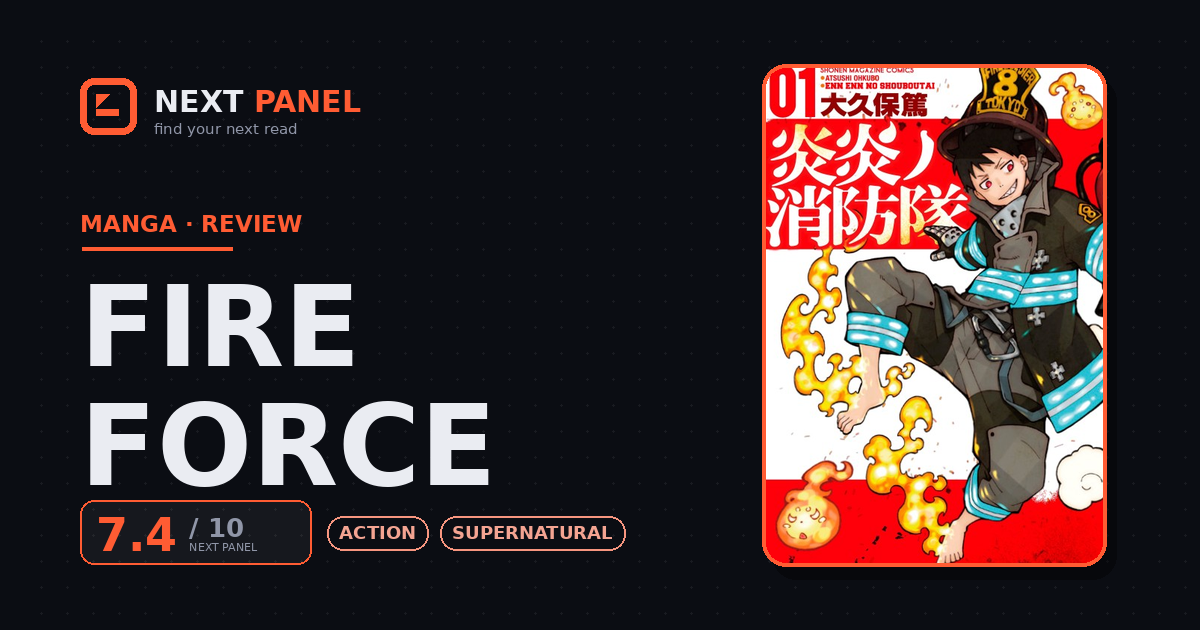
Mostly yes. The first half is a genuinely fun mix of horror-tinged mystery and shonen action with one of the more visually creative power systems in the genre; the back stretch trades some of that tightness for cosmic-scale exposition.
Quick Verdict
“Company 8's pyrokinetic power system is inventive enough to carry you through, even once the plot gets more interested in its own cosmology than its characters.”
Best for: Shonen readers who want a squad-based action series with a genuinely creative power system and an underlying conspiracy to chew on.
Not for: Readers who want a grounded, character-first story without heavy fanservice or increasingly abstract, cosmic-scale plotting.
- Type
- Manga
- Genres
- Action, Supernatural
- Status
- Completed
- This review
- Minor Spoilers
- Author
- Atsushi Ohkubo
- Publisher
- Kodansha
- Platform
- Kodansha USA
| Quick facts | |
|---|---|
| Format | Manga (shōnen), 305 chapters, 34 volumes |
| Run | 2015–2022 · completed |
| Community score | AniList 7.8 · MangaUpdates 7.3 |
| Content | Violence, fan service |
| Where to read | Kodansha USA — official |
Overview
In the world of Fire Force, people occasionally combust without warning and turn into rampaging fire demons called Infernals. The Special Fire Force is the militarized response — brigades of "third generation" pyrokinetics who fight fire with fire, literally. Shinra Kusakabe, a rookie with a habit of grinning under pressure, joins the scrappy Company 8, and what starts as a case-of-the-week setup slowly reveals a much bigger conspiracy about who's actually causing the combustions and why. Atsushi Ohkubo — previously known for Soul Eater — ran Fire Force in Weekly Shōnen Magazine from 2015 to 2022, wrapping at 304 chapters. It's a different cast and world from his earlier work, but it carries over the same interest in squad dynamics and stylized character design.
What it does well
The power system is the strongest hook here. Every major pyrokinetic uses fire differently — jet propulsion, combustion control, ignition through touch, fire that behaves more like a blade than a blast — and Ohkubo draws each ability with enough visual distinction that fights stay readable even when the cast balloons. Company 8 itself is easy to root for: Shinra's forced grin, Arthur's delusional knight routine, Maki and Iris rounding out a squad that actually functions like a team instead of a collection of powers waiting to be deployed.
What keeps the story moving, though, is the mystery underneath the action. Why do people combust? Who's the Evangelist orchestrating things from the shadows? What's actually going on with the White-Clad cult? Fire Force treats these as real, escalating questions rather than background flavor, and that conspiracy plot gives the series a sense of direction a lot of squad-based shonen never bother building. The early volumes in particular strike a nice balance of body-horror unease and shonen spectacle that makes the series feel distinct from its genre neighbors.
Where it falls short
The character designs are a real sticking point for some readers — the female cast in particular is drawn with a level of fan service that can feel at odds with the horror and mystery the story is trying to sell elsewhere. It's a tonal mismatch that shows up constantly and isn't going to work for everyone.
The other issue is scale creep. As the conspiracy plot expands into questions about parallel worlds, the nature of Adolla, and cyclical apocalypses, the story leans more and more on characters explaining the cosmology to each other rather than dramatizing it. Some of the biggest late-series reveals land as exposition rather than earned narrative beats, and a handful of characters introduced in the later volumes don't get room to become more than their role in the plot before the story has to close everything out.
Verdict
Fire Force is at its best when it's a squad of pyrokinetic firefighters investigating a genuinely unsettling mystery, and that stretch — roughly the first half — is worth reading on its own. The final stretch asks you to care more about cosmic mechanics than character moments, and the fan-service-heavy art won't land for every reader, but Company 8 and the power system carry it through to a real conclusion.
Strengths & Weaknesses
Strengths
- The Adolla Burst power system gives nearly every major character a visually distinct, genuinely inventive way to use fire, instead of everyone just throwing bigger fireballs.
- Company 8 works as a found-family unit — Shinra, Arthur, Maki, and the rest each get a clear role and enough page time to feel like a team rather than a lineup.
- The central mystery (what Infernals actually are, who the Evangelist is, why people combust) gives the story real forward pull instead of settling into a monster-of-the-week formula.
- The early arcs blend body-horror dread with shonen spectacle in a way that gives Fire Force its own identity rather than just being 'another squad-based action manga.'
Weaknesses
- Character designs, especially for the female cast, lean hard into fan service in a way that can clash with the horror and mystery the story is otherwise building.
- The back half of the series gets increasingly cosmic and abstract, and some of the biggest reveals land more through exposition dumps than dramatized scenes.
- A few characters introduced in the middle stretch don't get enough development time before the story has to start wrapping everything up.
Similar Titles
similar squad-based shonen structure with a clear organizational hierarchy
shares the body-horror-meets-shonen-spectacle tone, if darker and more irreverent
same Weekly-Shonen-magazine energy — squad dynamics carrying a long-running action plot
Where to Read Officially
| Platform | Format | Pricing | Region notes | Link |
|---|---|---|---|---|
| Kodansha USA | Digital chapters | Print & digital volumes | Paid | Region availability varies | Open |
Frequently Asked Questions
Is Fire Force finished?
Yes. It ran in Weekly Shōnen Magazine from 2015 to 2022, wrapping at 304 chapters across 34 volumes, and the full run is available in English from Kodansha USA.
Is Fire Force by the same creator as Soul Eater?
Yes, Atsushi Ohkubo wrote and drew both, and Fire Force was billed as his next major series after Soul Eater ended — but the two stories, casts, and worlds are unrelated.
Does Fire Force get more serious as it goes?
Yes. It starts as a fairly self-contained mission-of-the-week action series and gradually reveals a much bigger conspiracy plot underneath, with the tone shifting accordingly.