Is Forbidden Scrollery Worth Reading? Review & Where to Read
Quick Answer
Yes, and you don't need to have played a single Touhou game to enjoy it — this stands on its own as a charming, quietly dark fantasy-mystery about the danger of forbidden knowledge.
Quick Verdict
“Complete, well-told, and uses its game-franchise setting as flavor rather than a requirement, and is genuinely stronger for keeping its scope small.”
Best for: Readers who want a self-contained fantasy-mystery about the seductive danger of knowledge, with or without any prior Touhou Project familiarity.
Not for: Readers who want the fast, bullet-hell action energy of the Touhou games rather than a slower, folklore-driven mystery.
- Type
- Manga
- Genres
- Fantasy, Supernatural
- Status
- Completed
- This review
- Minor Spoilers
- Author
- ZUN
- Artist
- Moe Harukawa
- Publisher
- Kadokawa Shoten
- Platform
- Yen Press
| Quick facts | |
|---|---|
| Format | Manga (shounen), 54 chapters, 7 volumes |
| Run | 2012–2017 · completed |
| Community score | AniList 7.9 |
| Content | Mild horror imagery, youkai/demon themes |
| Where to read | Yen Press — official |
Overview
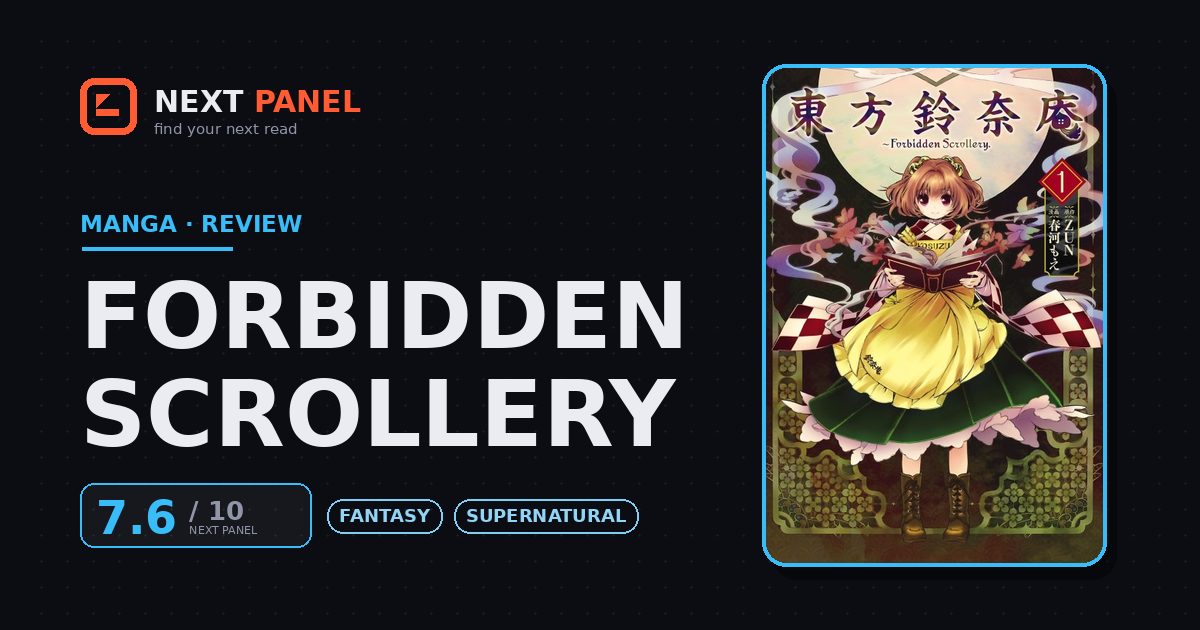
Forbidden Scrollery (Touhou Suzunaan) is a complete seven-volume manga written by ZUN, creator of the Touhou Project game series, with art by Moe Harukawa, officially published in English by Yen Press. Kosuzu Motoori runs a secondhand bookstore in Gensokyo stacked with youma books — texts about demons that are supposedly impossible for ordinary people to read. When Kosuzu suddenly finds she can read them, familiar Touhou faces like the witch Marisa Kirisame and shrine maiden Reimu Hakurei take notice, worried that a text written by demons might do more than just inform the person reading it.
It's a spin-off of a bullet-hell shooting game franchise, but the tone here couldn't be further from that — this is a quiet, folklore-driven mystery about the price of knowing too much.
What it does well
The central premise carries the whole series well. A girl who can suddenly read forbidden texts, each one a potential trap disguised as knowledge, is a strong enough hook that it would work as an original story with the serial numbers filed off — which is exactly why it succeeds as a way into the wider Touhou world for readers who've never touched the games. Kosuzu isn't a blank audience surrogate either; her bookish enthusiasm and reluctance to take the danger as seriously as everyone around her gives the story real character-driven tension.
Moe Harukawa's art deserves real credit for tonal control — Gensokyo's whimsy and the story's creeping horror elements coexist without either one undercutting the other, which is a harder balance than it sounds. And because this is a complete series rather than an ongoing one, the mystery threads set up early actually pay off by the end, something increasingly rare to find in this genre.
Where it falls short
The honest caveat is that familiarity with the wider Touhou cast adds a layer newcomers won't get — Marisa and Reimu's appearances land differently if you already know them from the games, even though the manga never requires that context to follow the plot. The pacing is also deliberately unhurried, built more around folklore-tinged mystery than the fast, bullet-hell energy the source franchise is known for, so readers expecting action-forward content may find the rhythm slower than anticipated. And the early volumes lean on a fairly familiar mystery-of-the-volume structure — a new demon book, a new danger — before the larger plot threads start pulling together in the final volumes.
Verdict
This is a genuinely well-crafted, complete fantasy-mystery that uses its game-franchise pedigree as flavor rather than a barrier to entry. You don't need to know Gensokyo at all to be pulled in by Kosuzu's dangerous new gift, and the fact that the story actually finishes what it starts makes it an easy recommendation for readers looking for something self-contained.
Strengths & Weaknesses
Strengths
- Kosuzu Motoori's power — the sudden, dangerous ability to read any book, including ones that can supposedly transform the reader — gives the series a clean, compelling central hook that would work even without the Touhou Project name attached.
- The series is accessible to complete newcomers to the games; it trades the franchise's bullet-hell chaos for a quieter, folklore-inflected mystery structure that stands entirely on its own.
- Moe Harukawa's art handles the shift between Gensokyo's whimsical fantasy tone and the story's genuinely eerie moments with real control, never undercutting the horror elements with excessive cuteness.
- As a complete seven-volume story, it has a real beginning, middle, and end — a rarity in this space, and a meaningful advantage for readers tired of open-ended, still-running series.
Weaknesses
- Familiar Touhou characters like Marisa Kirisame and Reimu Hakurei appear as guides into the world, and while the story doesn't require prior franchise knowledge, longtime fans will get an extra layer of recognition that newcomers simply won't.
- The pacing favors patient, folklore-driven mystery over action, which may undersell the series to readers expecting something closer to the games' fast, high-energy combat.
- Some of the youkai-of-the-volume plotting follows a fairly familiar mystery-of-the-week rhythm before the back half pulls the individual threads together.
Similar Titles
Where to Read Officially
| Platform | Format | Pricing | Region notes | Link |
|---|---|---|---|---|
| Yen Press | Print and digital volumes (Yen Press) | Paid | Region availability varies | Open |
Frequently Asked Questions
Do I need to have played the Touhou Project games to understand Forbidden Scrollery?
No. The manga is self-contained and accessible to newcomers, though longtime fans of the games will recognize characters like Marisa Kirisame and Reimu Hakurei who appear throughout.
Is Forbidden Scrollery finished?
Yes — it's a complete seven-volume story, fully translated and available in English from Yen Press.
Is this more of a horror manga or a fantasy manga?
It's primarily a fantasy-mystery with real horror undertones — the danger of Kosuzu's book-reading power is treated seriously, but the tone stays closer to eerie folklore than outright horror.