Is Fune wo Amu (The Great Passage) Worth Reading? Review & Where to Read
Quick Answer
If you like slow, character-driven slice-of-life about people who genuinely love their work, yes. It's a short, gentle read that earns its emotional beats without ever raising its voice.
Quick Verdict
“Two volumes about compiling a dictionary have no business being this moving, but here we are.”
Best for: Readers who enjoy quiet, low-stakes workplace stories and don't need action or conflict to stay invested.
Not for: Readers who want fast pacing, romance as a main focus, or a story with real tension driving it forward.
- Type
- Manga
- Genres
- Drama, Slice of Life
- Status
- Completed
- This review
- Minor Spoilers
- Author
- Shion Miura
- Artist
- Haruko Kumota
- Publisher
- Kodansha
| Quick facts | |
|---|---|
| Format | Manga |
| Run | completed |
Overview
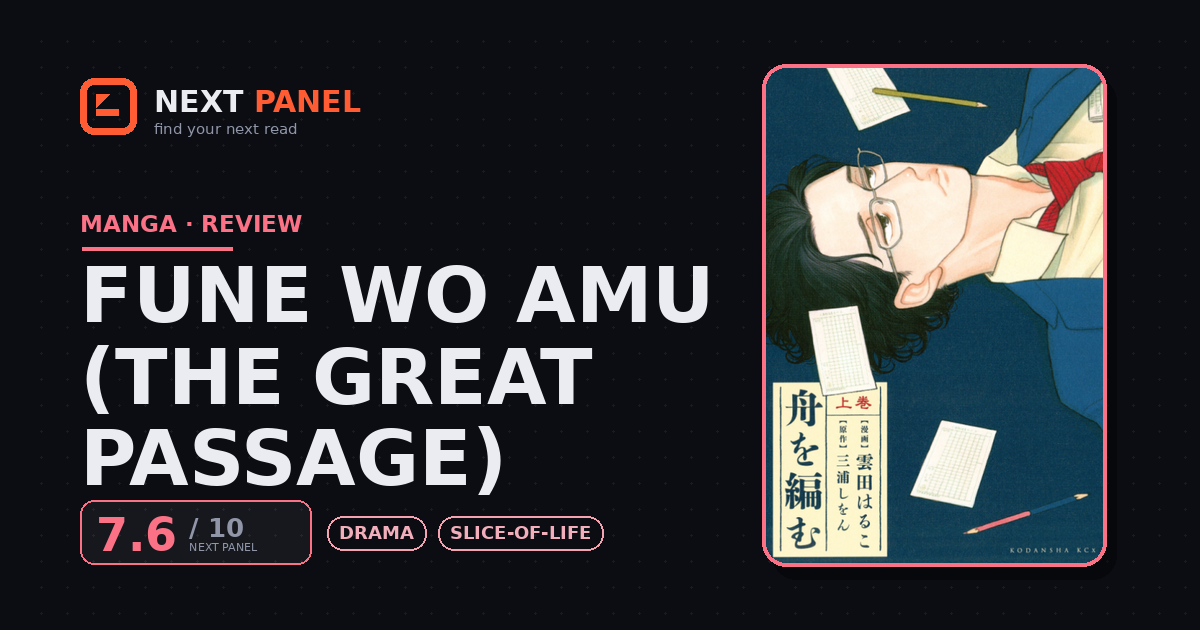
Fune wo Amu translates roughly to "boat that crosses the sea of words," which is a lovely way to describe what this manga is actually about: a small team of dictionary editors spending over a decade putting together a single, comprehensive Japanese dictionary called the Daitokai. Haruko Kumota adapts Shion Miura's novel into two volumes, following Majime, an awkward, introverted editor who turns out to have exactly the obsessive attention to language the job needs. It's a workplace story with almost no external conflict — the drama comes entirely from the work itself, and from watching an unlikely person find the one thing he's built for.
What it does well
The smartest choice this manga makes is treating lexicography as genuinely fascinating rather than a joke setup. You watch editors argue over how to define a word like "right" (as in the direction), track down regional slang nobody's written down before, and agonize over whether a definition is too narrow or too vague. It sounds dry described that way, but Kumota draws the process with real curiosity, and that curiosity is contagious — by the midpoint you're invested in whether they'll hit their deadline the same way you'd care about a sports team making the finals.
Majime himself is the other reason this works. He's socially stiff, bad at reading a room, and hopeless around the woman he's fallen for, but none of that is played for easy mockery — he's simply someone who's finally found a job that rewards the exact way his mind works, and watching him grow more confident without losing what makes him odd is genuinely satisfying. The supporting editors, especially the more senior ones who've spent their whole careers on dictionaries, give the office a real sense of history and stakes that never needed a villain to feel important.
Where it falls short
At two volumes, this is a short read, and it can feel like it's just settling into its groove before it has to wrap up — there's more story here than the page count fully has room for. The light romance between Majime and his eventual love interest gets some sweet moments but never develops much beyond a subplot, so anyone hoping for it to be a bigger focus will be a little let down. And practically speaking, there's no official English release of the manga itself, only the novel — so access is a real hurdle for most readers right now.
Verdict
Fune wo Amu takes the least cinematic job imaginable and turns it into a genuinely warm, absorbing character story. It won't grab you with incident, but if you give it the same patience its characters give their dictionary, it pays that patience back.
Strengths & Weaknesses
Strengths
- It makes the process of building a dictionary from scratch — choosing headwords, writing definitions, tracking down obscure usage — feel as absorbing as any adventure, because the manga trusts that expertise and obsession are interesting on their own.
- Majime, the awkward, socially clumsy lead, grows into his role in small, believable steps instead of one big transformation, which makes the arc land harder by the end.
- Haruko Kumota's art is warm and understated, matching the story's patient pace instead of fighting it with big dramatic paneling.
- The supporting editors each get a distinct voice and function on the team, so the workplace feels lived-in rather than like scenery for the lead.
Weaknesses
- The pace is genuinely slow, and at only two volumes it can feel like it ends just as it's fully found its rhythm.
- The romance subplot is minor and undercooked compared to the workplace material, so don't come in expecting it to be a focus.
- With no official English release, you're reading this in Japanese or waiting for a license — that's a real barrier for a lot of readers.
Similar Titles
Same gentle, character-first pacing, swapping the dictionary office for a small island community.
Another quiet story about someone finding purpose through total devotion to a craft.
Shares the same patient, understated approach to a character slowly opening up over time.
Frequently Asked Questions
Is Fune wo Amu based on a novel?
Yes. Shion Miura wrote the original novel first (published in English as The Great Passage); Haruko Kumota later adapted it into this two-volume manga.
Is there an anime or live-action version?
Yes, both — a 2013 anime film and a 2024 live-action series adapted the same story, though the manga tells it at its own pace with Kumota's art.
Is Fune wo Amu available in English?
Not the manga, as of this review — only the original novel has an official English translation. We'll revisit this if that changes.