Is Gabriel Dropout Worth Reading? Review & Where to Read
Quick Answer
Yes, if you want a low-effort, high-comfort comedy — this is exactly that. It's not ambitious, but the joke of angels and demons failing to live up to their own reputations stays funny for its entire run.
Quick Verdict
“Watching a literal angel skip her heavenly duties to grind a video game shouldn't work as a running joke for over a decade, but Gabriel Dropout somehow makes it hold up.”
Best for: Readers who want an easy, low-stakes comedy with a cast of likable slackers and don't mind a formula that barely changes across the whole run.
Not for: Readers who want character development, an actual plot, or comedy that goes anywhere beyond its central joke.
- Type
- Manga
- Genres
- Slice of Life, Comedy
- Status
- Completed
- This review
- Minor Spoilers
- Author
- Ukami
- Publisher
- Yen Press
- Platform
- Yen Press
| Quick facts | |
|---|---|
| Format | Manga (seinen), 140 chapters, 17 volumes |
| Run | 2013–2026 · completed |
| Community score | AniList 7.6 · MangaUpdates 7.3 |
| Where to read | Yen Press — official |
Overview
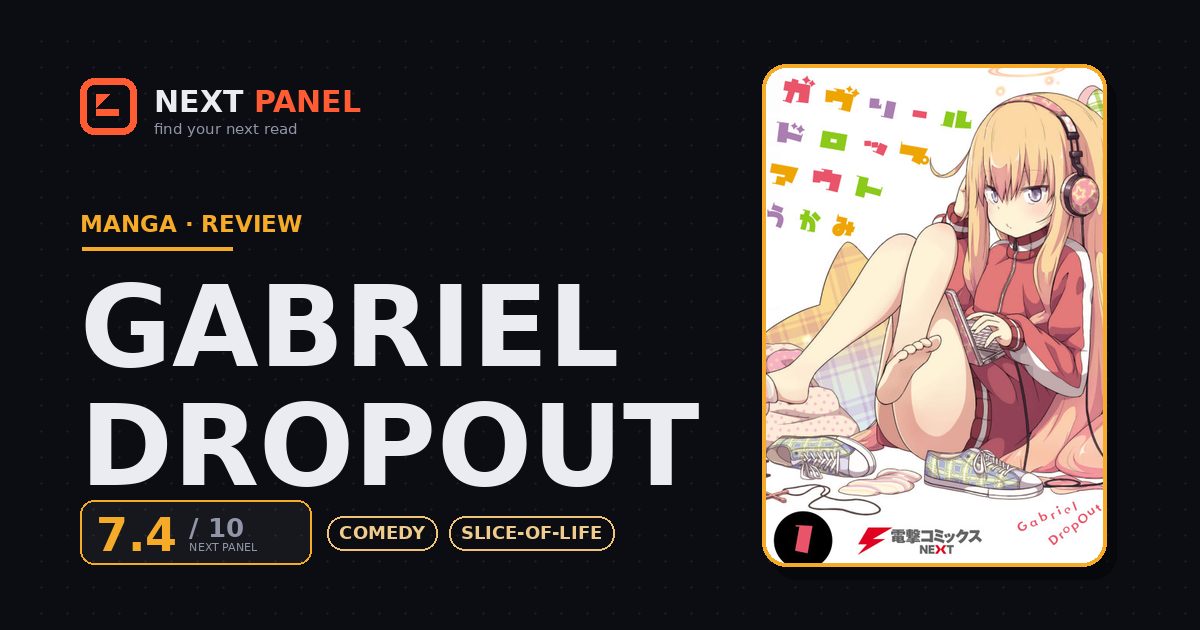
Gabriel White Tenma is an angel sent down from heaven to attend high school and guide humanity toward salvation. Within a few chapters, she's discovered online gaming and stopped bothering with the guiding-humanity part entirely. She's joined by Vignette, a demon who's actually too kind-hearted to cause real trouble, Raphiel, an angel who's secretly a little sadistic, and Satania, a demon whose attempts at evil never land because everyone finds her more pathetic than threatening.
The whole cast is built on the same joke from different angles: nobody is living up to what they're supposed to be. It's a simple premise, but Gabriel Dropout ran with it for over a decade because the writing keeps finding fresh, specific ways to let that irony play out.
What it does well
The central gag is stronger than it has any right to be. An angel who's lazier than the demon around her is funny on paper, but the manga earns repeat laughs by committing to Gabriel's specific brand of laziness — she's not just unmotivated, she's a genuinely dedicated gamer whose priorities have just been completely rearranged. That specificity extends to the rest of the cast too: Vignette's frustration at being too nice to be a proper demon, Raphiel's quiet cruelty hidden behind an angelic reputation, and Satania's constant, doomed attempts to be taken seriously as a villain all read as distinct characters rather than repeats of the same joke.
What keeps the whole thing likable is that none of it comes from a mean place. Even when the characters are needling each other, the manga clearly has affection for all four of them, and that warmth is what makes it comfortable to read in long stretches or in short bursts between other things.
Structurally, it's also just easy to consume. Most chapters are short, mostly self-contained gags, so you can read a handful in one sitting or pick it up occasionally without needing to remember much.
Where it falls short
The format doesn't really change across its run. If the central joke and the cast dynamic don't grab you in the first volume or two, nothing later is going to shift your opinion — this is a series that finds its groove early and stays there for the long haul.
There's also no plot in any meaningful sense, which is fine if you're here for the comedy but a dealbreaker if you want the story to build toward something. And outside the main four, side characters mostly function as setups for the leads' jokes rather than people in their own right.
Verdict
Gabriel Dropout is comfort-food comedy done well — a simple premise, a likable cast, and consistent enough jokes to carry a 13-year run. It's not trying to be more than that, and for what it is, it's an easy, low-effort recommendation.
Strengths & Weaknesses
Strengths
- The core irony — an angel who's lazier than the demon she's supposed to be fighting temptation with — gets consistently funny mileage across the whole series.
- Each main character subverts their role in a distinct way, so the comedy doesn't rely on one joke repeated with different faces.
- The cast is easy to like. Even at their laziest or pettiest, none of them come across as mean-spirited, which keeps the tone light.
- It's genuinely easy to pick up and put down — most chapters are short, self-contained gags you can read a few of at a time.
Weaknesses
- The format barely evolves over its run — if the first few volumes don't click for you, later ones won't change your mind.
- There's no plot to speak of, so anyone hoping for stakes or forward movement will be disappointed.
- A few side characters get far less development than the main four, and mostly exist to bounce jokes off the leads.
Similar Titles
Another gentle comedy about famous supernatural figures failing to live up to their own reputations in ordinary daily life.
Similar absurdist, low-stakes school comedy for readers who want humor without a plot to follow.
Where to Read Officially
| Platform | Format | Pricing | Region notes | Link |
|---|---|---|---|---|
| Yen Press | Digital chapters | Print volumes | Paid | Region availability varies | Open |
Frequently Asked Questions
Is the manga finished?
Yes — it concluded in August 2026 after 13 years of serialization, collected across 17 volumes.
Do I need to watch the anime first?
No, the manga stands on its own, though the anime adapts a decent chunk of the earlier chapters if you'd rather watch first.
Is this more about Gabriel or the full cast?
Gabriel gets top billing, but the demon Vignette, the angel Raphiel, and the demon Satania all get roughly equal screen time and their own running gags.