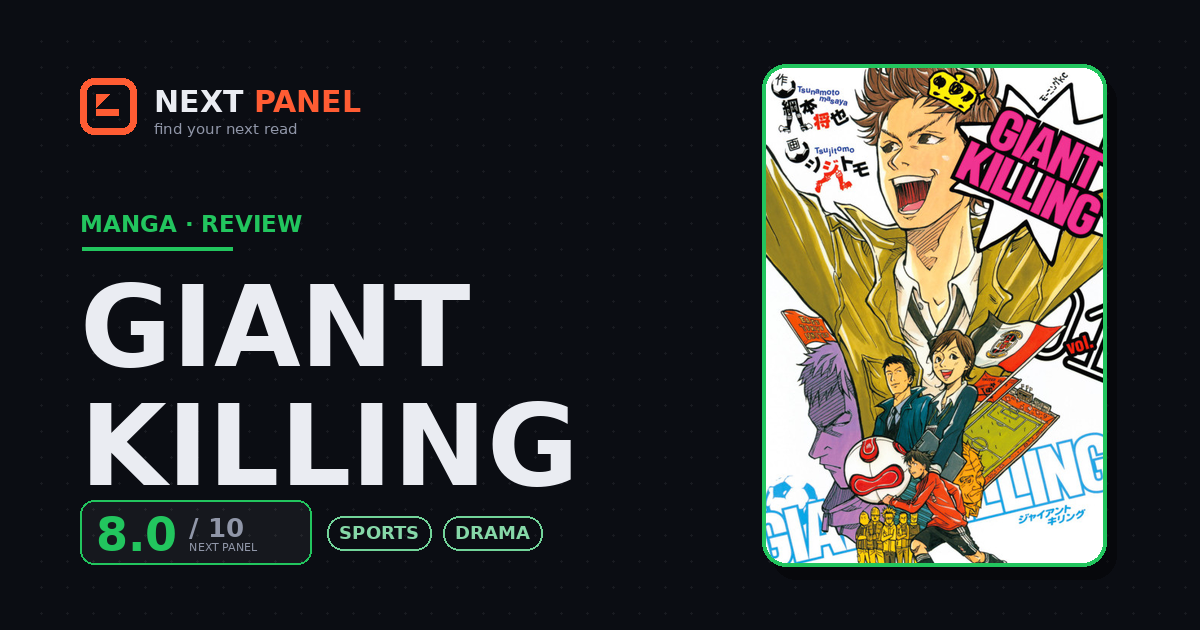
Is Giant Killing Worth Reading? Review & Where to Read
Quick Answer
Yes, if you like the strategy side of sports. Giant Killing follows a manager rebuilding an underdog soccer club, and its focus on tactics, mind games, and team chemistry makes it stand out. The art is plain and it's very long, but the drama is excellent.
Quick Verdict
“The rare sports manga told from the bench — it cares more about the manager's mind games and team chemistry than the star striker, and that's what makes it special.”
Best for: Readers who love tactics, team-building, and the chess match behind a match, not just the goals.
Not for: Readers who want flashy individual heroics and a short, self-contained story.
- Type
- Manga
- Genres
- Drama, Sports
- Status
- Ongoing
- This review
- Minor Spoilers
- Author
- Masaya Tsunamoto
- Artist
- Tsujitomo
- Publisher
- Kodansha
- Platform
- Kodansha
| Quick facts | |
|---|---|
| Format | Manga (seinen), 69 volumes |
| Run | 2007–present · ongoing |
| Community score | AniList 7.9 · MAL 8.0 · MangaUpdates 8.3 |
| Where to read | Kodansha — official |
Overview
Most soccer manga are about a gifted kid who wants to be the best. Giant Killing is about the guy in the windbreaker on the sideline. Takeshi Tatsumi, a former star player turned eccentric coach, comes back to Japan to manage East Tokyo United (ETU), a perennial bottom-half J-League club with frustrated players and a fan base that's lost hope. His job — and the whole series — is figuring out how a weaker team beats stronger ones. That's the 'giant killing' of the title.
Written by Masaya Tsunamoto and drawn by Tsujitomo, it's been running in Kodansha's Morning since 2007 and is one of the most respected sports manga out there, even if it's flown under the radar in the West.
What it does well
The manager's-eye view is what sets it apart. Instead of living inside one player's growth, you sit with Tatsumi as he reads the game: where to apply pressure, which player to trust in a big moment, how to bait an opposing coach into a mistake. The matches become tactical duels between two benches as much as two squads, and that's a genuinely fresh angle that keeps even routine games tense.
It also treats the club as a living thing. The story spreads its attention across the starting eleven, the bench, the front office, the ultras in the stands, and the reporters covering them. So when ETU pulls off an upset or blows a lead, it lands as a collective event — you feel the whole club rise or sink, not just one hero. That width gives the wins real emotional payoff.
And the tactics aren't hand-waved. The manga takes time to show why a formation change works or why a substitution flips a match, in a way that's clear without being a lecture. You come out of a good arc feeling like you understand soccer a little better, which is high praise for the genre.
Where it falls short
The art is the main knock. Tsujitomo's work is clean and readable, and it handles the chaos of a match well, but it isn't a looker — if you come to sports manga for jaw-dropping spreads, this is plainer than most. It serves the story rather than showing off.
The length is the other issue. Dozens of volumes in and still going, it has no ending on the horizon, and the pace dips during some of the longer league stretches. The manager focus, while its strength, also means a few players never get the deep character work a player-led series would give them.
Verdict
Giant Killing is the thinking fan's soccer manga, and on its own terms it's excellent. If you care about strategy, team-building, and the drama of an underdog club more than highlight-reel goals, there's nothing quite like it. Accept the plain art and the open-ended length, and you've got one of the smartest sports series going.
Strengths & Weaknesses
Strengths
- It's told from the manager's chair, which almost no sports manga does. The tension lives in Tatsumi's mind games, his lineup gambles, and reading the opposing bench — and it's genuinely gripping.
- The club feels real. Players, supporters, the front office, and the press all get screen time, so a win or a loss carries weight well beyond the scoreboard.
- The tactics are smart and clearly explained. You finish a match actually understanding why a substitution or a formation switch decided it.
Weaknesses
- The art is functional rather than beautiful. It reads clearly in motion but won't wow you the way the flashiest sports manga do.
- It's very long and still ongoing, so there's no ending in sight and a few mid-run arcs sag.
- Because the manager is the lead, individual players sometimes get less depth than they would in a player-focused series.
Similar Titles
Where to Read Officially
| Platform | Format | Pricing | Region notes | Link |
|---|---|---|---|---|
| Kodansha | Digital & print volumes | Paid | Region availability varies | Open |
Frequently Asked Questions
Do I need to like soccer to enjoy Giant Killing?
It helps, but the real appeal is the strategy and team drama. If you like underdog stories and tactics, you'll follow it fine even with light soccer knowledge.
Is Giant Killing finished?
No. It's still ongoing in Japan with a large volume count, though the English releases run a bit behind the Japanese ones.
Where can I read it in English?
Kodansha publishes it in English, primarily in digital format, with print editions also available.