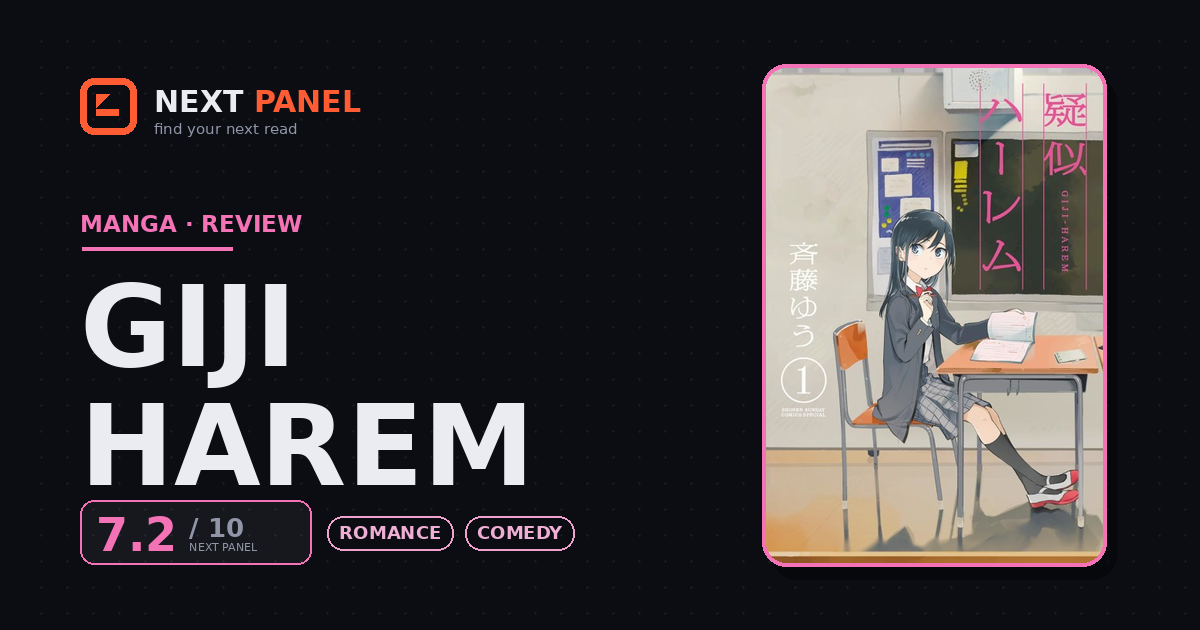
Is Giji Harem (Pseudo Harem) Worth Reading? Review & Where to Read
Quick Answer
Worth reading if you want a genuinely clever spin on harem-comedy tropes, using one girl playing multiple archetypes to poke fun at the genre while still building a real, sincere romance underneath the gag.
Quick Verdict
“Turning a genre cliché into a solo performance is a smarter joke than it sounds, and it keeps paying off because Rin's real feelings are never far from the surface.”
Best for: Readers who want a self-aware, comedic take on harem and rom-com tropes with a sincere romance underneath the gag.
Not for: Readers who want a slow-burn romance without a gimmick, or a story with a large, varied cast of love interests.
- Type
- Manga
- Genres
- Romance, Comedy
- Status
- Completed
- This review
- Minor Spoilers
- Author
- Yū Saitō
- Publisher
- Shogakukan
| Quick facts | |
|---|---|
| Format | Manga (shōnen), 157 chapters, 6 volumes |
| Run | 2018–2021 · completed |
| Community score | AniList 7.7 · MangaUpdates 7.8 |
| Content | None significant |
Overview
Eiji Kitahama, a member of his high school's Drama Club, offhandedly wishes out loud that he could experience having a harem like the ones in his favorite manga. His underclassman Rin Nanakura, who's secretly in love with him, decides to take that wish literally -- using her acting skills to cycle through a rotating cast of exaggerated harem-anime personas, effectively playing every stock love interest herself. Written and illustrated by Yū Saitō, Giji Harem (also translated as Pseudo Harem) ran in Shogakukan's Monthly Shōnen Sunday from 2019 to 2021 and received an anime adaptation; it has no official English release yet, though the creator has approved fan translations.
What it does well
The premise is smarter than the title suggests. Rather than being a straightforward harem comedy, it's a satire of one, using a single character's acting range to poke fun at genre archetypes -- the tsundere, the childhood friend, the shy girl -- while still telling a sincere, grounded romance underneath all the role-play. That double layer is what makes it work: the comedy comes from watching Rin commit fully to each bit, but the emotional throughline comes from knowing every persona is really just her trying to get closer to Eiji without having to say how she actually feels.
Eiji himself avoids being a frustrating harem-protagonist cliché. His obliviousness reads as genuine rather than as a cheap device to keep the story going, which makes the eventual moments where the mask starts slipping land with real weight instead of frustration.
The manga is also well-paced about its own gimmick -- it doesn't lean on the joke past its shelf life, letting the actual relationship develop and change the dynamic between the two leads as it goes.
Where it falls short
The premise does have a ceiling. Once the joke is established, some chapters are essentially variations on the same bit rather than genuinely new territory, and readers looking for a story that keeps escalating in new directions may feel it plateaus. Because Rin is single-handedly covering every love-interest archetype, there's also little room for a broader supporting cast the way a typical rom-com would build one out. And anyone expecting an actual harem story, rather than a clever subversion of one, should know upfront that this is really a two-hander romance in disguise.
Verdict
This is a genre-aware rom-com that gets real comedic and emotional mileage out of a single clever gimmick -- one girl playing an entire harem's worth of archetypes to get closer to the boy she loves. It won't reinvent itself past that core idea, but the sincerity underneath the joke makes it worth reading regardless.
Strengths & Weaknesses
Strengths
- The central gimmick -- one girl cycling through exaggerated harem-anime archetypes to simulate an entire cast of love interests -- is a genuinely clever way to satirize the genre while still telling a real romance.
- Rin's acting is played for both comedy and quiet heartbreak, since every persona she puts on is really just another way of getting closer to Eiji without confessing outright, which gives the joke real emotional stakes.
- Eiji is a more sympathetic straight man than the premise suggests; his obliviousness is played as genuine rather than as an excuse to string Rin along.
- The manga is efficient about it -- it doesn't stretch the central bit past its welcome, letting the relationship actually develop instead of looping the same joke indefinitely.
Weaknesses
- The premise is inherently limited -- once you understand the joke, some chapters lean on repeating variations of it rather than finding fully new ground.
- Because Rin is playing nearly every love-interest role herself, the manga doesn't have room for the kind of varied supporting cast a normal rom-com would build out.
- Readers expecting an actual harem story, rather than a satire of one, may find the bait-and-switch premise not what they signed up for.
Similar Titles
Shares a similar interest in exaggerated, self-aware romantic comedy tropes played for both laughs and real feelings.
For readers who want a more straightforward slow-burn version of the sincere romance underneath this manga's gimmick.
Another genre-aware rom-com that has fun with harem conventions while keeping its central couple's feelings sincere.
Frequently Asked Questions
Is Giji Harem licensed in English?
No official English release exists yet, though the creator has approved fan translations of the series.
Is the series finished?
Yes, the manga has completed its run.
Is this actually a harem story?
No -- it's a satire of the genre. One girl role-plays multiple harem archetypes to get closer to the boy she likes, rather than the boy having multiple real love interests.