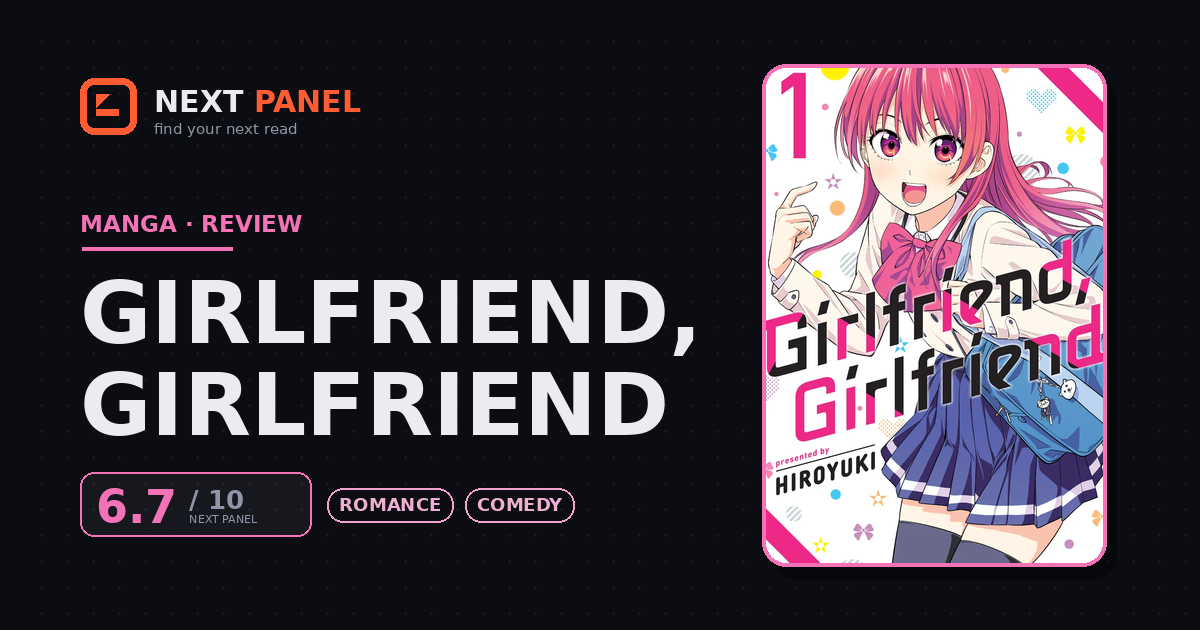
Is Girlfriend, Girlfriend Worth Reading? Review & Where to Read
Quick Answer
Worth a look if you want a rom-com built entirely around an absurd, ethically messy premise played for maximum chaos rather than romantic sincerity — go in expecting farce, not a love story you're meant to root for cleanly.
Quick Verdict
“The premise is a dare more than a romance, and the manga is at its best when it leans all the way into how uncomfortable that dare actually is.”
Best for: Readers who want a fast, gag-driven rom-com willing to sit in genuinely awkward romantic situations for laughs.
Not for: Readers who want a sincere, emotionally grounded love story or a cast that behaves like reasonable adults.
- Type
- Manga
- Genres
- Romance, Comedy
- Status
- Completed
- This review
- Minor Spoilers
- Author
- Hiroyuki
- Publisher
- Kodansha
- Platform
- Kodansha
| Quick facts | |
|---|---|
| Format | Manga (shōnen), 144 chapters, 16 volumes |
| Run | 2020–2023 · completed |
| Community score | AniList 6.8 |
| Content | Sexual humor, fanservice |
| Where to read | Kodansha — official |
Overview
Naoya finally gets a girlfriend in Saki, and the two are volatile but genuinely into each other — until a second girl, Nagisa, confesses to him out of nowhere. Rather than picking one or turning Nagisa down, Naoya does the thing that kicks off the entire series: he asks Saki for permission to date them both. Written and illustrated by Hiroyuki, Girlfriend, Girlfriend ran in Weekly Shōnen Magazine from 2020 to 2023, wrapping at 16 volumes, with an anime adaptation covering part of the story.
What it does well
The manga's biggest strength is that it doesn't try to sand the premise's edges off. A lot of harem-adjacent rom-coms would soften this setup into something more palatable, but Girlfriend, Girlfriend keeps leaning into how chaotic and ethically messy Naoya's arrangement actually is, and the comedy comes from watching the cast actually negotiate the terms rather than just vibing through a normal love triangle.
Saki does a lot of the comedic heavy lifting. Her mix of competitiveness, jealousy, and genuine affection for Naoya makes her reactions the funniest and most consistently entertaining part of the cast, and the series is smart to keep building situations around her specifically. The chapter-to-chapter pacing also helps — jokes resolve quickly instead of getting stretched thin, so even weaker gags don't overstay their welcome.
What keeps it from feeling hollow is that the manga is honest about the arrangement being a mess rather than dressing it up as some enlightened, drama-free ideal. That honesty is what makes the comedy work instead of feeling like the story is asking you to admire Naoya.
Where it falls short
The premise is a genuinely hard sell on its own terms — asking your girlfriend's permission to date someone else reads as more selfish than romantic, and the manga doesn't always give Naoya enough redeeming material to offset that. Readers who need to actually root for the central relationship rather than just watch it as farce may bounce off early.
The joke structure also repeats more than sixteen volumes can really sustain: jealousy flares, someone schemes, chaos breaks out, things reset to status quo. It's reliable but doesn't build much momentum. And the fanservice, while frequent, sometimes stands in for character beats rather than supporting them.
Verdict
This is a rom-com that works best when you read it as a farce about a terrible idea rather than a love story to root for sincerely — on those terms, Saki's chaos and the premise's sheer audacity carry it a long way. It runs long enough that the formula shows its seams, but it rarely stops being funny about just how bad Naoya's idea was.
Strengths & Weaknesses
Strengths
- The core premise commits to its own absurdity instead of softening into a safer love-triangle story, and the manga gets consistent comedic mileage out of characters actually negotiating the terms of a relationship most rom-coms would just gesture at.
- Saki in particular is a stronger comic engine than the premise suggests — her volatile, competitive reactions to the whole arrangement carry a lot of the series' funniest chapters.
- The pacing moves briskly panel to panel, with jokes landing quickly instead of stretching a single gag across too many pages.
- It's honest about how chaotic and unsustainable the setup is rather than pretending it's a mature, drama-free arrangement, which keeps the tone from tipping into saccharine.
Weaknesses
- The premise itself is a hard sell — a guy asking his girlfriend's permission to date someone else reads as more selfish than charming, and the manga doesn't always do enough to earn sympathy for him.
- The joke structure repeats a lot across 16 volumes: jealousy flares up, a scheme gets hatched, chaos ensues, reset. Readers wanting forward momentum in the actual relationships may find the loop wears thin.
- The fanservice is frequent and sometimes feels like it's substituting for character development rather than supporting it.
Similar Titles
Another long-running rom-com built around a messy, comedic love triangle rather than a clean central pairing.
Shares the mix of harem-adjacent comedy and a large ensemble of girls competing for the lead's attention.
Quintessential Quintuplets
For readers who want another rom-com that leans into an oversized cast and running gags over a slow-burn single romance.
Where to Read Officially
| Platform | Format | Pricing | Region notes | Link |
|---|---|---|---|---|
| Kodansha | Digital chapters (first chapter free, volumes for purchase) | Free + Paid | Region availability varies | Open |
Frequently Asked Questions
Is Girlfriend, Girlfriend licensed in English?
Yes — Kodansha USA publishes it digitally, with the first chapter free.
Is the series finished?
Yes, it ran from 2020 to 2023 across 16 volumes.
Is there an anime?
Yes, an anime adaptation covers part of the story, but the manga runs further.