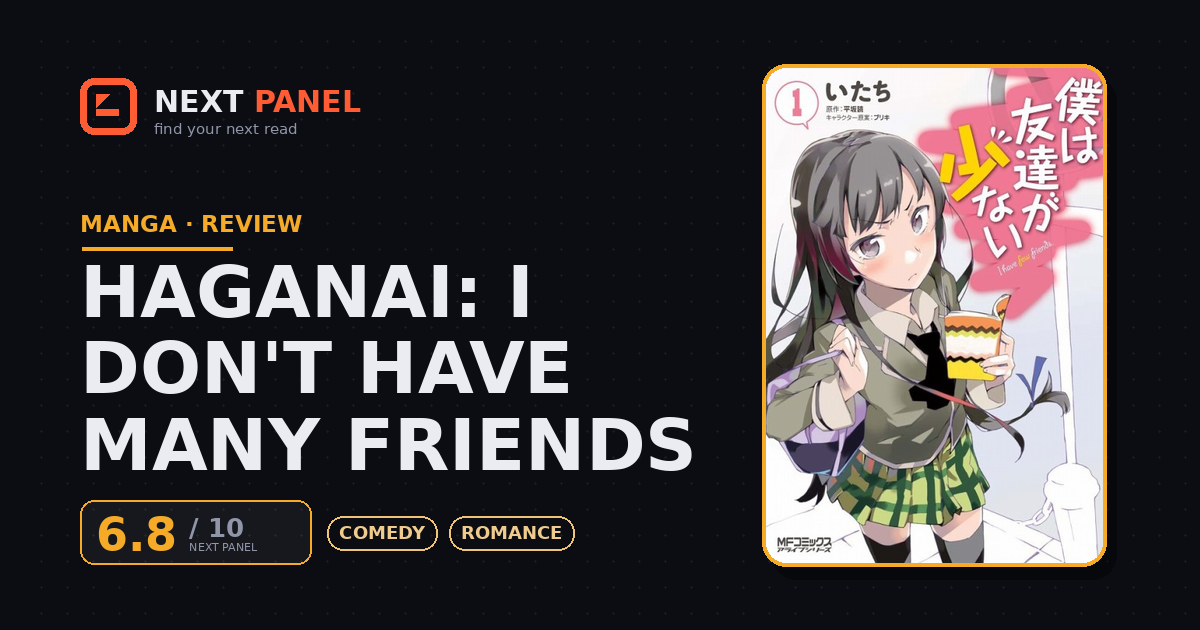
Is Haganai: I Don't Have Many Friends Worth Reading? Review & Where to Read
Quick Answer
If you want harem comedy built around socially awkward characters roasting each other rather than a smooth romantic ensemble, this delivers exactly that.
Quick Verdict
“Nobody in this club actually gets better at making friends, and somehow that's the joke that keeps working across twenty volumes.”
Best for: Readers who want harem comedy with a mean, self-aware edge and a cast defined by their social failures.
Not for: Readers who want warm, low-conflict slice-of-life or a harem cast that gets along smoothly.
- Type
- Manga
- Genres
- Romance, Comedy
- Status
- Completed
- This review
- Minor Spoilers
- Author
- Yomi Hirasaka
- Artist
- Itachi
- Publisher
- MediaWorks
- Platform
- Seven Seas Entertainment
| Quick facts | |
|---|---|
| Format | Manga (shōnen), 20 volumes |
| Run | completed |
| Community score | MangaUpdates 8.1 |
| Content | Sexual humor, fan service |
| Where to read | Seven Seas Entertainment — official |
Overview
Haganai follows Kodaka Hasegawa, a transfer student mistaken for a delinquent because of his intimidating looks, who ends up forming the Neighbor's Club with fellow social outcast Yozora Mikazuki. The club's stated purpose is to help its members practice making friends. In practice, it becomes a gathering point for a rotating cast of kids who are all, in their own specific way, bad at basic social interaction — and the series gets its comedy from watching them fail at the thing the club exists for.
It's a harem comedy, but a meaner, more self-aware one than most — the joke isn't that these characters are secretly great, it's that they're genuinely, specifically terrible at connecting with people.
What it does well
The central premise is stronger than it sounds. Every club member's social failure is specific rather than generic — Sena's inability to read a room despite being popular and wealthy, Yozora's history of an imaginary childhood friend, Kobato's retreat into a fictional persona — and the manga is consistent about mining each of those specific flaws instead of flattening everyone into one type of awkward.
Yozora and Sena's antagonism is the comedic backbone of the series, and it works because it's built on real, petty specifics rather than a generic rivalry. Their arguments feel like two people who actually know exactly how to hurt each other, which gives the comedy some teeth.
The series also isn't afraid to let its characters be genuinely unlikeable in the moment, which is a deliberate choice that separates it from softer harem comedies. Rika's constant inappropriate jokes and Yozora's cruelty toward Sena aren't smoothed over — they're the point, and the manga trusts you to find them funny rather than sanitizing the cast into something safer.
Where it falls short
The abrasive tone is a real ask. If constant insults, put-downs, and characters actively being unpleasant to each other isn't your idea of fun, the humor here will grate rather than land, and it doesn't let up much across twenty volumes.
Fan service is a frequent, structural presence rather than an occasional gag, and it can feel like it's competing with the character comedy for space rather than supporting it.
Because the whole premise depends on the cast staying bad at making friends, actual character growth stays minimal by design — which keeps the emotional stakes fairly low no matter how many volumes you read.
Verdict
Haganai is a harem comedy with real bite, built on a cast whose specific social failures stay funny because the writing commits to them rather than softening them. If you want your ensemble comedy a little meaner and more self-aware than most, it's a solid, complete twenty-volume read — just know the tone stays sharp-edged the whole way through.
Strengths & Weaknesses
Strengths
- The core joke — a club formed to fix social awkwardness that instead becomes a showcase of it — stays sharp because every member's specific flaw is distinct and consistent.
- Yozora and Sena's rivalry is genuinely funny, built on real pettiness rather than generic tsundere bickering.
- The comedy leans into cruelty and self-awareness rather than warmth, which sets it apart from softer harem-comedy peers.
- Side characters like Kobato and Rika get enough focused chapters to become more than a single running gag.
Weaknesses
- The humor relies heavily on characters insulting each other, and that constant abrasiveness will wear thin for readers who want a gentler tone.
- Fan service shows up often enough to be a structural element rather than an occasional aside.
- Character growth is minimal by design, which means the emotional stakes stay low across the whole run.
Similar Titles
Oregairu
Shares the socially awkward, self-aware protagonist angle but with a more sincere, less abrasive tone.
Similar harem-comedy energy with heavier fan-service focus, if that's what you're after.
A gentler alternative harem comedy with less mean-spirited humor.
Where to Read Officially
| Platform | Format | Pricing | Region notes | Link |
|---|---|---|---|---|
| Seven Seas Entertainment | Print & digital volumes | Paid | Region availability varies | Open |
Frequently Asked Questions
Is Haganai finished?
Yes, it's complete at 20 volumes, serialized from 2010 to 2020.
Is this based on a light novel?
Yes, the manga adapts Yomi Hirasaka's original light novel series, illustrated in manga form by Itachi.
Is it more comedy or romance?
Comedy first — the romantic tension between characters is present but mostly serves as another source of jokes rather than a driving plot.