Is Hellsing Worth Reading? Review & Where to Read
Quick Answer
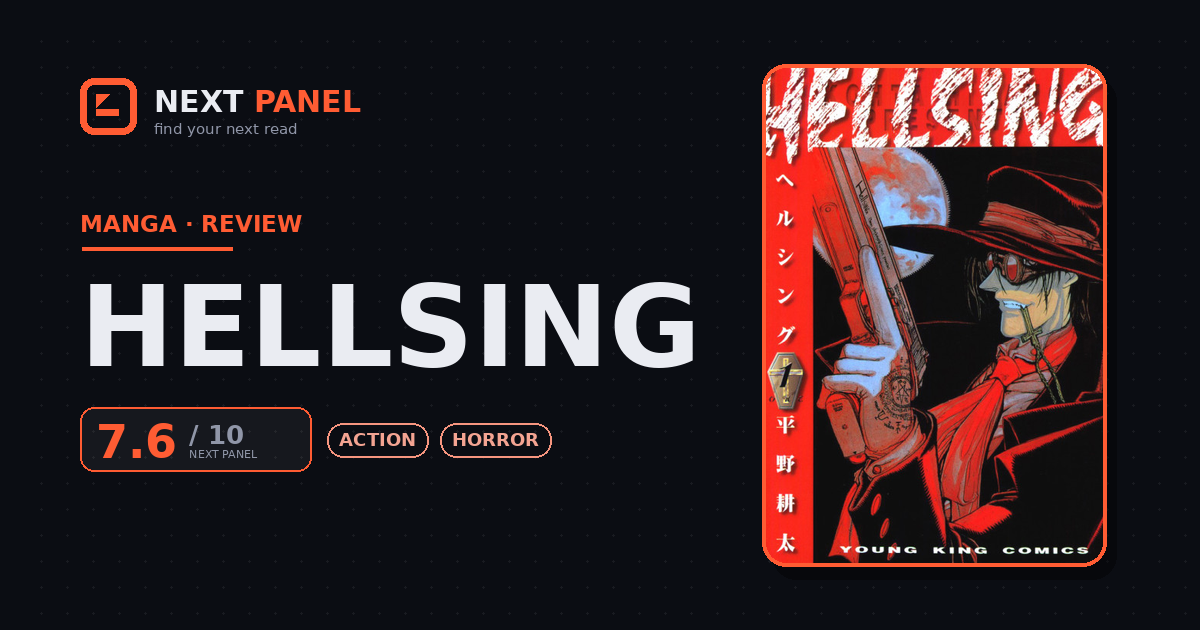
Yes, if you want cool, over-the-top vampire action. Hellsing follows Alucard, an absurdly powerful vampire who serves a secret organization that protects England from supernatural threats — and who relishes destroying his enemies, including a resurgent army of Nazi vampires. It's stylish, ultra-violent, and gleefully edgy, built around one of manga's coolest antiheroes. The plot is thin and the art is messy, but for pure gothic-action spectacle, it delivers.
Quick Verdict
“Pure stylish carnage — a gleefully overpowered vampire mowing down Nazis with a grin — that's all spectacle and swagger, not plot or polish.”
Best for: Readers who want stylish, ultra-violent gothic vampire action with a gleefully overpowered antihero.
Not for: Readers who want clean art, a deep plot, or restraint.
- Type
- Manga
- Genres
- Horror, Action
- Status
- Completed
- This review
- Minor Spoilers
- Author
- Kouta Hirano
- Publisher
- Shonen Gahosha / Dark Horse
- Platform
- Dark Horse
| Quick facts | |
|---|---|
| Format | Manga (seinen), 92 chapters, 10 volumes |
| Run | 1997–2008 · completed |
| Community score | AniList 7.9 · MAL 5.9 · MangaUpdates 8.2 |
| Content | Extreme graphic violence, gore, and Nazi imagery |
Overview
Hellsing is a stylish, blood-drenched gothic action manga about monsters fighting monsters. The Hellsing Organization is a secret arm of the British establishment that protects the country from supernatural threats — vampires, ghouls, and worse. Its commander is the cold, iron-willed Integra Hellsing, but its ultimate weapon is Alucard: an ancient, monstrously powerful vampire who serves Hellsing and delights in annihilating lesser undead. Alongside Seras Victoria, a young policewoman he turns into a vampire, Alucard becomes the spearhead in a war against Millennium — a remnant of Nazi mad scientists who've built an army of artificial vampires to burn the world. What follows is essentially one long, escalating orgy of stylish violence. It's by Kouta Hirano, ran in Young King OURs, and is complete in ten volumes from Dark Horse.
What it does well
It is unbelievably cool, and it knows it. Hellsing runs on pure style and attitude — Alucard is one of the great manga antiheroes, a swaggering, grinning, nigh-unkillable monster who treats apocalyptic battles like entertainment, and watching him cut loose is a genuine thrill. The series commits totally to its edgy, operatic, over-the-top tone, and that conviction is infectious.
The action is spectacular in spirit. When the carnage hits, it's massive and gleeful — vampire armies, impossible powers, last-stand battles — and the gothic-military aesthetic (the coats, the guns, the grandstanding villains) is iconic. The villains, especially the gloriously hammy Major and his Nazi vampire horde, are memorably theatrical.
And it's mercifully focused. At ten volumes, it doesn't overstay; it picks a conflict, escalates it relentlessly, and ends. There's no filler bloat here, just a steady climb toward maximum spectacle.
Where it falls short
The art is divisive, and often messy. Hirano's style is dynamic and stylish in stills, but his busy action scenes can be genuinely hard to follow — a scratchy, chaotic tangle where you lose track of who's doing what. For an action manga, that's a real weakness.
The story is also thin. The plot is essentially a straight line toward bigger fights, the characters are cool but shallow, and the thematic content takes a back seat to spectacle. This is a vibe and a power fantasy, not a deep narrative. And the relentless edge — the Nazi villains, the wall-to-wall gore, the nihilistic swagger — is the appeal for some and a turn-off for others.
Verdict
Hellsing is a stylish, ultra-violent gothic-action romp built around one of manga's coolest antiheroes and a glorious commitment to over-the-top spectacle. It's not deep, the plot is a straight line, and Hirano's chaotic action art won't work for everyone — but if you want cool vampires, operatic villains, and gleeful carnage in a tight ten volumes, it delivers exactly that. For fans of stylish, edgy action horror, it's a blast.
Strengths & Weaknesses
Strengths
- It's unbelievably cool and knows it — Alucard is one of the great manga antiheroes, a swaggering, grinning, nigh-unkillable monster who's a thrill to watch.
- It commits totally to its edgy, operatic, over-the-top tone, and that conviction is infectious.
- The gothic-military aesthetic and theatrical villains (the hammy Major and his Nazi vampire horde) are iconic.
- At ten volumes it's focused — no filler, just a relentless escalation toward maximum spectacle.
Weaknesses
- The art is divisive and often messy — Hirano's busy action scenes can be genuinely hard to follow.
- The story is thin — a straight line toward bigger fights, with cool but shallow characters and little depth.
- The relentless edge — Nazi villains, wall-to-wall gore, nihilistic swagger — is the appeal for some and a turn-off for others.
Similar Titles
Kouta Hirano's other manga — the same gleeful, over-the-top, ultra-violent style in a historical-fantasy war.
Stylish dark-fantasy action with a gothic-occult edge and great fights.
Dark, weird, hyper-violent fantasy with a strong, grimy visual identity.
Frequently Asked Questions
Is Hellsing finished?
Yes. It ran from 1997 to 2008 and is complete in 10 volumes, published in English by Dark Horse.
Is it the same as Hellsing Ultimate?
Hellsing Ultimate is the OVA anime that faithfully adapts the full manga (the older 2001 TV anime went its own way). The manga is the original, complete story.
How violent is it?
Extremely. It's wall-to-wall gore and carnage, with Nazi-themed villains and dark, edgy content — firmly adults-only.