Is Hikaru no Go Worth Reading? Review & Where to Read
Quick Answer
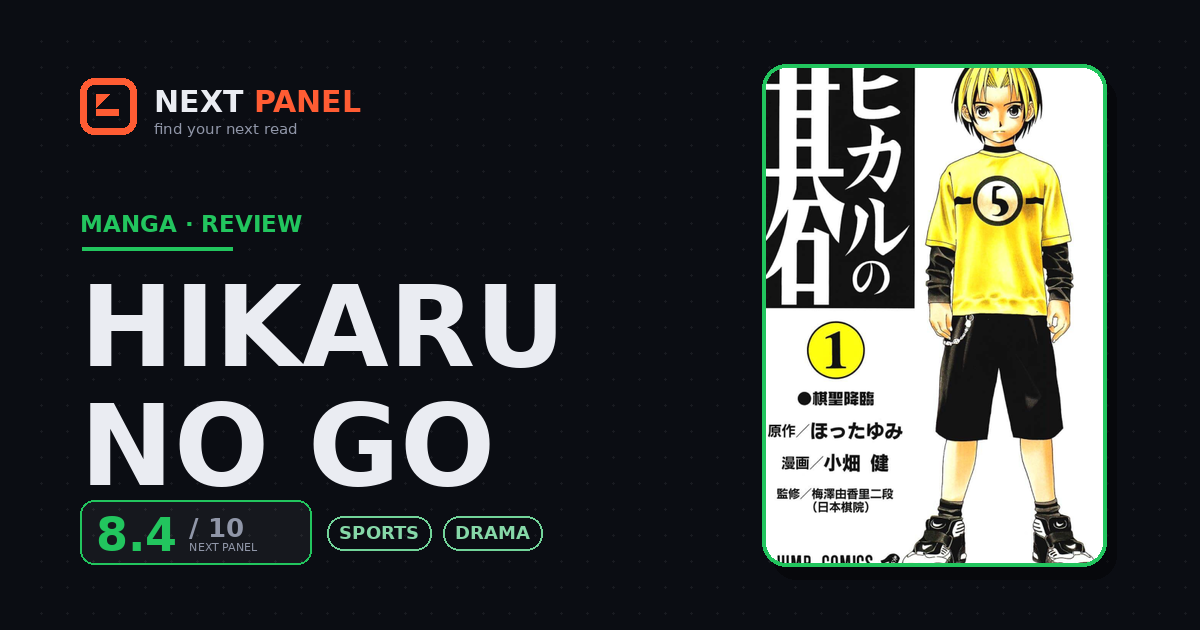
Yes — it's a classic, even if you've never touched a Go board. Hikaru no Go turns a boy's reluctant journey into competitive Go into a gripping coming-of-age story, anchored by one of manga's most moving character relationships. You won't learn to play Go from it, and the later arcs dip, but the emotional ride is special.
Quick Verdict
“It makes a 2,000-year-old board game feel like a life-or-death duel — one of the most gripping manga about a hobby ever, and quietly one of the saddest.”
Best for: Readers who love coming-of-age and rivalry stories, even about a niche subject.
Not for: Readers who want fast action and a subject they can follow rule-by-rule.
- Type
- Manga
- Genres
- Drama, Sports
- Status
- Completed
- This review
- Minor Spoilers
- Author
- Yumi Hotta
- Artist
- Takeshi Obata
- Publisher
- VIZ Media
- Platform
- VIZ Media
| Quick facts | |
|---|---|
| Format | Manga (shōnen), 197 chapters, 23 volumes |
| Run | 1998–2003 · completed |
| Community score | AniList 7.9 · MAL 8.1 · MangaUpdates 8.7 |
| Where to read | VIZ Media — official |
Overview
Hikaru no Go is a coming-of-age manga by Yumi Hotta with art by Takeshi Obata (the artist behind Death Note). Hikaru Shindo is an ordinary kid who, poking around his grandfather's attic, finds an old Go board and awakens Sai — the spirit of a Heian-era Go master who lived and died for the game and dreams of playing the perfect move, the "Divine Move." Sai attaches himself to Hikaru and begs him to play. Hikaru couldn't care less at first, but slowly he's pulled into the world of competitive Go: the tournaments, the prodigy rival Akira Touya, and a growing passion of his own. VIZ Media publishes the complete series in English.
What it does well
Its great trick is making Go genuinely thrilling. Go is an ancient, abstract, slow board game, and Hikaru no Go turns matches into white-knuckle duels you can feel even if you don't understand a single move. That's an astonishing feat of storytelling, and it's why the manga famously sparked a Go boom among kids when it came out.
The heart of it is Sai. He's a wonderful character — passionate, gentle, a little tragic — and the bond between him and Hikaru carries enormous emotional weight. Without spoiling anything, the series builds to a turning point around that relationship that is one of the most devastating, unforgettable moments in shonen manga. Alongside it, Hikaru's rivalry with the intense prodigy Akira gives the story its engine, and his growth from bored kid to dedicated player is deeply satisfying.
It's also gorgeous. Obata's art is clean, expressive, and great at conveying tension across a board, and it makes the quiet drama of two people sitting and thinking feel cinematic.
Where it falls short
One thing to set straight: you won't really learn Go from this. The manga rides the emotion and the stakes rather than teaching strategy, so you follow how characters feel about a game more than the game itself. For most readers that's fine, but if you wanted a proper tutorial, look elsewhere.
The pacing also dips. After the big midpoint turning point, some of the later tournament arcs lose momentum, and a number of readers feel the ending arrives a little abruptly, without fully resolving everything it sets up. The subject is niche, too, so the early chapters have to win you over before the hooks set in.
Verdict
Hikaru no Go is a classic for good reason, and worth reading even if a manga about a board game sounds like the dullest thing imaginable. Come for a gripping coming-of-age rivalry, stay for Sai and a story that hits harder than you'd ever expect. The later stretch isn't as strong as the peak, but that peak is unforgettable.
Strengths & Weaknesses
Strengths
- It makes Go genuinely thrilling — turning an abstract, slow board game into white-knuckle duels is an astonishing storytelling feat.
- Sai is a wonderful, poignant character, and his bond with Hikaru carries huge emotional weight, including one of shonen's most devastating turning points.
- The Hikaru-Akira rivalry and Hikaru's growth from bored kid to dedicated player are classic and satisfying.
- Obata's clean, expressive art makes two people thinking over a board feel cinematic.
Weaknesses
- You won't actually learn Go from it — it rides the emotion and stakes rather than teaching strategy.
- The pacing dips after the midpoint turning point, and some readers find the ending abrupt.
- The subject is niche, so the early chapters have to win you over first.
Similar Titles
Another gorgeous story about throwing yourself into a niche competitive pursuit (karuta).
A shogi manga with the same mix of competition and deep emotional growth.
The gold-standard sports manga, if you want the same rivalry and obsession with a team twist.
Where to Read Officially
| Platform | Format | Pricing | Region notes | Link |
|---|---|---|---|---|
| VIZ Media | Print & digital volumes | Paid | Region availability varies | Open |
Frequently Asked Questions
Do I need to know how to play Go?
No. The manga doesn't really teach the rules — it makes you feel the tension and stakes of the matches, so you can enjoy it knowing nothing about Go.
Is it finished?
Yes. VIZ publishes the complete series in 23 volumes in English.
Where can I read it officially in English?
VIZ Media publishes it in print and digitally, including via the Shonen Jump app.