Is Jin Worth Reading? Review & Where to Read
Quick Answer
Yes, if you want a time-travel premise used as a real lens on the history of medicine rather than just an excuse for fish-out-of-water jokes. It takes its own stakes seriously.
Quick Verdict
“The time-travel hook gets you in the door; the honest medical stakes are why you stay for twenty volumes.”
Best for: Readers who want a historical drama that treats medicine and its limits as the actual story, not just set dressing.
Not for: Readers who want a fast-moving adventure or a story that doesn't dwell on grief and death.
- Type
- Manga
- Genres
- Drama, Historical
- Status
- Completed
- This review
- Minor Spoilers
- Author
- Motoka Murakami
- Publisher
- Shueisha (Super Jump)
- Platform
- Mangamo
| Quick facts | |
|---|---|
| Format | Manga (seinen), 20 volumes |
| Run | completed |
| Community score | MangaUpdates 8.7 |
| Content | Depictions of surgery, death, and disease |
| Where to read | Mangamo — official |
Overview
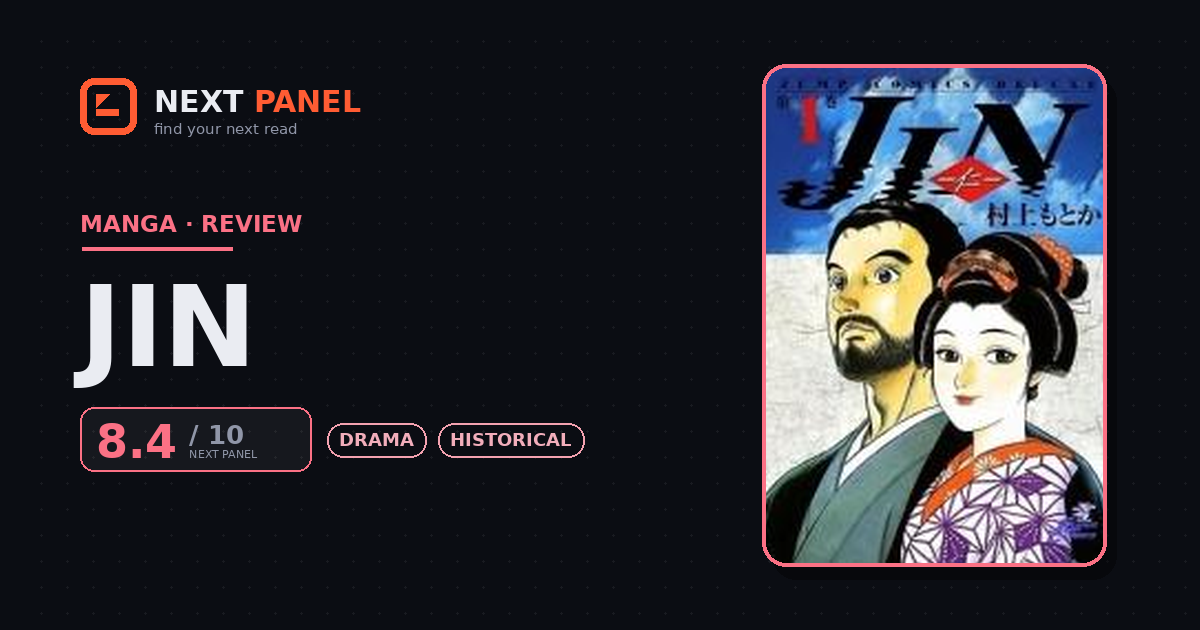
Jin Minakata is a top neurosurgeon in modern-day Tokyo. After a strange operation on an unidentified patient, an accident throws him back to the final years of the Edo period — a Japan with no anesthesia worth the name, no antibiotics, and no understanding of germ theory. Jin has all the knowledge of 21st-century medicine and almost none of the tools, and the manga spends its run on the very specific problem of what a modern doctor can and can't actually do with 1862 in front of him.
It's a great premise, and Motoka Murakami is more interested in following it seriously than mining it for easy fish-out-of-water comedy.
What it does well
The medical drama is the heart of the manga, and it earns that position. Jin isn't a miracle worker just because he knows more than everyone around him — he has to improvise instruments, explain concepts nobody has a vocabulary for, and accept that some things he could fix instantly in his own time are simply beyond what's possible here. That honesty about limitation is what keeps the story from feeling like a power fantasy.
The historical texture backs it up. Murakami works real historical figures and real turning points into Jin's story in ways that feel like genuine research rather than trivia, and the manga isn't shy about the human cost of the era — patients die, sometimes because Jin genuinely can't save them, and the story lets that land instead of cutting away from it. That willingness to sit with loss is what turns Jin from a clever premise into a real drama.
Where it falls short
The manga does slow down considerably once the story widens beyond Jin's clinic and into the political maneuvering of the era. It's not uninteresting, but it's a tonal shift from the tight medical-drama momentum of the opening volumes, and some readers will feel the pace sag through the middle stretch. The plot also leans on Jin repeatedly crossing paths with major historical figures and events, which asks you to accept a fair number of convenient coincidences.
If you came for the medical problem-solving specifically, be ready for the historical drama to take up just as much space as the surgery does.
Verdict
Jin takes a great high-concept premise and refuses to cut corners on it — the medicine feels real, the history feels researched, and the losses actually hurt. It's a slower, heavier read than its pitch suggests, but that seriousness is exactly what makes it worth the twenty volumes.
Strengths & Weaknesses
Strengths
- The medicine is treated as genuinely high-stakes rather than a gimmick — Jin has to weigh what he can realistically pull off with Edo-period tools against what he knows should be possible, and that tension drives most of the tension in the story.
- The historical setting isn't just background color: real figures and real medical history get worked into the plot in ways that feel researched rather than name-dropped.
- Jin's growing relationships with the people around him, especially those he can't save, give the series real emotional weight beyond the novelty of its premise.
- The manga is honest about failure — Jin loses patients, and those losses actually matter to the story instead of being brushed past.
Weaknesses
- The pacing slows considerably in the middle stretch as the story widens into more political and historical territory, which can feel like a detour from the medical drama that hooked you.
- A few of the coincidences that keep pulling Jin toward major historical events ask for a fair amount of suspension of disbelief.
Similar Titles
Vagabond
Another historical seinen drama that treats its period setting and craft (swordsmanship instead of medicine) with the same seriousness.
Similar interest in ordinary people caught up in events bigger than themselves, told with real emotional patience.
The Climber
Shares the same seinen commitment to showing competence and failure honestly instead of glossing over them.
Where to Read Officially
| Platform | Format | Pricing | Region notes | Link |
|---|---|---|---|---|
| Mangamo | Digital chapters | Free + Paid | Region availability varies | Open |
Frequently Asked Questions
Is Jin finished?
Yes, it ran 20 volumes and reaches a complete ending.
Is there an anime?
Yes, and it was popular enough in Japan to spawn a live-action TV drama as well, but the manga covers the full story.
Where can I read Jin in English?
Mangamo has the complete series officially translated, with the first chapters free and the rest available through the app.