Is Kingdom Worth Reading? Review & Where to Read
Quick Answer
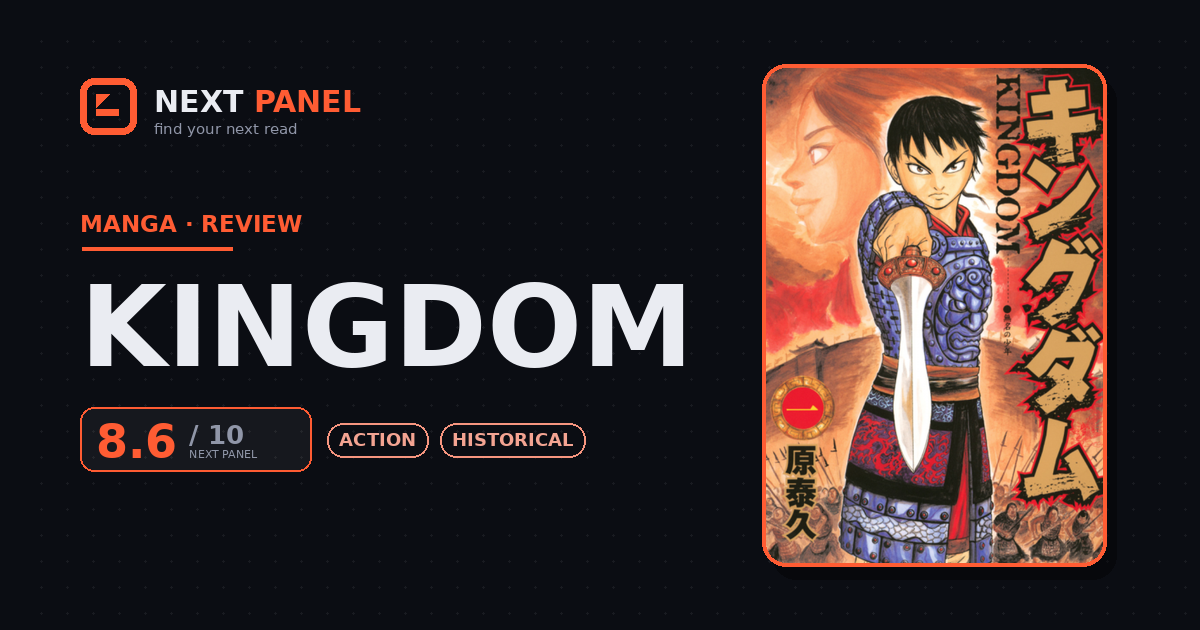
Yes, if you want an epic historical war saga. Kingdom is set in China's Warring States period and follows Xin, a war orphan and slave who dreams of becoming a Great General of the Heavens, and Ying Zheng, the young king of Qin determined to unify the warring states into one nation. It's a sweeping epic of massive battles, military strategy, and political intrigue, with stirring character growth and genuinely thrilling war. The early art is rough and it's enormously long, but it's one of the best war manga out there.
Quick Verdict
“Massive, stirring, and strategically rich — a Warring States epic about a slave who would be a great general and a king who would unify China — that only asks you to commit to its length.”
Best for: Readers who want a sweeping historical war epic with massive battles, military strategy, and a rags-to-glory hero.
Not for: Readers who want a short, contained story, polished early art, and a tight, fast plot.
- Type
- Manga
- Genres
- Action, Historical
- Status
- Ongoing
- This review
- Minor Spoilers
- Author
- Yasuhisa Hara
- Publisher
- Shueisha / Viz Media
- Platform
- Viz Media
| Quick facts | |
|---|---|
| Format | Manga (seinen), 79 volumes |
| Run | 2006–present · ongoing |
| Community score | AniList 8.9 · MAL 9.0 · MangaUpdates 8.7 |
| Content | Graphic war violence |
Overview
Kingdom is a sweeping historical war epic set during China's Warring States period, in the centuries-long struggle that would end with the warring kingdoms unified into a single empire. Its hero is Xin, a war orphan and lowly slave who, alongside his best friend, dreams of rising on the battlefield to become a "Great General of the Heavens." When fate throws him together with Ying Zheng, the young, embattled king of Qin who burns to unify all of China under one banner, Xin's path becomes bound to that vast ambition. From there the series charts his rise from foot soldier to commander through war after war, intercut with the political intrigue surrounding the king's bid for the throne and the nation's destiny. It's by Yasuhisa Hara, has run in Weekly Young Jump since 2006, and is ongoing at around eighty volumes.
What it does well
Its battles are extraordinary. Kingdom understands war at scale — armies of tens of thousands maneuvering, feints and flanks and gambits — and it makes large-scale military strategy genuinely thrilling, with reversals and tactical brilliance that pay off the setup. The big clashes are some of the most stirring in any manga, blending spectacle with real strategic logic.
The character growth is deeply satisfying. Xin's climb from nothing to a feared commander is a classic, rousing arc, and the enormous cast of generals, strategists, and kings is full of memorable, larger-than-life figures whose rivalries and ideals give the wars weight. The series is brilliant at making you care about leaders on both sides.
And the scope is staggering. This is grand historical storytelling — about ambition, loyalty, what nations cost, and what it takes to unify a fractured world — told with sincerity and momentum across an epic canvas. When it hits its peaks, it's truly inspiring.
Where it falls short
The early art is rough. Hara's drawing in the first dozen-or-so volumes is awkward and inconsistent, and while it improves dramatically into something powerful, the shaky start is a real hurdle that turns some readers off before the series finds its footing.
It's also enormous and uneven. At eighty-plus volumes and counting, it demands a massive commitment, and not every arc is a winner — some campaigns drag, certain stretches lean on repetition or lengthy strategy exposition, and the sheer length means pacing dips are inevitable. And as historical fiction it dramatizes freely, so readers wanting strict accuracy should treat it as spectacle, not record. These are the costs of an epic this big.
Verdict
Kingdom is one of the great war epics in manga — thrilling, strategic, and emotionally rousing, with battles and character arcs that few series can match at their best. Its rough early art and immense length are real barriers, and it asks for serious commitment, but push past the shaky start and it becomes a stirring, large-scale saga of ambition and war. For fans of historical epics and military strategy, it's essential, and it's finally available in English.
Strengths & Weaknesses
Strengths
- Its battles are extraordinary — large-scale military strategy made genuinely thrilling, with feints, flanks, and tactical reversals that pay off.
- Xin's rise from slave to feared commander is a classic, rousing arc, backed by an enormous cast of memorable, larger-than-life generals and kings.
- The scope is staggering — grand historical storytelling about ambition, loyalty, and the cost of unifying a fractured world.
- It makes you care about leaders on both sides, giving the wars real weight.
Weaknesses
- The early art is rough — awkward and inconsistent for the first dozen-plus volumes before it improves dramatically.
- It's enormous and uneven — eighty-plus volumes means some campaigns drag and pacing inevitably dips.
- As historical fiction it dramatizes freely, so it's spectacle, not an accurate record.
Similar Titles
A Three Kingdoms war epic with the same blend of massive battles and brilliant military strategy.
A sweeping war saga following a young leader's rise through battle and political intrigue.
An epic dramatization of Chinese history (the Three Kingdoms) with grand-scale warfare and ambition.
Frequently Asked Questions
Is Kingdom finished?
No. It's been running since 2006 and is ongoing, with around 80 volumes so far. It's one of the best-selling manga in Japan.
Can I read it in English officially?
Yes — after years of being available only in Japanese, Kingdom was officially licensed for English release by Viz Media, with volumes now rolling out. It's also a long-running anime.
Is it historically accurate?
It's based on the real history of Qin's unification of China and figures like Ying Zheng (the future first emperor) and the general Li Xin, but it dramatizes heavily and takes creative liberties. It's historical fiction, not a textbook.