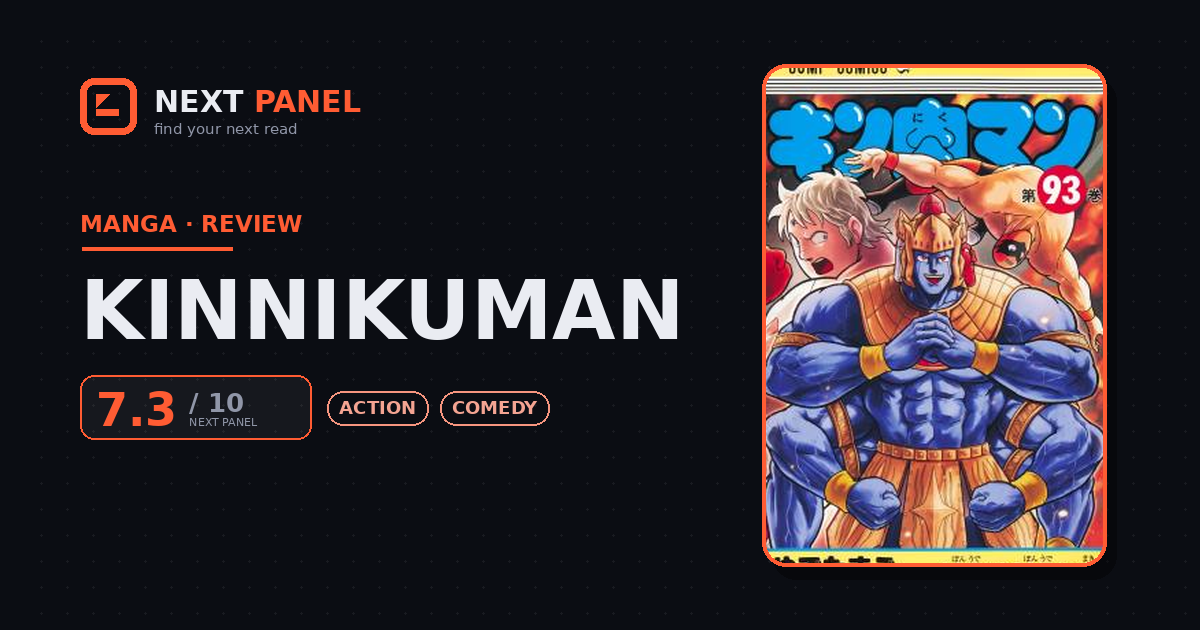
Is Kinnikuman Worth Reading? Review & Where to Read
Quick Answer
If you want to see where an enormous chunk of shonen's power-scaling and tournament-arc DNA comes from, yes — it's goofy, sincere, and historically important.
Quick Verdict
“Somehow a wrestling superhero comedy ended up shaping an entire genre's power-scaling logic, and it's still fun to watch happen.”
Best for: Readers curious about shonen history, who enjoy over-the-top wrestling moves and earnest, silly hero-versus-villain tournaments.
Not for: Readers who want modern art, subtlety, or a story that isn't built entirely around escalating wrestling matches.
- Type
- Manga
- Genres
- Action, Comedy
- Status
- Ongoing
- This review
- Minor Spoilers
- Author
- Yudetamago
- Publisher
- Shueisha
| Quick facts | |
|---|---|
| Format | Manga (shōnen), 93 volumes |
| Run | ongoing |
| Community score | MangaUpdates 6.7 |
Overview
Kinnikuman follows the title character, a clumsy, not particularly bright alien prince who spends more time as a struggling professional wrestler on Earth than acting like the hero he's supposed to be. When the story kicks into gear, it becomes a tournament-driven action-comedy about wrestling superheroes (and supervillains) facing off in increasingly outlandish matches, with Kinnikuman stumbling his way from underdog to genuine contender. Created by the writing-and-art duo Yudetamago, it's one of the most influential and longest-running shonen manga in the medium's history.
What it does well
The wrestling itself is the main event, and Yudetamago clearly never ran out of ideas for it — moves get more absurd and inventive as the series goes, and watching Kinnikuman and his rivals one-up each other with increasingly ridiculous techniques stays entertaining well past the point you'd expect it to run dry. Kinnikuman himself works as a lead specifically because he's not smooth or naturally gifted; he's a screwup who keeps winning through stubbornness and heart, which gives every victory a real sense of payoff even when the plot logic getting him there is a little silly.
The tournament structure also does a lot of heavy lifting, giving the manga a natural, satisfying shape and a steady stream of new wrestlers with distinct gimmicks and personalities to root for or against. And there's real value in reading this as a piece of shonen history — an enormous amount of what became standard in tournament-based shonen, from escalating special moves to rival-turned-ally arcs, either started or was massively popularized here.
Where it falls short
This is very much an early-80s manga, and its humor, character designs, and pacing show that age clearly — some gags land more as historical curiosities than as things that are still funny today. The franchise's sheer size, having continued in various forms for decades, makes committing to it a genuinely daunting task rather than a tidy read. And the wrestling-rules logic the plot runs on doesn't always hold together if you think about it too hard, though the manga rarely asks you to.
Verdict
Kinnikuman is goofy, sincere, and historically significant in a way that makes it worth experiencing even now, if you're willing to meet its era-specific humor halfway. As a piece of shonen foundation, it's hard to overstate how much came after it.
Strengths & Weaknesses
Strengths
- The wrestling moves are inventive and escalate in genuinely creative, absurd ways match after match, which keeps the fights entertaining even decades in.
- Kinnikuman's lovable-loser energy — clumsy, not that bright, but stubbornly heroic when it counts — makes him easy to root for despite the constant slapstick.
- The tournament structure gives the story a clear, satisfying shape, introducing colorful rivals and allies with distinct wrestling gimmicks.
- As one of the earliest hugely popular tournament shonen, it's genuinely interesting to read as the template a huge amount of the genre later built on.
Weaknesses
- The humor and character designs are firmly a product of the early 80s, and some gags read as very dated by modern standards.
- The sheer scale of the franchise (still ongoing decades later) makes it a daunting, sprawling read rather than something you can finish in a reasonable stretch.
- The plot logic bends around wrestling rules and power levels in ways that don't always hold up to scrutiny.
Similar Titles
Saint Seiya
Another foundational 80s shonen built on escalating tournament battles and over-the-top special moves.
Shares the same era's love of exaggerated physical combat and dramatic, larger-than-life rivals.
A later shonen that carries forward the same appetite for absurd, ever-escalating power-ups.
Frequently Asked Questions
Is Kinnikuman still being made?
Yes — remarkably, the series has continued in various forms since 1979, including the long-running sequel Kinnikuman Nisei/Ultimate Muscle.
Do I need to know about pro wrestling to enjoy it?
No, though it helps appreciate some of the references — the manga explains its own wrestling moves and rules as it goes.
Where should a new reader start?
At the beginning of the original 1979 run, which introduces Kinnikuman and the core wrestling-tournament structure the whole franchise builds on.