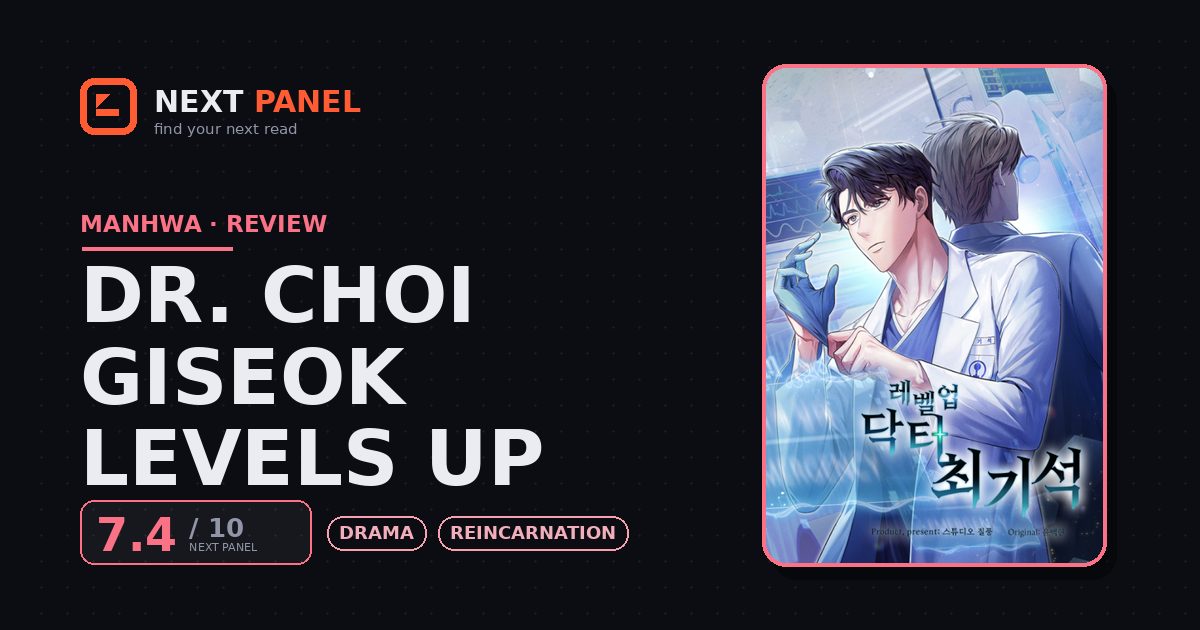
Is Dr. Choi Giseok Levels Up Worth Reading? Review & Where to Read
Quick Answer
If you want a medical drama that treats its stat-screen gimmick as a diagnostic tool instead of a cheat code, this delivers — just don't expect much beyond the lead surgeon's own arc.
Quick Verdict
“The system-screen gimmick would sink most medical webtoons; here it's the reason the surgery scenes actually hold tension instead of just being a montage.”
Best for: Readers who want a competence-driven power fantasy that's actually about surgical skill, not stat-grinding.
Not for: Readers who want fast-paced action or a large ensemble cast getting equal spotlight.
- Type
- Manhwa
- Genres
- Drama, Reincarnation
- Status
- Completed
- This review
- Minor Spoilers
- Author
- Jin Ju Yeon
- Artist
- Studio Zilpung
- Publisher
- Tapas Entertainment
- Platform
- Tapas
| Quick facts | |
|---|---|
| Format | Manhwa, 111 chapters |
| Run | 2022–2024 · completed |
| Community score | AniList 6.6 · MangaUpdates 6.5 |
| Where to read | Tapas — official |
Overview
Dr. Jung Haejin dies on his last day of surgical residency, hit by a truck outside the hospital where he'd just spent years grinding through 100-hour weeks. He wakes up in the body of Choi Giseok — a soon-to-be surgical intern who happens to be the recipient of Haejin's own transplanted heart. Along with a second shot at the career he never got to finish, Giseok inherits something stranger: holographic status screens only he can see, laying out vitals, hidden conditions, and diagnostic hints for every patient and colleague around him.
That's the whole engine of the story, and it's a smart one. Giseok isn't handed god-tier surgical hands or an instant medical license — he still has to operate, still has to convince skeptical attendings he knows what he's doing, and still has to survive a hospital hierarchy that doesn't care how many past lives he's lived. The screens tell him what's wrong. They don't fix it for him.
What it does well
The best thing this webtoon does is treat its gimmick as a diagnostic aid instead of a cheat code. A lot of "leveling up" medical stories let the power do the surgery; here, the status screen flags a problem the same way a good attending's instinct would, and Giseok still has to make the cut, manage the bleed, and read the room when a case goes sideways. That restraint is what keeps the surgical arcs tense instead of turning them into a highlight reel.
The case-of-the-week structure benefits from it too. Each patient gets enough medical specificity — the kind of detail that feels like someone actually did the research — that you buy the stakes even before Giseok's screen tells you how bad things are. And because he remembers being Haejin, a resident who burned out and died still feeling like he hadn't done enough, every save carries a weight that a purely video-game power fantasy wouldn't earn. The art supports all of this cleanly: operating-room panels stay legible and controlled even in high-tension moments, which matters a lot for a story that lives and dies on whether you can follow what's happening on the table.
Where it falls short
The cast around Giseok is the weak link. Fellow residents, nurses, and attendings are pleasant enough company for a chapter or two, but most of them don't carry much identity past their function in that week's case — swap two of the side doctors and you might not notice for a while. Hospital politics and rival-surgeon subplots show up regularly, but they tend to get resolved in a chapter or two rather than building into anything with real teeth, which makes the hospital feel smaller and less consequential than the premise suggests it could be.
The status screen itself also creeps outward as the series progresses. What starts as "I can see your vitals" edges toward broader, more convenient applications later on, and each expansion chips a little at the grounded, earned-competence feeling that made the earlier chapters work so well.
Verdict
This isn't a webtoon that reinvents the reincarnated-professional genre, but it executes its own idea with more discipline than most: the power is a tool, the surgery is still the surgeon's, and the emotional hook of a doctor getting one more shot at doing right by his patients holds up across all 111 chapters. If you want tight, competence-focused medical drama with just enough of a fantastical hook to raise the stakes, it's worth the read — just go in knowing the supporting cast is thinner than the lead's own arc.
Strengths & Weaknesses
Strengths
- The status-screen power stays a diagnostic tool, not a cheat code — it shows patient vitals but never performs the surgery for him, so every operation still feels earned.
- The case-of-the-week surgical arcs go into enough real detail to feel researched, with genuine tension over whether a procedure will go wrong.
- Giseok's memories of his past life as a burned-out resident give him a real emotional throughline instead of just narrating the rules of his new ability.
- The art keeps surgical scenes clean and easy to follow panel to panel, even when a scene is trying to convey real medical pressure.
Weaknesses
- Most of the supporting doctors and nurses stay flat — likable in the moment but interchangeable once their case wraps up.
- Hospital politics and rival-doctor conflicts tend to resolve faster than they're set up, which softens the tension they're supposed to build.
- As the series goes on, Giseok's ability quietly expands in scope in ways that edge toward overpowered, diluting the grounded feel of the earlier chapters.
Similar Titles
another reincarnated-doctor premise, with a similar second-chance emotional core
The Holy Power of Modern Medicine
same isekai-doctor hook of modern medical knowledge dropped into a world that doesn't have it
for the surgical tension without any fantasy gimmick at all
Where to Read Officially
| Platform | Format | Pricing | Region notes | Link |
|---|---|---|---|---|
| Tapas | Digital chapters | Free + Paid | Region availability varies | Open |
Frequently Asked Questions
Is Dr. Choi Giseok Levels Up finished?
Yes — it ran for 111 chapters and is complete, so there's no ongoing cliffhanger wait.
Do you need a medical background to follow it?
No. It explains procedures and terminology as it goes, and it's written for readers who enjoy medical dramas rather than actual clinicians.
Is this connected to any other 'Level Up' series?
No. Despite aggregator sites sometimes listing it as 'Level-Up Doctor,' it's a standalone story with no shared universe or characters.