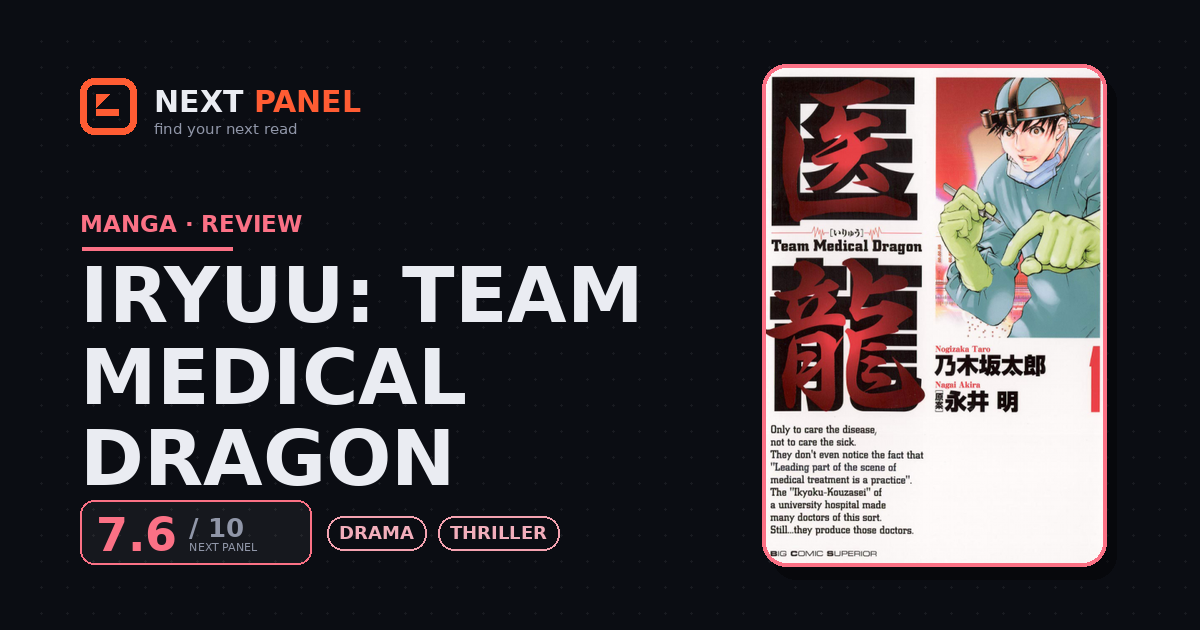
Is Iryuu: Team Medical Dragon Worth Reading? Review & Where to Read
Quick Answer
Yes, if you want a tense, well-researched medical drama that treats surgery like a thriller set piece. It runs long and leans on genre formula, but the operating-room tension rarely lets up.
Quick Verdict
“Every operation plays like a heist with a scalpel, and the hospital politics around them are just as sharp as the surgery itself.”
Best for: Readers who want a long, tense medical drama with real institutional stakes and don't mind a large recurring cast of doctors and administrators.
Not for: Readers who want a short, self-contained story or a lighter, more comedic take on hospital life.
- Type
- Manga
- Genres
- Drama, Thriller
- Status
- Completed
- This review
- Minor Spoilers
- Author
- Akira Nagai
- Artist
- Taro Nogizaka
- Publisher
- Shogakukan
| Quick facts | |
|---|---|
| Format | Manga (seinen), 210 chapters, 25 volumes |
| Run | 2002–2011 · completed |
| Community score | AniList 8.1 · MangaUpdates 8.5 |
| Content | Graphic surgical content, intense hospital politics |
Overview
Iryuu: Team Medical Dragon follows Ryutaro Asada, a brilliant but unaffiliated cardiovascular surgeon who works freelance rather than climb the ladder at any single hospital. Noboru Kato, an ambitious internist determined to fix the corrupt, politics-choked cardiovascular department at a major teaching hospital, recruits him to build a team capable of pulling off operations everyone else has written off as impossible. What follows is part surgical drama, part institutional thriller, as Asada's team takes on increasingly dangerous cases while navigating a hospital hierarchy more interested in protecting turf than saving patients.
Written by Akira Nagai and drawn by Taro Nogizaka, the manga ran in Big Comic Superior for nearly a decade and spun off multiple live-action TV adaptations in Japan, which says something about how well the central hook landed with readers.
What it does well
The operations themselves are the main event, and they're staged with real thriller instincts — a ticking clock, a technique nobody's tried before, a complication nobody saw coming. The manga treats surgery the way a heist movie treats a vault, and that framing makes even purely medical tension genuinely gripping.
What elevates it above a simple procedural is the hospital politics running alongside every operation. Department heads protect their turf, administrators bury inconvenient results, and Asada's team has to win battles in meeting rooms as often as operating rooms. That institutional layer gives the medical drama real stakes beyond "will the patient survive," and it's where a lot of the story's best tension actually lives.
Asada himself is a strong anchor for all of it. He has no interest in politics, prestige, or playing nice with people protecting their own careers, which makes him easy to root for and gives the story a clean moral throughline even as everything around him gets messier. The manga also clearly did real research into cardiovascular procedures, and it explains that research confidently enough that a reader with zero medical background can follow exactly what's at stake in any given operation.
Where it falls short
At 25 volumes, the underlying formula — new patient, new political obstacle, new operation everyone says can't be done — repeats often enough that some later arcs feel like variations on earlier ones rather than genuinely new territory. It's a long commitment for a structure that doesn't evolve as much as the page count might suggest.
The hospital's political ecosystem, while gripping, also produces a lot of side characters who exist mainly to represent a faction rather than to feel like fully realized people, and the emotional material around individual patients can lean melodramatic, particularly in flashback-heavy stretches.
Verdict
Iryuu: Team Medical Dragon is a long, confident medical thriller that treats both surgery and hospital politics as high-stakes drama worth taking seriously, and for most of its run that confidence pays off. Go in for a lengthy, formula-driven but consistently tense read, and it delivers; go in wanting something tighter or less repetitive over 25 volumes, and the length will wear on you.
Strengths & Weaknesses
Strengths
- Every major operation is staged and paced like a thriller set piece, with real tension over whether the team pulls it off, not just how.
- The hospital politics are just as gripping as the surgeries — corrupt department heads, budget battles, and career sabotage give the medical drama real institutional teeth.
- Ryutaro Asada works well as a lead precisely because he doesn't care about the politics around him, which gives the story a clear moral center to root for.
- The manga clearly did its homework on cardiovascular surgery, and that research shows in how confidently it explains complex procedures without losing momentum.
Weaknesses
- At 25 volumes, the formula of new patient, new political obstacle, new impossible surgery repeats often enough that some arcs feel like retreads of earlier ones.
- Several side characters exist mainly to represent a faction in the hospital's power struggles rather than to develop as people in their own right.
- The emotional beats around patients can tip into melodrama, especially in the flashback-heavy arcs.
Similar Titles
Say Hello to Black Jack
A grittier, more grounded look at Japan's hospital system through the eyes of a struggling young intern.
Osamu Tezuka's classic episodic take on a brilliant, unlicensed surgeon, for a shorter-chapter version of the same medical-thriller thrill.
A different genre entirely, but shares the hook of a gifted surgeon whose choices in the operating room have consequences far beyond the hospital.
Frequently Asked Questions
Is Iryuu: Team Medical Dragon finished?
Yes. It ran in Shogakukan's Big Comic Superior from 2002 to 2011 and is complete at 25 volumes.
Is there an official English release?
Not currently. There's no confirmed official English digital or print edition as of this review — worth re-checking down the line in case that changes.
Do I need a medical background to follow it?
No. The surgical procedures are explained clearly enough for a general audience, and the drama is built around the people in the room, not jargon.