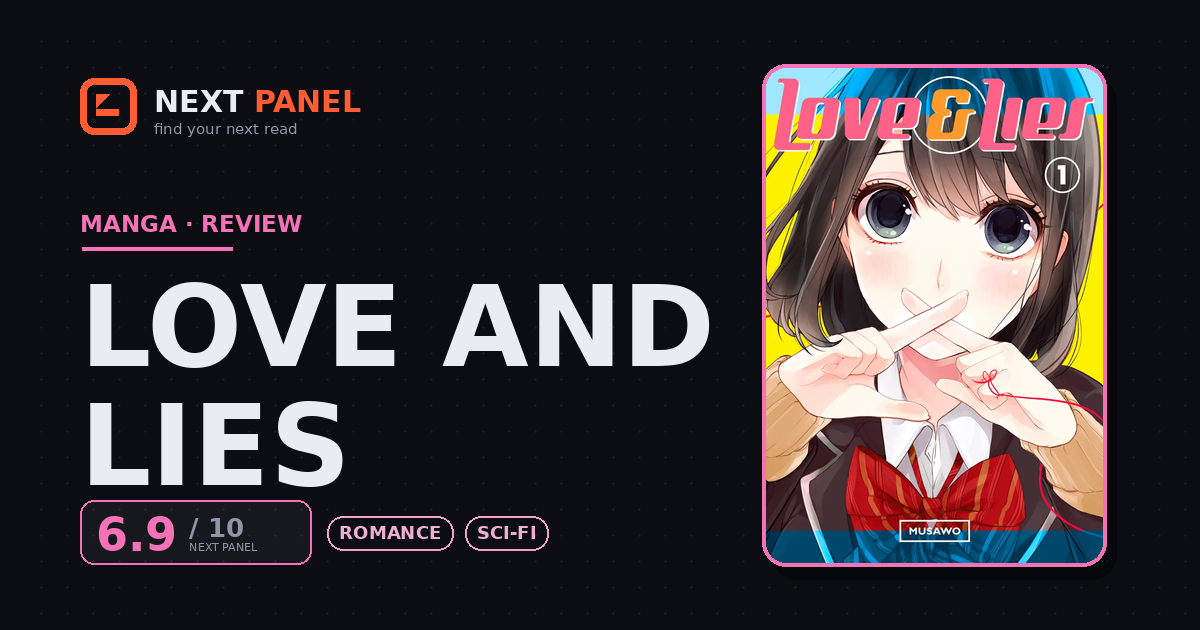
Is Love and Lies Worth Reading? Review & Where to Read
Quick Answer
Worth reading if you want a love triangle with genuine philosophical stakes about whether an arranged, data-driven match can compete with a feeling you chose yourself.
Quick Verdict
“Two people getting engaged by government algorithm sounds like a gimmick, but the manga takes the idea seriously enough to make you actually argue with yourself about which side is right.”
Best for: Readers who want a love triangle built on real thematic tension, not just misunderstandings and jealousy.
Not for: Readers who want their romance manga free of sci-fi premise or heavy-handed government intrigue.
- Type
- Manga
- Genres
- Romance, Sci-Fi
- Status
- Completed
- This review
- Minor Spoilers
- Author
- Musawo
- Publisher
- Kodansha
- Platform
- Kodansha
| Quick facts | |
|---|---|
| Format | Manga (shōnen) |
| Run | completed |
| Community score | MangaUpdates 6.5 |
| Content | None significant |
| Where to read | Kodansha — official |
Overview
In Musawo's near-future Japan, the government assigns every citizen a marriage partner the moment they turn 16, chosen by a compatibility algorithm built to raise the country's birth rate. Yukari has spent years quietly in love with his classmate Misaki, and on the eve of his own assignment, he finally works up the nerve to confess — only to learn the next day that the state has paired him with someone else entirely: his sickly, idealistic classmate Ririna. Love and Lies ran in Kodansha's Weekly Shonen Magazine from 2015 to 2022, including a hiatus partway through, and is licensed in English by Kodansha USA, with a 2017 anime adaptation covering part of the story.
What it does well
What elevates this above a standard love-triangle premise is how seriously the manga takes its own sci-fi conceit. The government-matching system isn't just a plot device to keep Yukari and Misaki apart — it's a genuine thematic question the story returns to again and again: is a relationship built on data and social utility less real than one built on a feeling you chose yourself? The manga doesn't pretend the answer is obvious, and that ambiguity is what keeps the love triangle from feeling like empty melodrama.
Ririna, the arranged partner, is the story's best asset. She could easily have been written as a simple obstacle standing between the reader's preferred couple, but instead she gets her own convictions, her own arc, and genuine reasons for believing in the system even as her feelings for Yukari complicate things. That choice makes the whole triangle feel more honest.
The dual-ending structure at the finale is a genuinely bold move — rather than picking a definitive winner and treating the other route as a loss, the manga commits fully to both outcomes as separate, valid endings, which suits a story built around the idea that there isn't one correct answer to who you're supposed to love.
Where it falls short
Yukari himself is the weak link for a lot of the run — he spends long stretches being pulled along by decisions other characters make rather than driving the story with his own convictions, which can be frustrating in a story so interested in the idea of choosing love deliberately. The government-conspiracy subplot around the marriage system's origins also doesn't always mesh smoothly with the character-driven romance; some chapters clearly exist to service worldbuilding rather than the emotional throughline.
The manga's hiatus left visible scars on its pacing too — the chapters after it returned move faster and feel more compressed than the careful buildup of the earlier volumes.
Verdict
This is a love triangle with real philosophical teeth, using its government-matchmaking premise to ask an honest question about what makes a relationship legitimate rather than just manufacturing jealousy for its own sake. The passive lead and some clunky worldbuilding hold it back from greatness, but the dual-ending finale and Ririna's arc make it worth seeing through.
Strengths & Weaknesses
Strengths
- The central premise — a government-mandated marriage system built to raise the birth rate — isn't just a setup for a love triangle, it's treated as a genuine philosophical question the story keeps circling back to: does a scientifically compatible match deserve the same weight as a feeling you chose for yourself?
- Ririna avoids the trap a lot of 'third wheel' love-interest characters fall into; her own arc and growing feelings are given enough space that she reads as a real person with her own stakes, not an obstacle for the main couple.
- The dual-ending structure at the finale is an unusually bold way to resolve a love triangle, letting the story commit fully to both outcomes instead of picking a single winner and undercutting the other route.
- The dystopian backdrop adds real tension to ordinary teenage scenes — a stolen conversation or a secret meeting carries actual risk in a way a typical school romance doesn't.
Weaknesses
- Yukari can be frustratingly passive for long stretches, letting the plot and the women around him drive decisions more than his own convictions do.
- The political and government-conspiracy subplot around the marriage system doesn't always integrate smoothly with the romance, and some chapters feel like they're serving worldbuilding at the expense of character.
- The series went on hiatus mid-run, and the compressed back stretch after it returned shows some pacing scars from that gap.
Similar Titles
Another romance built around an artificial social premise that raises real questions about choice and authenticity.
Domestic Girlfriend
Shares the messy, morally complicated love-triangle structure and willingness to sit in genuine emotional discomfort.
For readers who want a more grounded, premise-free version of the slow-burn high school romance at this story's core.
Where to Read Officially
| Platform | Format | Pricing | Region notes | Link |
|---|---|---|---|---|
| Kodansha | Digital chapters (first chapter free, volumes for purchase) | Free + Paid | Region availability varies | Open |
Frequently Asked Questions
Is Love and Lies licensed in English?
Yes — Kodansha USA publishes it, with the first chapter free and the rest sold by volume.
Is the series finished?
Yes, it ran from 2015 to 2022 (including a hiatus) across 13 volumes.
How does the ending work?
The manga has two official endings, printed as alternate versions of the final volume, so readers can choose which pairing's resolution to read.