Is Love★Com Worth Reading?
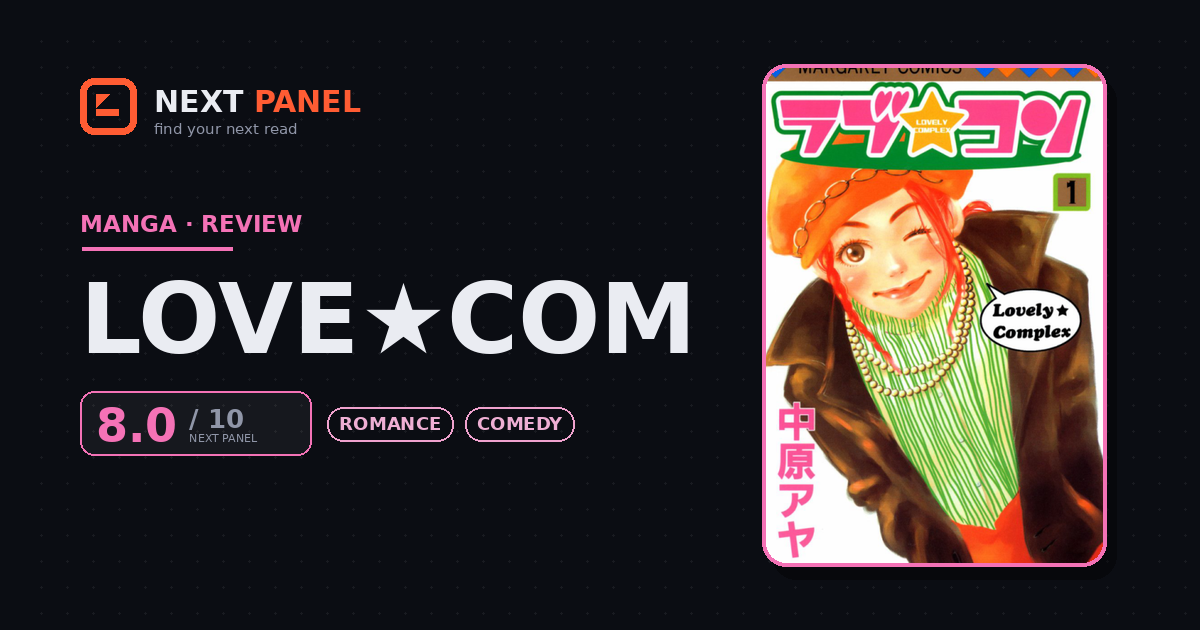
Quick Answer
Yes, especially for readers who want a classic, complete shojo romcom with real comic chemistry between its leads.
Quick Verdict
“Aya Nakahara's height-gap romantic comedy turns an old shojo joke, a tall girl and a short boy, into one of the genre's most durable will-they-won't-they pairings.”
Best for: Readers who want a classic, completed shojo romcom built on genuine comic chemistry between two loud, funny leads.
Not for: Readers who want a quiet, understated romance instead of a loud, gag-heavy comedy where the central relationship gets played for laughs as often as sincerity.
- Type
- Manga
- Genres
- Romance, Comedy
- Status
- Completed
- Author
- Aya Nakahara
- Publisher
- Shueisha (Bessatsu Margaret)
- Platform
- VIZ Media
| Quick facts | |
|---|---|
| Format | Manga, 72 chapters, 17 volumes |
| Run | 2001–2007 · completed |
| Community score | AniList 8.1 |
| Content | None significant |
| Where to read | VIZ Media — official |
Overview
Love★Com follows Risa Koizumi, the tallest girl in her class, and Atsushi Otani, the shortest boy, who get lumped together as a comedy duo by their classmates because of their mismatched height and matching bluntness. What starts as a running classroom joke slowly turns into an actual will-they-won't-they romance as the two spend three years of high school bickering, supporting each other's crushes on other people, and gradually realizing they'd rather be arguing with each other than with anyone else. Aya Nakahara's manga ran in Shueisha's Bessatsu Margaret from 2001 to 2007, won the Shogakukan Manga Award for shojo manga, and wrapped as a complete 17-volume series. VIZ Media publishes the official English translation, and the manga also spawned a 2007 anime adaptation that broadly follows the same arc.
What it does well
The comedy is the reason Love★Com has stayed in print for two decades. Nakahara writes Risa and Otani's bickering with real rhythm, and the height-gap gag never curdles into mockery because both characters get to be funny at each other's expense in roughly equal measure. The slow-burn structure works because the manga spends real time on both leads' insecurities. Risa's height and Otani's height are each played as sources of specific, sympathetic anxiety rather than pure punchlines, which gives the eventual romance actual weight once it arrives. The supporting cast, especially the friend group that spends the first several volumes shipping Risa and Otani together long before either admits anything, adds a layer of dramatic irony that keeps even the slower chapters entertaining. And because the series is complete, the payoff the whole story is building toward actually arrives.
Where it falls short
The comedy-first tone means the romance takes a genuinely long time to become the story's main focus, and readers expecting a more conventional slow-burn structure may find the constant gag-interruptions frustrating before the shift finally happens. Some of the supporting romantic subplots, particularly Risa and Otani's respective crushes on other people early on, run long enough that they can feel like padding in hindsight. The very broad, exaggerated comedy style, full of shouting, sight gags, and slapstick, is also a matter of taste rather than a flaw in execution. Readers who prefer subtler shojo romance may find the constant loud reactions and sight gags wear thin well before volume 17.
Verdict
Love★Com earns its status as a shojo classic by committing fully to its bickering-duo premise and trusting that commitment to eventually pay off in a real romance. It's a complete series that pays off its own setup, which makes it an easy, low-risk recommendation for readers who want proof that a comedy-first premise can still land something sincere.
Strengths & Weaknesses
Strengths
- Nakahara writes Risa and Otani's bickering with real rhythm, and the height-gap gag never curdles into mockery since both leads are funny at each other's expense in equal measure.
- Both leads' height-related insecurities are played as specific and sympathetic rather than pure punchlines, giving the eventual romance real weight once it arrives.
- The friend group spends volumes shipping Risa and Otani long before either admits anything, adding dramatic irony that keeps even slower chapters entertaining.
- Being a complete series, the payoff the whole story builds toward actually arrives instead of trailing off unresolved.
Weaknesses
- The comedy-first tone means the romance takes a genuinely long time to become the story's main focus, which can frustrate readers expecting a more conventional slow burn.
- Some supporting romantic subplots, particularly the leads' early crushes on other people, run long enough to feel like padding in hindsight.
- The broad, exaggerated comedy style is a matter of taste, and readers who prefer subtler shojo romance may find the constant loud reactions wear thin.
Similar Titles
Another comedy-first shojo classic that plays its ensemble cast for laughs as much as romance.
Shares the slow-burn structure, though with a gentler, quieter tone than Love★Com's loud comedy.
A similarly gag-heavy shojo romance built around two mismatched, strong-willed leads.
Where to Read Officially
| Platform | Format | Pricing | Region notes | Link |
|---|---|---|---|---|
| VIZ Media | Print & Digital | Paid | Region availability varies | Open |
Frequently Asked Questions
Is Love★Com finished?
Yes, it's a complete 17-volume series, and VIZ Media publishes the full English translation.
Is this the same as Lovely Complex?
Yes, Lovely Complex is the original Japanese title, and Love★Com is how it's marketed in English.
Is this mostly comedy or mostly romance?
Both, but it leans comedy-first before the romance becomes the story's clear focus as the series progresses.