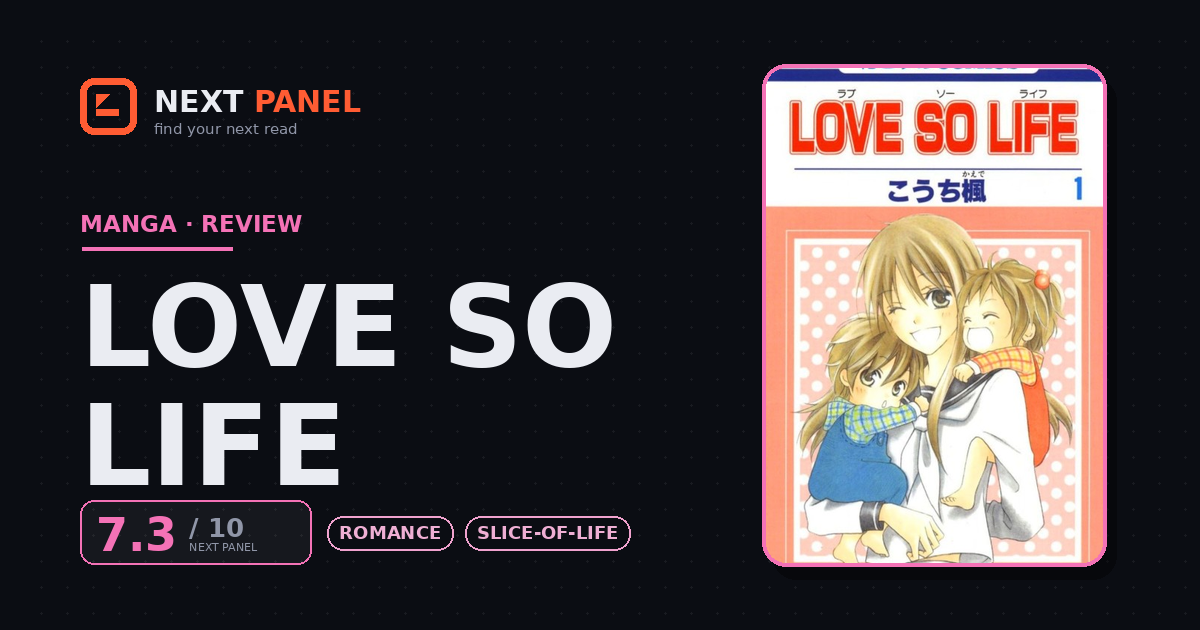
Is Love So Life Worth Reading? Review & Where to Read
Quick Answer
Yes, if you want a shojo romance that spends real time on caretaking and found family before it settles into its central couple. It's more domestic drama than swoon-first romance.
Quick Verdict
“The twins get more emotional investment than the romance for a long stretch, and that's actually the manga's strongest angle.”
Best for: Readers who want a domestic, caretaking-focused shojo drama with a slow-building romance layered on top.
Not for: Readers who want the central romance to be the immediate focus rather than something that develops gradually alongside a family drama.
- Type
- Manga
- Genres
- Romance, Slice of Life
- Status
- Completed
- This review
- Minor Spoilers
- Author
- Kaede Kouchi
- Publisher
- Shueisha
| Quick facts | |
|---|---|
| Format | Manga (shōjo), 111 chapters, 17 volumes |
| Run | 2008–2015 · completed |
| Community score | AniList 8.0 · MangaUpdates 8.7 |
Overview
Love So Life follows Shiharu Nakamura, a high schooler who grew up in an orphanage and now works at a daycare to support herself. When she takes on the daily care of Aoshi and Aoi, twin boys who lost their parents, her attachment to them pulls her into the orbit of their guardian, Ao Kiryu. What starts as a story about caretaking gradually becomes a slow-burn romance layered on top of a found-family drama.
What it does well
The strongest choice Kaede Kouchi makes is treating the twins and Shiharu's bond with them as just as important as the eventual romance, at least for a long stretch of the story. Shiharu's motivation isn't chasing a love interest; it's genuine care for two kids she's grown attached to, and that gives the manga real emotional stakes that don't depend on the central couple actually getting together.
When the romance does develop, it's built on shared routine and responsibility rather than sudden sparks, which suits the domestic tone of the series. Watching Shiharu and Ao's relationship grow out of co-parenting duties feels more grounded than a lot of shojo romances that skip straight to attraction.
The twins themselves are a highlight. Aoshi and Aoi get distinct personalities and their own small arcs rather than existing purely to motivate the adults around them, which keeps the found-family thread compelling even in stretches where the romance takes a back seat.
The art is well suited to this tone, rendering quiet domestic moments, meals, bedtime routines, small arguments, with real warmth without tipping into saccharine territory.
Where it falls short
The pacing is the main hurdle. If you come in expecting a shojo romance to take center stage immediately, the long stretch spent on caretaking and family dynamics before the central couple's relationship really develops will test your patience.
A few plot turns meant to escalate tension rely more on convenient timing and coincidence than earned drama, which can undercut some of the stakes. And across 17 volumes, a handful of arcs run longer than the conflict at their center really needs, especially in the later volumes, where certain obstacles feel recycled from earlier chapters.
Verdict
Love So Life is a patient, domestic shojo drama that earns its slow-burn romance by grounding it in genuine caretaking and found family first. It asks for real patience before the romance becomes central, and some later arcs overstay their welcome, but the twins and the sincerity of Shiharu's arc make it a worthwhile, gentler alternative to faster-paced shojo romances.
Strengths & Weaknesses
Strengths
- Shiharu's motivation, raising two orphaned twins she's grown attached to at her daycare job, gives the story real emotional stakes beyond the romance plot.
- The slow build of the central relationship feels grounded in shared responsibility and daily routine rather than sudden attraction.
- The twins are written with real personality instead of functioning as pure plot devices, which keeps the found-family thread engaging on its own.
- The art handles quiet domestic scenes well, giving small caretaking moments real warmth without over-sentimentalizing them.
Weaknesses
- The romance takes a long time to become the story's central focus, which will frustrate readers expecting a more traditional shojo love story from the start.
- Some plot developments meant to raise the stakes lean on convenient timing rather than earned tension.
- The long 17-volume run means a handful of arcs stretch out conflicts that could have resolved faster without losing anything.
Similar Titles
Similar interest in caretaking and found family as the emotional core of the story.
Shares a patient, slow-build approach to shojo romance over quick declarations.
Frequently Asked Questions
Is this mainly a romance or a family drama?
Both, but the caretaking and found-family elements carry a lot of the early volumes before the romance becomes the clear focus.
Is the manga complete?
Yes, it ran to completion across 17 volumes.
Is there an official English release?
Not currently — there's no licensed English digital or print release at this time, so there's no official link here.