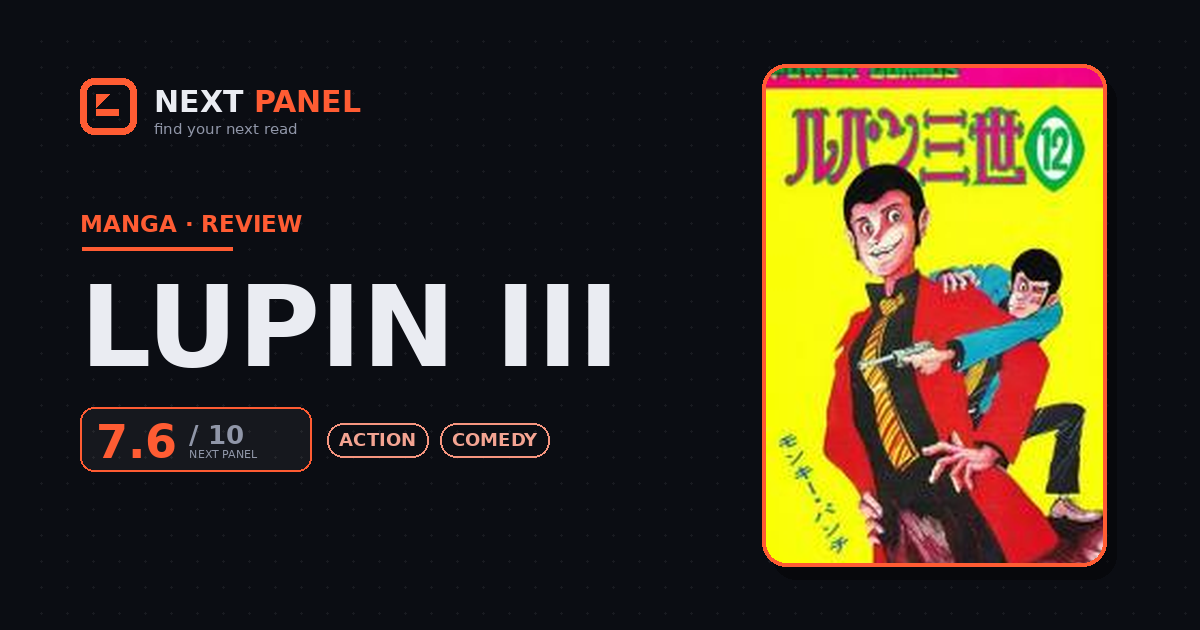
Is Lupin III Worth Reading? Review & Where to Read
Quick Answer
If you know Lupin only from the anime's cleaner adventures, the original manga is a rawer, weirder, funnier experience worth seeing for yourself.
Quick Verdict
“The anime sanded down the edges; the manga is where you find out how sharp they originally were.”
Best for: Readers who want the original, rougher-edged source material behind a huge franchise, with dark comedy and genuine unpredictability.
Not for: Readers who want the anime's cleaner, more family-friendly tone, or who are sensitive to crude, era-typical adult humor.
- Type
- Manga
- Genres
- Action, Comedy
- Status
- Completed
- This review
- Minor Spoilers
- Author
- Monkey Punch
- Publisher
- Futabasha
- Platform
- Seven Seas
| Quick facts | |
|---|---|
| Format | Manga (seinen), 5 chapters |
| Run | completed |
| Content | Crude humor, sexual content, violence |
Overview
Lupin III follows Arsène Lupin III, grandson of the classic gentleman thief, as he pulls off increasingly outrageous heists alongside his loyal, itchy-fingered partner Jigen, the samurai swordsman Goemon, and the double-crossing femme fatale Fujiko — all while Interpol inspector Zenigata chases him with a doomed, obsessive persistence. If your only exposure to Lupin is the long-running, family-friendly anime franchise, Monkey Punch's original manga is a genuine surprise: rougher, funnier, more sexual, and considerably more unpredictable.
What it does well
The biggest draw here is Monkey Punch's art and energy, which still feels loose and alive in a way a lot of manga from this era doesn't. His action scenes have real motion and style, and his character acting sells Lupin as a genuinely chaotic, funny presence rather than the smoothed-out rogue the anime often settles for. This version of Lupin is selfish, horny, and gleefully willing to betray his own crew for a payoff, and that unpredictability makes every caper feel like it could genuinely go anywhere — including, often, somewhere much darker or bleaker than you'd expect from the tone of the opening pages.
The supporting cast holds up their end too: Jigen and Goemon each get moments to shine as more than sidekicks, Fujiko's constant betrayals are a fun running wrinkle in the group dynamic, and Zenigata's dogged, doomed chase after Lupin remains a genuinely funny throughline across the whole series.
Where it falls short
The humor leans crude and sexual often enough that it's a real barrier for a lot of readers — this is very much a product of its era, and some of it hasn't aged well by any measure. The tonal whiplash between broad comedy and surprisingly dark, sometimes downbeat endings can also feel inconsistent if you're expecting a single, steady register throughout. And because it's told as a loose string of episodic capers across a long run, it doesn't offer the kind of single satisfying arc a modern reader might expect — it's more a collection of adventures than one throughline.
Verdict
Lupin III's manga is a rawer, weirder, and often funnier experience than the character's more famous anime incarnations, and it's worth reading specifically to see where all of it started. Go in ready for its era-specific crudeness, and it's a genuinely entertaining ride.
Strengths & Weaknesses
Strengths
- Monkey Punch's art is loose, expressive, and stylish in a way that still feels distinct decades later, full of exaggerated motion and confident linework.
- Lupin himself is funnier and more unpredictable here than in most of the sanitized anime adaptations — genuinely selfish, horny, and gleefully amoral instead of just charmingly roguish.
- The heist plots are inventive and often darkly funny, willing to end on notes the franchise's later, cleaner adaptations would never risk.
- Zenigata's obsessive, doomed pursuit of Lupin has real comic energy that holds up as the franchise's signature dynamic.
Weaknesses
- The humor is frequently crude and sexual in a way that's dated even by the standards of other 60s-70s manga, and it won't land for every reader.
- The tone swings wildly between goofy comedy and surprisingly dark or bleak endings, which can feel inconsistent if you're expecting one register.
- As an episodic, decades-spanning series, the reading experience is less a single arc than a loose collection of capers.
Similar Titles
City Hunter
A spiritual successor in tone, mixing stylish action with unapologetic sex-comedy humor.
Cat's Eye
Another classic thief-focused caper series, with a gentler tone and more romantic-comedy structure.
Shares the same era's confident, cool-headed professional-criminal protagonist, minus the comedy.
Frequently Asked Questions
Is the manga very different from the anime?
Yes — the manga is rawer, more sexually explicit, and darker in tone than most of the long-running anime, which softened Lupin considerably for broader audiences.
Do I need to read it in order?
Not strictly — it's largely episodic capers, though reading in publication order helps track recurring characters and running gags.
Is Lupin III complete?
The original Monkey Punch manga is complete, though the character has continued in many spin-off manga and anime by other creators since.