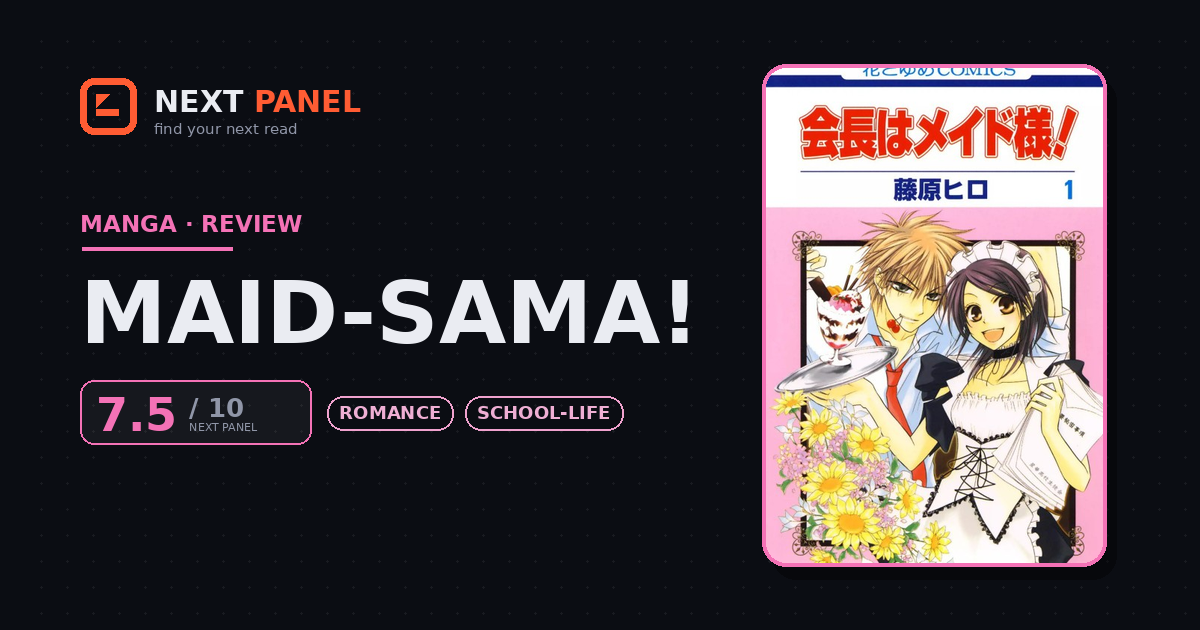
Is Maid-sama! Worth Reading? Review & Where to Read
Quick Answer
Yes, if you want a shoujo rom-com with a genuinely strong lead. Misaki carries the series, and her dynamic with Usui is funnier and less saccharine than a lot of the genre's love interests.
Quick Verdict
“Misaki Ayuzawa is a better reason to read this than Usui is — a rare shoujo lead whose toughness comes from real stakes instead of just being a personality trait.”
Best for: Readers who want a classic school-set shoujo rom-com anchored by a strong-willed, three-dimensional female lead.
Not for: Readers who want a love interest whose romantic pursuit respects boundaries rather than constantly overriding them for comic effect.
- Type
- Manga
- Genres
- School Life, Romance
- Status
- Completed
- This review
- Minor Spoilers
- Author
- Hiro Fujiwara
- Publisher
- Hakusensha
- Platform
- VIZ
| Quick facts | |
|---|---|
| Format | Manga (shōjo), 99 chapters, 18 volumes |
| Run | 2005–2013 · completed |
| Community score | AniList 8.1 · MangaUpdates 8.3 |
| Content | None significant |
| Where to read | VIZ — official |
Overview
Misaki Ayuzawa runs Seika High School's student council with an iron fist, determined to make the newly co-ed former all-boys school safe and respectable for its small population of girls. What almost nobody knows is that she also works part-time at a maid café to support her broke, single-parent family — a secret that Takumi Usui, the school's most popular and most infuriating boy, stumbles onto almost by accident. Hiro Fujiwara's Maid-sama! ran in Hakusensha's LaLa magazine from 2005 to 2013 and is a genuine staple of 2000s shoujo romantic comedy.
What it does well
Misaki is the reason this series holds up. A lot of shoujo rom-com leads are defined mainly by how the love interest sees them; Misaki has a life of her own before Usui ever shows up — a mission to protect her school's girls, a family she's quietly supporting, a chip on her shoulder about men that comes from a specific, real place (her father's abandonment and debt). That gives her toughness weight instead of making it just a genre trope, and it makes her reactions to Usui land as character, not just as rom-com friction.
Usui himself helps by not being the usual smooth shoujo prince. He's odd, invasive, and frequently just strange in ways that are genuinely funny rather than swoon-bait, and the push-pull between Misaki's public image and the private self Usui alone gets to see gives their slow-burn romance real structure. The tone throughout stays light and funny without needing manufactured crises to keep you reading — it trusts the central relationship to carry the story, and mostly, it does.
Where it falls short
The elephant in the room for modern readers is Usui's approach to courtship: he shows up in Misaki's apartment uninvited, ignores her stated boundaries repeatedly, and the story treats this as charming rather than something to examine. It's a product of its genre and era, but it's worth knowing about before you start, since it doesn't really let up.
Once Usui discovers Misaki's maid job fairly early in the story, the central secret that generates a lot of the early tension loses most of its stakes, and the later volumes run more on general school rom-com incident than the sharper hook that opened it. The supporting cast's own romances also get comparatively little room; this is very much a two-lead show, and anyone hoping for a fuller ensemble may come away wanting more.
Verdict
Maid-sama! earns its status as a shoujo classic mostly on the strength of Misaki herself — a lead whose backbone comes from something real. If you can look past Usui's more dated courtship habits, it's a genuinely funny, well-paced romantic comedy worth the read.
Strengths & Weaknesses
Strengths
- Misaki is a genuinely strong, funny lead whose toughness is tied to real stakes — her family's poverty and her absent father — rather than being just a rom-com quirk.
- Usui subverts the standard shoujo 'perfect prince' love interest by being odd, teasing, and often just plain weird instead of conventionally smooth.
- The tension between Misaki's public persona as student council president and her private life as a maid café worker gives the central will-they-won't-they real structural stakes, not just delay tactics.
- The tone stays consistently funny and breezy without leaning on manufactured melodrama to keep readers invested.
Weaknesses
- Usui's constant boundary-crossing — showing up uninvited, pushing past Misaki's clearly stated limits for comic or romantic effect — reads as genre convention the story doesn't meaningfully question, and it hasn't aged perfectly for every reader.
- Side-character romances get noticeably less development than the central Misaki/Usui pairing.
- The core secret that kicks off the plot, Misaki's maid job, loses most of its tension once it's discovered early on, and the back stretch leans more on general rom-com incident than the original hook.
Similar Titles
similar battle-of-wits rom-com energy between two strong-willed leads
shares a school-set rom-com setup with a lead who subverts typical shoujo gender expectations
another shoujo classic pairing genuine emotional stakes with romance and comedy
Where to Read Officially
| Platform | Format | Pricing | Region notes | Link |
|---|---|---|---|---|
| VIZ | Print & digital volumes (2-in-1 editions) | Paid | Region availability varies | Open |
Frequently Asked Questions
Is Maid-sama! finished?
Yes, it's complete at 18 volumes in Japanese, collected into 9 English volumes in VIZ's 2-in-1 editions.
Does Maid-sama! have an anime?
Yes, a 26-episode anime adapted the earlier part of the story, but the manga continues well past where the anime ends.
Is Maid-sama! appropriate for younger shoujo readers?
Generally yes — it's a fairly clean, school-set romantic comedy without major mature content, though Usui's persistent boundary-pushing is worth knowing about going in.