Is Me and the Devil Blues Worth Reading? Review & Where to Read
Quick Answer
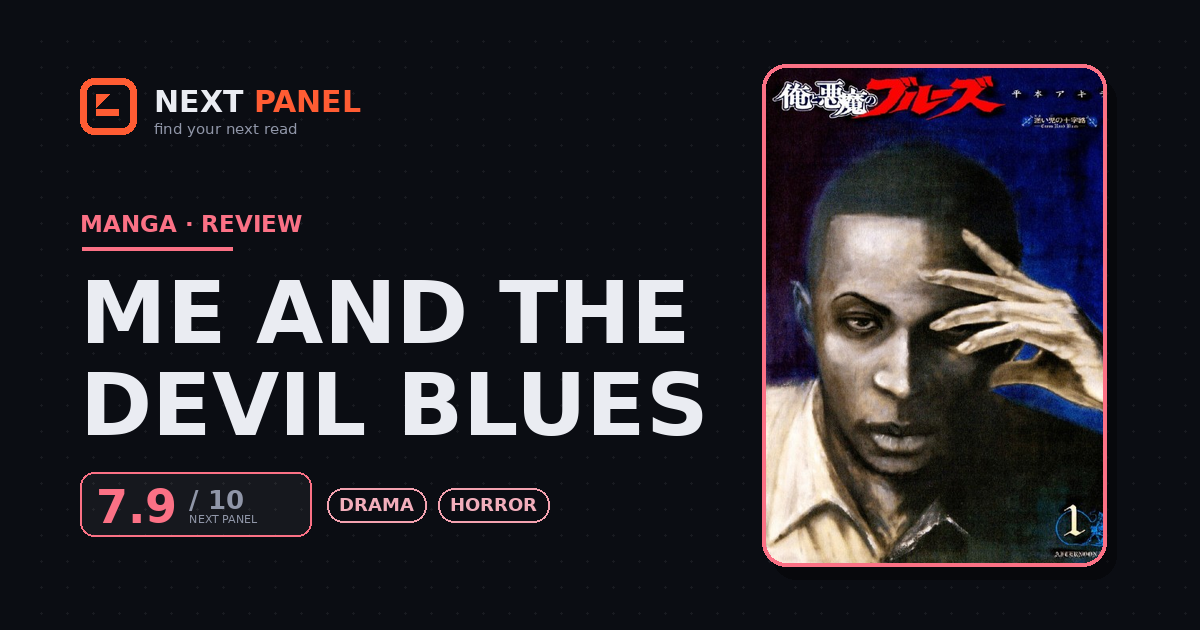
Yes, if you want a genuinely striking, mythologized take on the Robert Johnson crossroads legend with art that holds up against any seinen manga you'd name. Just know going in that the story was left unfinished.
Quick Verdict
“It builds one of the best-looking manga takes on American musical myth you'll find, and then stops before it ever tells you how the myth ends.”
Best for: Readers who want a moody, historically-grounded horror-drama about the Robert Johnson legend and can accept an unfinished story.
Not for: Readers who need a complete, resolved narrative rather than a striking fragment.
- Type
- Manga
- Genres
- Drama, Horror
- Status
- On Hiatus
- Author
- Akira Hiramoto
- Publisher
- Kodansha (Monthly Afternoon / Young Magazine the 3rd)
- Platform
- Del Rey Manga
| Quick facts | |
|---|---|
| Format | Manga (seinen) |
| Run | 2003–present · on hiatus |
| Community score | AniList 7.9 |
| Content | Racial violence, period-accurate racism, body horror |
| Where to read | Del Rey Manga — official |
Overview
RJ is a mediocre blues musician until, as the story goes, he sells his soul to the devil at a Mississippi crossroads and comes back able to play like nothing anyone has heard before. Akira Hiramoto's Me and the Devil Blues takes the real urban legend around musician Robert Johnson and turns it into a mythologized horror-drama, following RJ through Depression-era Mississippi as his talent, and his luck, both start to feel less and less like his own. Hiramoto serialized the manga in Kodansha's Monthly Afternoon from 2003 to 2008, later resuming in Young Magazine the 3rd from 2014 to 2017.
What it does well
The art is the first thing that'll grab you — Hiramoto renders 1930s Mississippi with a density most historical manga doesn't attempt, from the dust and sweat of a juke joint to the specific violence of the period, and it never feels like generic period backdrop. That same care extends to the horror elements: the manga stays genuinely ambiguous about whether RJ's transformation is supernatural or a symptom of trauma and delusion, and it's smart enough not to resolve that tension into a simple answer.
The manga also doesn't flinch from the period's racial violence, which gives the story a weight a lot of stylized historical fiction avoids by keeping things comfortable. That commitment, paired with the visual craft, is exactly what earned it a 2009 Glyph Comics Award and a spot on School Library Journal's best adult books for teens — recognition that tracks with how genuinely well-made the material is.
Where it falls short
The unavoidable issue is that this manga isn't finished, and there's no getting around it. After an initial hiatus in 2008 and a brief 2014 revival, it lapsed again into what's been an indefinite hiatus since 2017, with no ending currently in print. The English release from Del Rey only covers the earlier volumes and has been out of print for years, so even finding what does exist takes real effort. And because the story stops rather than concludes, some of its central ambiguities read less like deliberate mystery and more like a manga that simply never got to answer its own questions.
Verdict
Me and the Devil Blues is one of the best-looking, most seriously-researched takes on American musical myth in manga, and that makes its unfinished status genuinely frustrating rather than just a footnote. If you want a striking, ambiguous horror-drama and can accept it as a fragment rather than a complete story, it's worth tracking down. If you need a real ending, this isn't going to give you one.
Strengths & Weaknesses
Strengths
- Hiramoto's art is genuinely exceptional here, rendering 1930s Mississippi and its dust, sweat, and violence with a density and precision that a lot of historical fiction manga doesn't attempt.
- It treats the crossroads legend as something the story itself stays ambiguous about, letting RJ's transformation read as possibly supernatural and possibly just trauma and delusion, which is a smarter choice than committing to either.
- It doesn't soften the period's racial violence for easier reading, giving the story real weight instead of using 1930s Mississippi as generic backdrop.
- It won the 2009 Glyph Comics Award for Best Reprint Publication and was named one of School Library Journal's best adult books for high schoolers, recognition that reflects real craft rather than just novelty.
Weaknesses
- The single biggest issue: the manga was never finished. It went on hiatus in 2008, resumed briefly in 2014, and lapsed into what looks like permanent hiatus again in 2017, so the English release stops without a real ending.
- The Del Rey English edition covers only the earlier volumes and has been out of print for years, making a legal copy genuinely hard to find.
- Because it's unresolved, some of its central questions about RJ's fate and the nature of his deal are left open in a way that reads as incompleteness rather than intentional ambiguity.
Similar Titles
Another visually stunning, historically-rooted seinen series that has also gone on extended, likely permanent hiatus.
A completely different tone, but the same artist's more famous, fully available work.
Where to Read Officially
| Platform | Format | Pricing | Region notes | Link |
|---|---|---|---|---|
| Del Rey Manga | Print volumes (out of print) | Paid | Region availability varies | Open |
Frequently Asked Questions
Is Me and the Devil Blues finished?
No. It went on hiatus in 2008, had a brief revival from 2014-2017, and has been on indefinite hiatus since, with no ending currently published.
Is Me and the Devil Blues based on a true story?
It's a fictionalized, mythologized take on real blues musician Robert Johnson and the crossroads legend associated with him, not a factual biography.
Is Me and the Devil Blues available in English?
Del Rey Manga published two volumes in English in 2008, but they've been out of print for years, so finding a legal copy takes some searching.