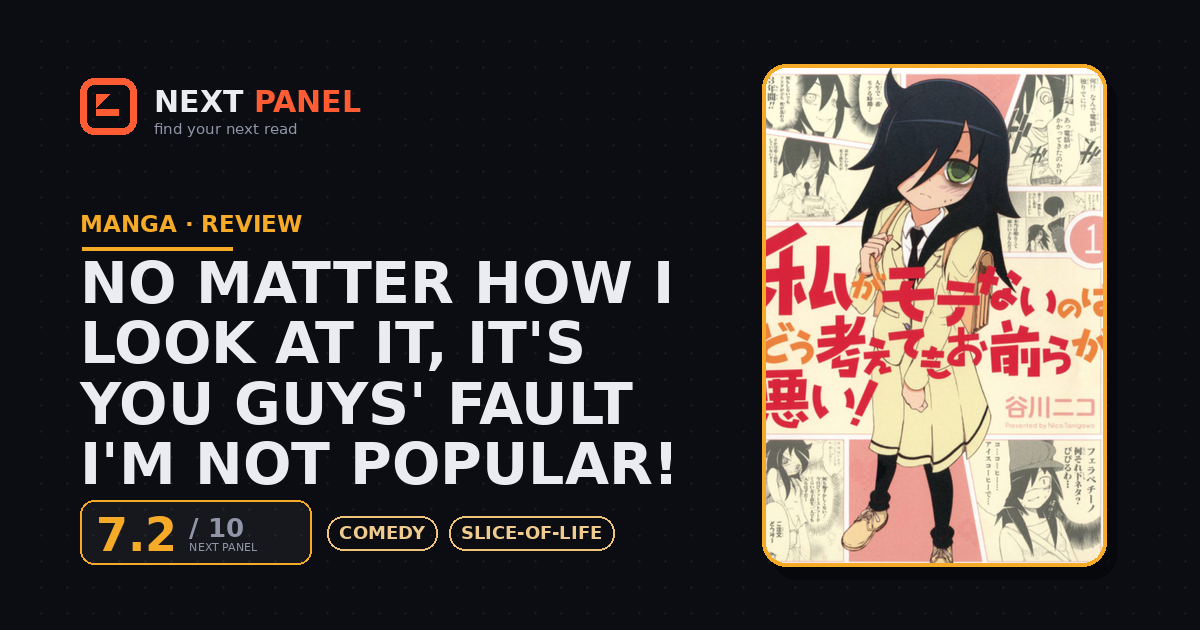
Is No Matter How I Look at It, It's You Guys' Fault I'm Not Popular! Worth Reading? Review & Where to Read
Quick Answer
Yes, if cringe comedy built on a character who never quite learns her lesson is your thing — it's one of the sharper social-anxiety comedies out there, though it can be genuinely uncomfortable to read.
Quick Verdict
“It's less a romance manga about a girl who can't get a boyfriend and more a character study of denial, and it's funniest exactly when it's most cringe-inducing.”
Best for: Readers who enjoy comedy built on secondhand embarrassment and a lead character who's self-aware just enough to make her worse decisions sting.
Not for: Readers who need a protagonist to actively grow and change chapter over chapter, rather than one who mostly circles the same flaws.
- Type
- Manga
- Genres
- Slice of Life, Comedy
- Status
- Ongoing
- This review
- Minor Spoilers
- Author
- Nico Tanigawa
- Publisher
- Yen Press
- Platform
- Yen Press
| Quick facts | |
|---|---|
| Format | Manga |
| Run | 2011–present · ongoing |
| Community score | AniList 7.4 |
| Where to read | Yen Press — official |
Overview
Tomoko Kuroki spends the last day of middle school convinced she's about to become popular the second high school starts. She is, immediately and repeatedly, wrong. WataMote follows her through that mismatch between her plans and reality, mining comedy from exactly how she copes with failure: not by changing, but by finding someone else to blame.
What it does well
The comedy works because it's specific. Tomoko doesn't fail in broad, cartoonish ways — she fails in small, painfully recognizable ways, misreading a social cue by exactly the wrong amount or overthinking a five-second interaction into a doomed scheme. Her internal monologue carries most of the book, and Nico Tanigawa is very good at making her rationalizations funny without making her simply pathetic. You're laughing at the gap between what she tells herself and what actually happened, and that gap is drawn precisely enough to sting.
Her friendship with Yuu Naruse is what keeps the book from being comedy at Tomoko's expense and nothing else. It's a real relationship with real history, and it gives the manga an emotional throughline that the gag-a-chapter structure alone wouldn't provide. The series is also honestly clear-eyed about how hard entrenched social habits are to break — Tomoko wants to change, in her way, and the manga doesn't pretend that wanting it is the same as doing it.
Where it falls short
The structure is repetitive by design — plan, backfire, blame everyone but herself — and if you read a lot of volumes in one sitting, that rhythm can start to wear thin. Readers looking for a protagonist who visibly grows chapter over chapter will find the pacing frustrating; change here comes in inches, not arcs, and some stretches barely move the needle at all.
The humor also leans hard on secondhand embarrassment, and how well that lands depends entirely on your tolerance for cringe. There are chapters that are less "funny-awkward" and more just uncomfortable to sit through, and the manga doesn't always know when it's crossed that line.
Verdict
WataMote is a sharper, sadder comedy than its premise lets on — less a story about a girl who can't get a boyfriend, more a study of denial and the small, specific ways people avoid looking at their own flaws. If cringe comedy with a real emotional core sounds appealing, it's one of the better examples of the genre.
Strengths & Weaknesses
Strengths
- Tomoko's internal monologue is the comedic engine of the series, and it's consistently sharp about how she rationalizes every failure as someone else's fault.
- The cringe comedy lands because it's specific — small, painfully recognizable social miscalculations rather than broad slapstick.
- Her friendship with Yuu gives the book a genuine emotional anchor, so the comedy doesn't run entirely on humiliation.
- It's unusually honest about how hard it is to change ingrained social habits, even when the character clearly wants to.
Weaknesses
- The one-joke structure — plan backfires, blame everyone else, repeat — can feel repetitive if you binge a lot of volumes back to back.
- Tomoko's growth is slow by design, and readers hoping for a steady character arc may find the pacing frustrating.
- Some of the humor leans on secondhand embarrassment hard enough that it stops being funny and starts being simply uncomfortable, depending on your tolerance.
Similar Titles
same low-key, character-flaw-driven comedy energy
another comedy built around one character's specific, exhausting social pattern
similar social-anxiety comedy, told from the more sympathetic side of the awkwardness
Where to Read Officially
| Platform | Format | Pricing | Region notes | Link |
|---|---|---|---|---|
| Yen Press | Print & digital volumes | Paid | Region availability varies | Open |
Frequently Asked Questions
Is WataMote a romance manga?
Not really — it's marketed with romance-comedy trappings, but it's much more a character-study comedy about social anxiety and denial than an actual love story.
Is the manga finished?
No, it's still ongoing, with dozens of volumes released so far and more on the way from Yen Press.
Do I need to watch the anime first?
No — the manga covers far more ground than the single anime season and stands fine on its own.