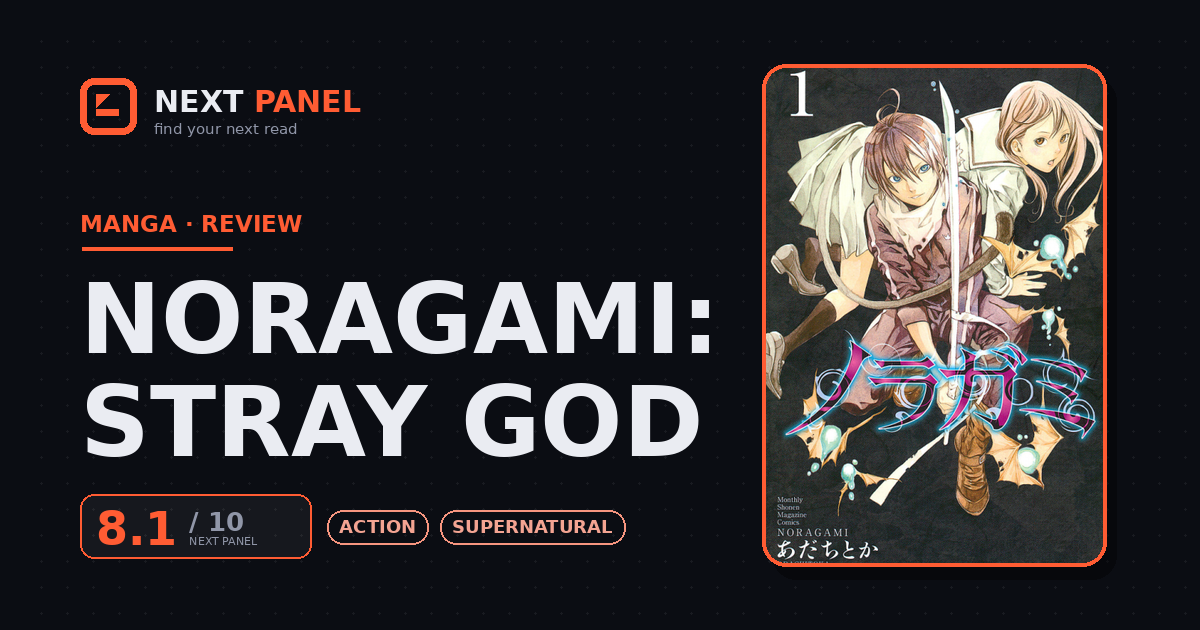
Is Noragami: Stray God Worth Reading? Review & Where to Read
Quick Answer
Yes, especially if you want supernatural action with real emotional weight. The god-for-hire premise is fun, the art is sharp in the fights, and the central trio anchors everything. The mythology gets tangled later on, but the payoffs are worth it.
Quick Verdict
“The god-for-hire hook is fun, but it's the bond between Yato, Hiyori, and Yukine that keeps you reading — and guts you when it counts. One of the better supernatural shonen out there.”
Best for: Readers who want supernatural action with real emotional stakes and a tight central cast they can get attached to.
Not for: Readers who want a simple, self-contained story and a plot that stays easy to follow.
- Type
- Manga
- Genres
- Action, Supernatural
- Status
- Completed
- This review
- Minor Spoilers
- Author
- Adachitoka
- Publisher
- Kodansha
- Platform
- Kodansha
| Quick facts | |
|---|---|
| Format | Manga (shōnen), 109 chapters, 27 volumes |
| Run | 2010–2024 · completed |
| Community score | AniList 8.2 · MangaUpdates 8.4 |
| Content | Violence, self-harm themes, death |
| Where to read | Kodansha — official |
Overview
Noragami is about Yato, a minor god with no shrine, no followers, and big dreams. He runs a five-yen odd-job service — catching stray cats, scrubbing graffiti, anything for a coin — hoping to save up for a temple of his own. Everything shifts when a high-schooler named Hiyori shoves him out of the path of a bus and ends up half-stuck between the living world and the world of spirits. To put her right, Yato and his young weapon-spirit Yukine get pulled into a much bigger story about gods, the dead, and where forgotten things end up. It's drawn by the two-person team Adachitoka and ran from 2010 to 2024.
What it does well
The core relationship is what makes it stick. Yato is a lazy, cash-strapped goofball with a much darker past; Hiyori is a practical girl who keeps getting dragged out of her own body; Yukine is a dead teenager learning to be a weapon and a person at the same time. The three of them bicker, hurt each other, and slowly become a family, and the manga treats that bond as the real plot rather than a break from it. When the story wants to land a gut-punch, it has somewhere to aim.
It's also braver than the premise suggests. Under the comedy, Noragami keeps circling hard subjects — being forgotten, feeling worthless, what you owe the people who keep you around — and it doesn't flinch from them. Yukine's early arc in particular takes a bratty side character and turns him into the emotional center of the whole series, and it's handled with real care.
When the fights arrive, the art rises to meet them. Adachitoka's line work is clean and full of motion, and the god-versus-god battles have a weight and speed that a lot of action manga only fake. Quiet chapters look good too, but the big set pieces are where the book shows off.
Where it falls short
The mythology is the main sticking point. The early volumes are lean and easy to follow, but the deeper arcs stack on new gods, factions, and rules about weapon-spirits and the afterlife until the plot gets genuinely tangled. If you put it down for a while, you may need a recap to remember who's scheming against whom.
Pacing is the other issue. The series published with long gaps over its run, and it shows in the rhythm — some arcs take their time getting going, and a few threads sit untouched longer than they should. And while the mix of jokes and horror is usually a strength, now and then a hard tonal turn lands with a bump instead of a punch.
Verdict
Noragami is one of the better supernatural shonen of its era, carried by a trio you actually care about and a willingness to go somewhere sad and mean it. It asks for some patience with its lore and its stop-start pacing, but it rewards that patience with strong arcs and a real ending. If you like action that's built on relationships rather than just power levels, this is an easy one to recommend.
Strengths & Weaknesses
Strengths
- The central trio is the heart of it. Yato, Hiyori, and Yukine have a messy, believable dynamic, and the story puts real weight on it.
- It hits hard under the comedy. It deals with abandonment, self-worth, and mortality, and it earns its bigger emotional moments instead of forcing them.
- The art levels up for the fights. Adachitoka draws clean, kinetic action, and the god-and-weapon battles look great.
- Yukine's arc is a standout. His growth from a bratty kid into something steadier is one of the best-handled character arcs in the genre.
Weaknesses
- The mythology gets dense. Later arcs pile on new gods, weapon-spirit rules, and backstory, and it's easy to lose the thread.
- The pacing is uneven. The series ran with long gaps, and a few arcs drag before the payoff arrives.
- The comedy and the horror don't always mix cleanly, and a couple of tonal shifts land awkwardly.
Similar Titles
Another supernatural-action series about fighting spirits, built on a sword-and-powers core.
Supernatural action that balances comedy and darkness across a big cast.
Shonen supernatural action with demons, found family, and flashy powers.
Where to Read Officially
| Platform | Format | Pricing | Region notes | Link |
|---|---|---|---|---|
| Kodansha | Print & digital volumes | Paid | Region availability varies | Open |
Frequently Asked Questions
Is the manga finished?
Yes. It ran from 2010 to 2024 and wrapped up in 27 volumes, so you can read the whole thing start to finish.
Do I need to watch the anime first?
No. The anime covers the early arcs well, but the manga tells the complete story, including everything the anime never adapted.
Where can I read it in English?
Kodansha publishes it in English as 'Noragami: Stray God' in print and digital, including omnibus editions.