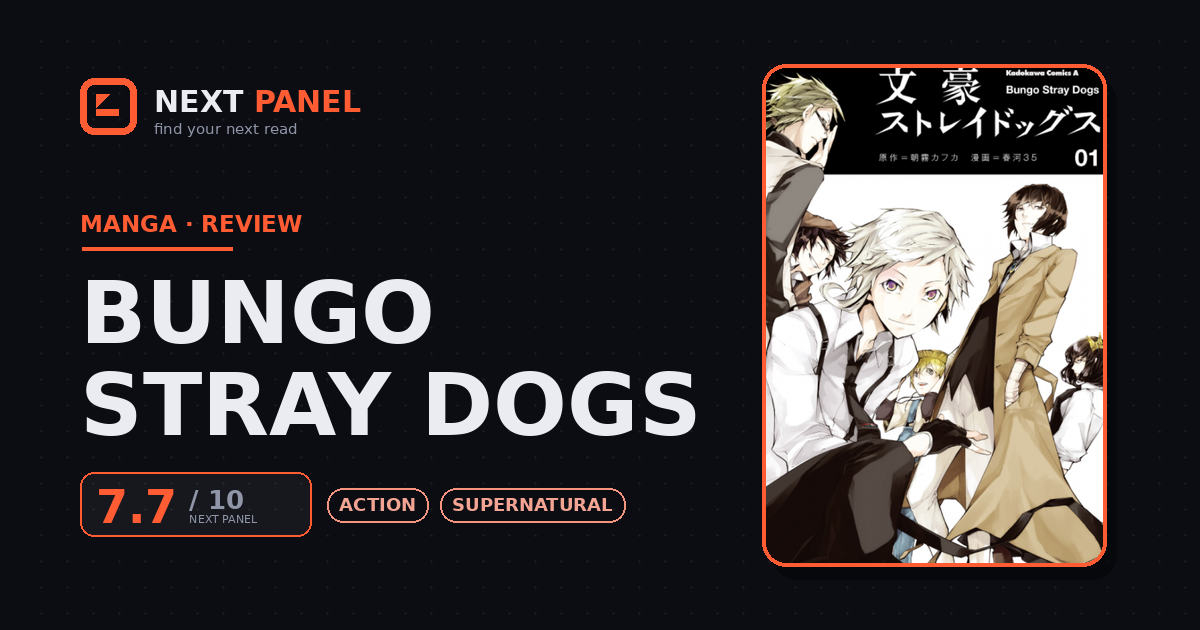
Is Bungo Stray Dogs Worth Reading? Review & Where to Read
Quick Answer
Yes, if you want stylish superpowered action with a distinctive hook. Every character is named after a real author, the art is sharp, and the lead cast is a real draw. Just be ready for a big roster and tone that swings hard between comedy and grim violence.
Quick Verdict
“When it's on, few action manga look this good — a cast of literary weirdos, knockout art, and fights with real stakes. You just have to roll with the wild tonal swings and an ever-growing roster.”
Best for: Readers who want stylish supernatural action, a big colorful cast, and flashy art with a dark streak.
Not for: Readers who want a small cast, a steady tone, and a story that doesn't sprawl.
- Type
- Manga
- Genres
- Action, Supernatural
- Status
- Ongoing
- This review
- Minor Spoilers
- Author
- Kafka Asagiri
- Artist
- Sango Harukawa
- Publisher
- Yen Press
- Platform
- Yen Press
| Quick facts | |
|---|---|
| Format | Manga (seinen) |
| Run | 2012–present · ongoing |
| Community score | AniList 8.3 |
| Content | Violence, torture, suicide themes |
| Where to read | Yen Press — official |
Overview
Bungo Stray Dogs runs on one great idea: a cast of super-powered characters, each named after a famous writer, whose ability is named after that author's best-known work. Atsushi, a broke and jumpy orphan who can turn into a tiger, gets pulled into the Armed Detective Agency — a crew of gifted misfits who take the cases the police won't touch. From there it becomes a running three-way war between the Agency, the mafia, and worse, told as a mix of detective mystery, superpower brawls, and comedy. It's written by Kafka Asagiri with art by Sango Harukawa, and it's been running since 2012.
What it does well
The hook does a lot of heavy lifting, and the series knows it. Watching how each writer's real work gets twisted into a combat power is a steady, low-key pleasure, and the deeper you get into literature the more little jokes you'll catch — though you never need to. More importantly, the powers are used cleverly. Fights usually turn on how two abilities interact rather than who hits harder, so the action stays a puzzle instead of a slugfest.
The art is the other reason to pick it up. Harukawa's style is angular and high-contrast, all sharp shadows and bold shapes, and it gives even a conversation on a rooftop some real visual snap. When the fights kick off, the layouts stay clear — you always know who's doing what to whom, which is rarer than it should be in busy action manga.
And the cast holds it together. Dazai is the standout: a former mafia executive turned detective who hides a very sharp mind behind constant suicide jokes, and the story keeps you guessing about what he actually wants. He's surrounded by a deep bench of oddballs, and the best arcs use that ensemble well, planting quiet setups and cashing them in with twists that genuinely surprise.
Where it falls short
The biggest issue is tone. Bungo Stray Dogs can swing from goofy slapstick to torture, betrayal, and on-page death within a few pages, and if you're not on its wavelength the whiplash is real. Some readers love that mix; others will find the jokes undercut the drama, or the darkness undercuts the jokes.
The cast is also a double-edged sword. New characters, factions, and organizations keep arriving, and once you're several arcs deep it's easy to lose track of who belongs to which side and what their power does. The pacing feels it too — the peaks are excellent, but the stretches between them can drift, filling time before the next big confrontation.
Verdict
At its best, this is one of the sharpest-looking action series around, built on a premise that never stops being fun and a lead who's worth the price of entry on his own. It's held back by uneven pacing and a roster that outgrows itself, so it works better as a stylish, arc-by-arc ride than a tightly-plotted whole. If flashy powers, a dark streak, and a huge cast of literary weirdos sound good to you, it's an easy recommendation.
Strengths & Weaknesses
Strengths
- The premise is a genuine hook. Each character is named after a real author and their power is named after that writer's most famous work, and the series has a lot of fun with it.
- The art is a big draw. Harukawa's angular, high-contrast style makes even quiet scenes look striking, and the fights stay easy to follow.
- The cast carries it. Dazai in particular is a magnetic lead — funny, unreadable, and genuinely unsettling when the story needs him to be.
- It commits to its mysteries. The strongest arcs plant setups early and pay them off with twists that actually land.
Weaknesses
- The tone lurches. It jumps from slapstick to torture and death fast enough to give you whiplash, and that won't click for everyone.
- The cast keeps growing. New factions and faces pile up, and it's easy to lose track of who's who between arcs.
- The pacing sags between the big arcs, with quieter stretches that don't move much.
Similar Titles
Another dark, stylish supernatural-action series with a big cast and grim stakes.
Supernatural action built on a strong core trio, mixing comedy with darker turns.
Shonen supernatural action with a found-family cast and flashy powers.
Where to Read Officially
| Platform | Format | Pricing | Region notes | Link |
|---|---|---|---|---|
| Yen Press | Print & digital volumes | Paid | Region availability varies | Open |
Frequently Asked Questions
Do I need to know the real authors it's based on?
No. The literary references are a fun bonus, but the story works fine if you've never read Dazai or Poe.
Is it finished?
No. The manga is still ongoing, with the Armed Detective Agency's story continuing across new arcs.
Where can I read it in English?
Yen Press publishes the series in English in both print and digital.