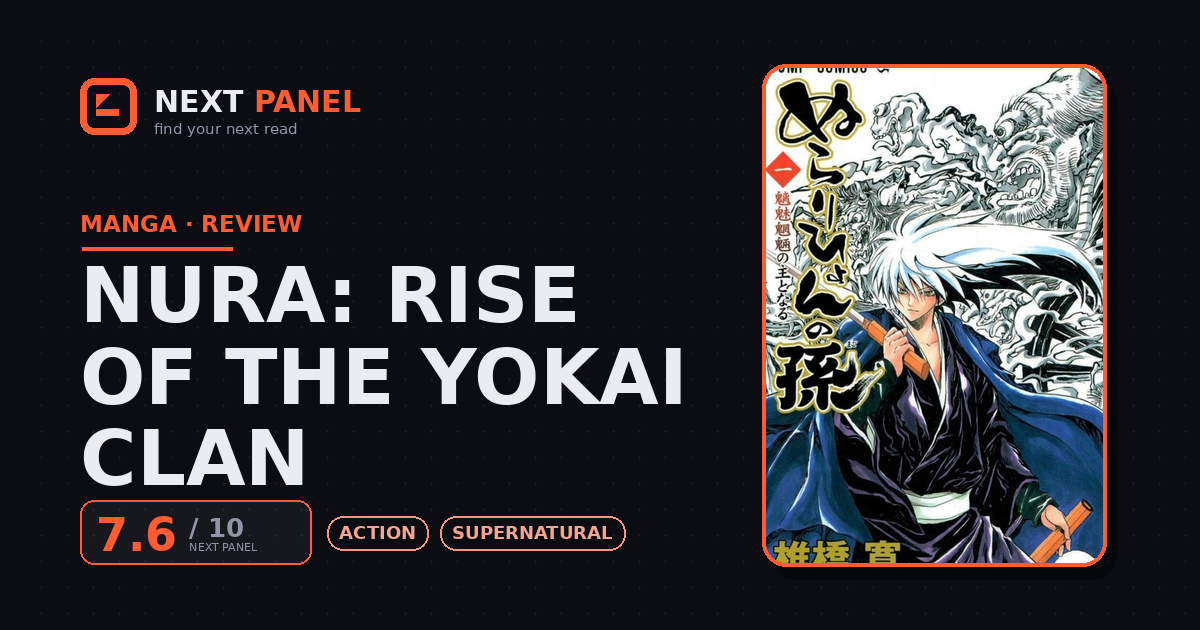
Is Nura: Rise of the Yokai Clan Worth Reading? Review & Where to Read
Quick Answer
Yes, especially if you want yokai folklore done with real texture — the clan of demon retainers around the lead are the highlight of the whole series.
Quick Verdict
“It never quite decides if Rikuo is a kid playing at being a yokai lord or the real thing, but the demon-of-the-week creativity carries it anyway.”
Best for: Readers who want a yokai-flavored shonen with a fun human/supernatural double life and inventive monster designs.
Not for: Readers who want a tightly consistent power fantasy or a lead who commits fully to one identity early on.
- Type
- Manga
- Genres
- Action, Supernatural
- Status
- Completed
- This review
- Minor Spoilers
- Author
- Hiroshi Shiibashi
- Publisher
- VIZ Media
- Platform
- VIZ
| Quick facts | |
|---|---|
| Format | Manga (shōnen), 218 chapters, 25 volumes |
| Run | 2008–2012 · completed |
| Community score | AniList 7.6 · MangaUpdates 8.2 |
| Content | Violence |
| Where to read | VIZ — official |
Overview
Rikuo Nura looks like an ordinary, if unusually polite, middle schooler. By night, though, he's the reluctant heir to the Nura clan, a powerful consortium of yokai led by his grandfather, the legendary Nurarihyon. Rikuo is three-quarters human and wants nothing to do with the family business, but the yokai around him have other plans, and the pull toward his supernatural inheritance keeps getting harder to ignore.
What it does well
The yokai themselves are the star here. Shiibashi draws from real Japanese folklore for the Nura clan's ranks, and it gives the world a specific, distinct flavor that a lot of generic 'demon army' shonen don't bother with — these feel like creatures with history, not just monster designs invented for the plot.
Rikuo's day-and-night double life is a strong hook, too, and the manga handles the tonal shift between 'awkward human kid' and 'commanding yokai lord' well, using it for both comedy and genuine intimidation depending on the scene. The clan's retainers around him, Kubinashi, Aotabo, Kejoro, and the rest, are a memorable, often very funny group, and the found-family dynamic among them gives the series real warmth alongside the demon-hunting plot.
The action holds up too: fights tend to lean on specific yokai abilities and clever use of the setting rather than just raw power escalation, which keeps battles feeling varied even across a long story.
Where it falls short
Rikuo's reluctance to embrace his yokai side is the emotional engine of the early story, but it gets repetitive well before the plot resolves it — the back-and-forth over his identity revisits the same beats more than it needs to.
The pacing is uneven too, especially early on, when the story leans on monster-of-the-week structure before the larger clan-war plot takes over. If you're hoping for a tightly focused single conflict from chapter one, the opening volumes ask for some patience.
Verdict
It never quite decides if Rikuo is a kid playing at being a yokai lord or the real thing, but the demon-of-the-week creativity and a genuinely charming cast of yokai retainers carry it anyway. Nura: Rise of the Yokai Clan is a solid, folklore-rich shonen that's worth the read for anyone who wants their demon-hunting with a real sense of found family behind it.
Strengths & Weaknesses
Strengths
- The yokai designs draw on real Japanese folklore and give the world a rich, distinct flavor beyond generic demon tropes.
- Rikuo's double life as an ordinary kid by day and a commanding yokai lord by night is a fun hook, and the tonal shift between the two is well handled.
- The Nura clan's cast of yokai retainers are memorable and often genuinely funny, giving the series a strong sense of found family.
- Action sequences lean into clever use of specific yokai abilities rather than pure power escalation.
Weaknesses
- Rikuo's back-and-forth about embracing his yokai side gets repetitive over the course of the story instead of building toward a clean resolution.
- Some arcs, especially early on, lean on monster-of-the-week pacing before the larger clan-war plot takes hold.
Similar Titles
Where to Read Officially
| Platform | Format | Pricing | Region notes | Link |
|---|---|---|---|---|
| VIZ | Print & digital volumes | Paid | Region availability varies | Open |
Frequently Asked Questions
Is Nura: Rise of the Yokai Clan finished?
Yes, it's a complete 25-volume series.
Do I need to know Japanese yokai folklore going in?
No — the manga introduces its folklore-based cast as it goes, though fans of yokai folklore will recognize a lot of references.
Is the anime a good substitute for the manga?
The anime covers a good chunk of the story but stops well short of the manga's ending, so the manga is the only way to see the full story play out.