Is Opus Worth Reading? Review & Where to Read
Quick Answer
Yes, especially if you're already a fan of Satoshi Kon's films — this is the clearest look at where his reality-bending instincts started. It's also a strong read on its own even if you've never seen Perfect Blue or Paprika.
Quick Verdict
“Watching Kon's cinematic instincts show up on the page years before Perfect Blue is reason enough to read this on its own; the fact that it's also a tense, well-constructed story is the bonus.”
Best for: Readers who want a tense, metafictional thriller about a creator confronting the consequences of his own story, especially fans curious where Satoshi Kon's filmmaking style began.
Not for: Readers who want a tidy genre thriller without any self-aware, story-within-a-story structure to keep track of.
- Type
- Manga
- Genres
- Horror, Thriller
- Status
- Completed
- This review
- Minor Spoilers
- Author
- Satoshi Kon
- Publisher
- Dark Horse
- Platform
- Dark Horse
| Quick facts | |
|---|---|
| Format | Manga, 20 chapters, 2 volumes |
| Run | 1995–1996 · completed |
| Community score | AniList 7.4 · MangaUpdates 7.2 |
| Where to read | Dark Horse — official |
Overview
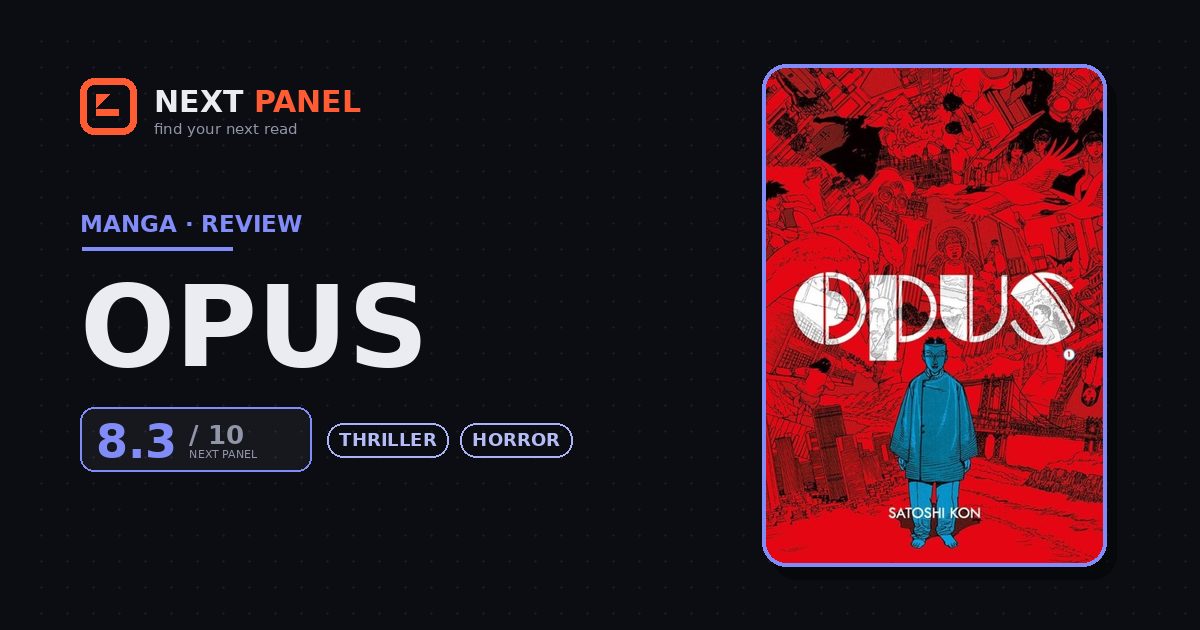
Chikara Nagai is a manga artist under deadline pressure, planning a shocking twist ending for his story Resonance — one that means killing off a character he's grown attached to. Then he's pulled physically into his own unfinished manga, discovering that the characters inside it experience Resonance as their actual world, and that they have opinions about the ending he's been planning for them. Opus is Satoshi Kon's only manga, drawn on the eve of his first film, and it's a clear preview of the reality-bending instincts that would define his entire directing career.
What it does well
The premise could easily have played as a cute gimmick, but Kon takes it seriously as a source of real tension. Once Nagai is inside his own story, the danger feels genuine — the characters aren't just winking at the audience about being fictional, they're reacting with something closer to betrayal and fear toward the person who's been deciding their fates. That commitment is what elevates the concept from clever premise to actual thriller.
For anyone who knows Kon's films, the throughline is unmistakable. The blurred boundary between the world of the story and the world of its creator is exactly the territory Perfect Blue and Paprika would later explore on screen, and seeing it worked out first on the page gives real insight into how his particular brand of unreliable, layered storytelling took shape.
The pacing benefits from being a single, complete omnibus rather than a sprawling series — every chapter is pulling toward the same central tension, with no padding to dilute it.
Where it falls short
The metafictional structure is also the story's biggest ask of the reader. Keeping track of which layer of the narrative you're in — the real world, the world of Resonance, and the increasingly blurred space between them — takes real attention, and readers who prefer a single, uncomplicated narrative thread may find some sequences disorienting rather than thrilling.
It's also worth knowing going in that the manga was left unfinished at Kon's death, and the final chapter included here was assembled posthumously from pages found among his papers. It completes the story, but the seams of an interrupted project are there if you're looking for them.
Verdict
Opus is a tense, well-built metafictional thriller in its own right, and a genuinely valuable piece of Satoshi Kon's artistic history — you can watch the ideas that would define Perfect Blue and Paprika take their first shape here on the page. It asks real attention from its readers, but for anyone drawn to stories that blur the line between creator and creation, it delivers.
Strengths & Weaknesses
Strengths
- The central hook — a creator getting pulled into his own unfinished story right before its planned twist ending — is executed with real tension instead of just being a clever gimmick.
- You can see Satoshi Kon's film sensibility taking shape on the page: the same interest in blurred reality and unreliable perspective that defines Perfect Blue and Paprika is already fully present here.
- The characters inside the story-within-the-story push back against their creator in ways that feel genuinely unsettling rather than cute or ironic.
- As a single-volume omnibus, the whole thing is tightly constructed with no filler stretching it out.
Weaknesses
- The metafictional structure demands attention — readers who prefer a straightforward narrative may find keeping track of which "layer" of the story they're in occasionally disorienting.
- The final chapter was assembled from pages found after Kon's death, and the seams of an unfinished project show a little in the closing stretch.
- This is Kon's only manga, so if it clicks for you, there's nothing else quite like it in his comics work to follow it up with.
Similar Titles
Similar cold, unsettling psychological thriller energy, if the metafiction angle isn't what draws you in.
A different kind of reality-bending horror, for readers who want more of that off-kilter, dread-building tone.
A much longer read, but similar in how it builds a mystery around the line between fiction and reality.
Where to Read Officially
| Platform | Format | Pricing | Region notes | Link |
|---|---|---|---|---|
| Dark Horse | Print omnibus (single volume) | Paid | Region availability varies | Open |
Frequently Asked Questions
Is Opus finished?
Yes, in the sense that matters — it's collected as a complete single-volume omnibus, including a final chapter assembled from pages found among Kon's papers after his death.
Do I need to have seen Satoshi Kon's films first?
No. Opus works as a standalone story, though fans of Perfect Blue and Paprika will recognize a lot of the same instincts here in earlier form.
Is this more horror or more thriller?
It's closer to a psychological thriller with genuine horror-adjacent dread, built around a metafictional mystery rather than jump scares.