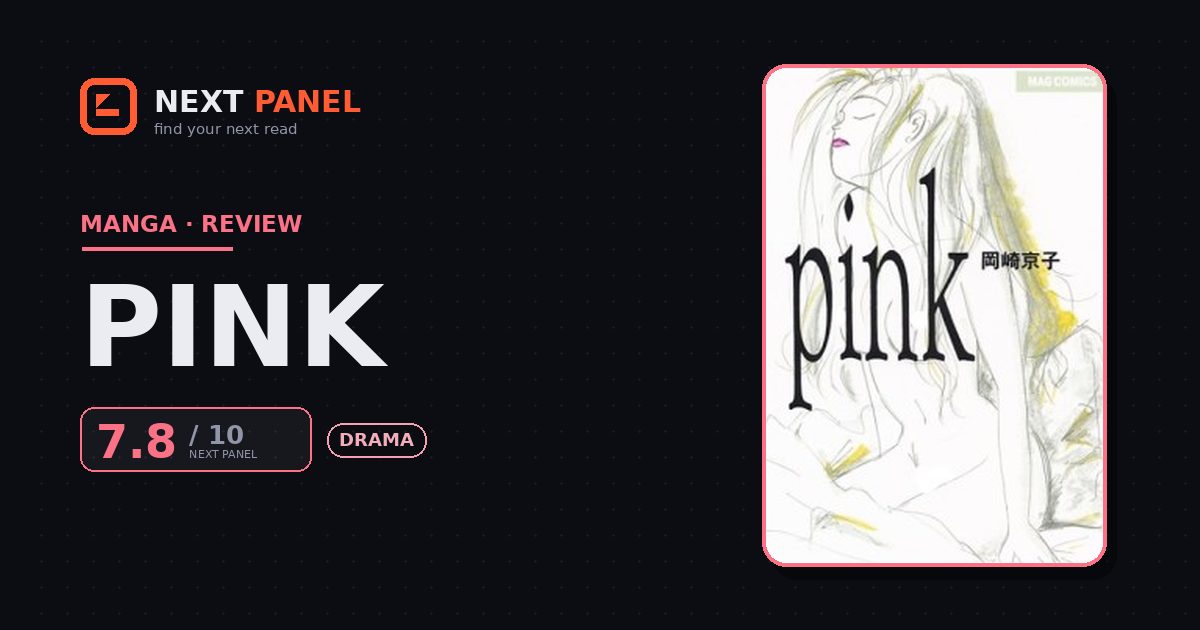
Is Pink Worth Reading? Review & Where to Read
Quick Answer
Yes, especially if you want a manga that's genuinely doing something different — this is a sharp, funny, and quietly sad satire of late-80s Japan that still reads as fresh today.
Quick Verdict
“Feeding a pet crocodile with money from sex work sounds like a gimmick, but Okazaki uses it to say something real about consumption, love, and what people are willing to trade for either.”
Best for: Readers who want a short, sharp literary manga with dark humor, and who don't mind following a morally messy, sympathetic lead.
Not for: Readers who want a long series to sink into, or a story with a tidy, comforting resolution.
- Type
- Manga
- Genres
- Drama
- Status
- Completed
- This review
- Minor Spoilers
- Author
- Kyoko Okazaki
- Publisher
- Vertical Comics
- Platform
- Vertical Comics
| Quick facts | |
|---|---|
| Format | Manga (josei), 20 chapters, 1 volumes |
| Run | 1989–1989 · completed |
| Community score | AniList 7.7 · MangaUpdates 7.2 |
| Content | Sex work, mature themes |
| Where to read | Vertical Comics — official |
Overview
Yumi spends her days as an unremarkable office worker and her nights as a call girl, and she's upfront about why: her pet crocodile, Croco, needs to eat, and neither hobby nor affection comes cheap in late-1980s Tokyo. When she meets Haruo, a broke young writer who happens to be her stepmother's boyfriend, the two start something that's less a conventional romance than two people quietly recognizing they're both faking their way through lives built on other people's money and expectations.
Pink reads less like a typical manga and more like a short, sharp literary novella that happens to be drawn. Kyoko Okazaki uses a premise that could easily be played for shock value — sex work, a pet crocodile, a tangled family entanglement — to say something pointed about consumerism, class, and what people convince themselves they're owed.
What it does well
The biggest achievement here is Yumi herself. Okazaki writes her without judgment or moralizing — she's making choices a lot of manga leads wouldn't, and the story simply presents her reasoning and lets you sit with it. That refusal to editorialize is what gives the book its edge; it trusts you to hold complicated feelings about a character instead of resolving them for you.
The satire is sharper than its era might suggest. Bubble-era Japan's specific brand of status anxiety and consumption-as-identity gets skewered directly, but the underlying targets — buying your way into feeling like you matter, mistaking transactions for connection — haven't aged out of relevance. It reads less like a period piece and more like something that just happens to be set in 1989.
The art does a lot of quiet work too. Okazaki's linework is clean and almost cheerful, which creates real friction against material that's often uncomfortable — that tension between how the book looks and what it's actually saying is a big part of why it sticks with you.
Where it falls short
The pacing won't work for every reader. This isn't built like a typical serialized manga with clean plot beats — it moves more like a literary short story, and if you're expecting conventional structure, some stretches will feel like they're drifting.
A handful of the satirical targets are specific enough to their moment that readers with no context for late-80s Japanese consumer culture will miss a layer or two, though the core story still holds up without that background. And the ending leans emotional rather than tidy — it resolves the relationship, not every question the book raises.
Verdict
Pink is short, strange, and doesn't behave like most manga you'll read this year, and that's exactly the point. If you want something that actually has something to say and says it in one sitting, this is an easy, worthwhile read — just don't go in expecting a conventional story.
Strengths & Weaknesses
Strengths
- Yumi is written with real sympathy — she's making choices most readers wouldn't, but the manga never asks you to judge her for it.
- The satire of consumerism and status-chasing in bubble-era Tokyo still lands, because the specific anxieties it's mocking haven't really gone away.
- Okazaki's art style — clean, almost breezy linework paired with genuinely uncomfortable subject matter — creates a tone nothing else quite matches.
- It says everything it needs to in one volume, with no padding or filler stretching the story out.
Weaknesses
- The pacing is unconventional by manga standards — it reads more like a literary novella than a typical serialized story, which can feel jarring if you're expecting a clearer plot structure.
- Some of the satire is specifically aimed at late-1980s Japanese consumer culture, and a few references will go over the heads of readers unfamiliar with that context.
- The ending resolves emotionally rather than neatly, which won't satisfy readers who want every thread tied off.
Similar Titles
Another Okazaki-adjacent dissection of beauty, consumption, and self-destruction under a glossy surface.
A different tone, but similar interest in what women in Tokyo trade away chasing a life they're told they should want.
Where to Read Officially
| Platform | Format | Pricing | Region notes | Link |
|---|---|---|---|---|
| Vertical Comics | Print & digital volume | Paid | Region availability varies | Open |
Frequently Asked Questions
Is this a long series?
No — Pink is a single, complete volume, originally serialized in 1989.
Is this the same Kyoko Okazaki as Helter Skelter?
Yes, same author. Pink came earlier and is shorter, but shares her interest in consumerism and women navigating a transactional world.
Is the tone more comedic or more serious?
Both — it's played with a light, almost comic touch on the surface, but the underlying story is genuinely sad and pointed.