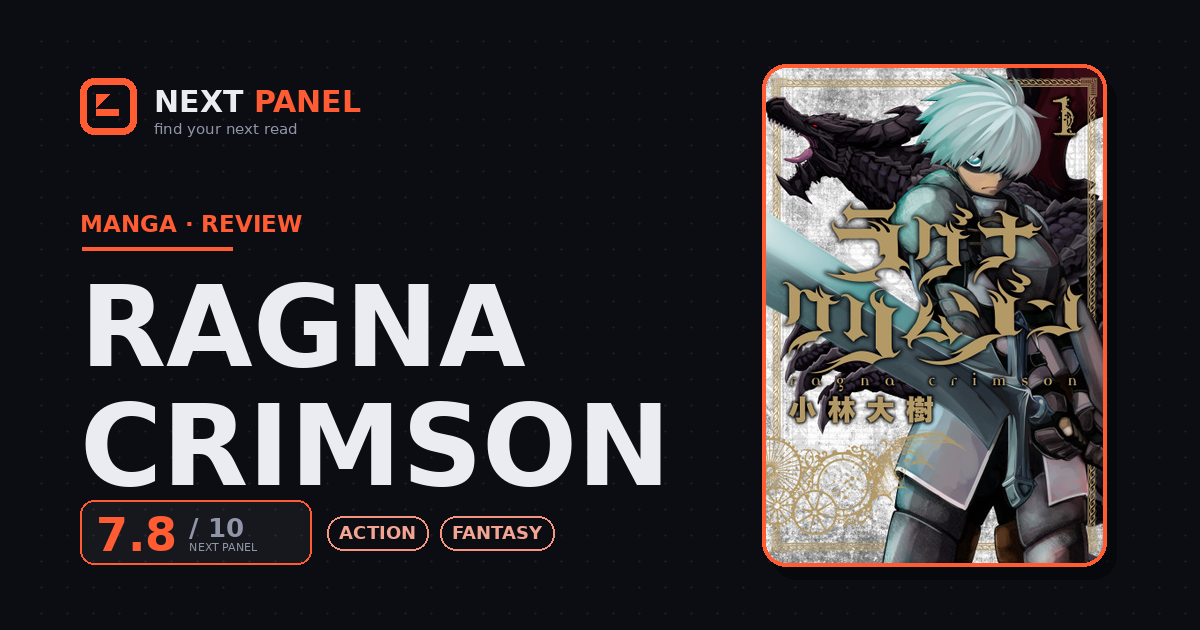
Is Ragna Crimson Worth Reading? Review & Where to Read
Quick Answer
Yes, if you want brutal dragon-slaying action with real stakes. The early chapters lean on a repeatable formula, but the Ragna-Crimson partnership and the willingness to kill named characters keep the tension genuine.
Quick Verdict
“Brutal dragon fights and a genuine revenge hook carry this past its repetitive opening stretch.”
Best for: Readers who want high-stakes, high-body-count dragon-slaying action with real emotional weight behind it.
Not for: Readers who want a slow character study or a gentle, low-stakes fantasy story.
- Type
- Manga
- Genres
- Fantasy, Action
- Status
- Ongoing
- This review
- Minor Spoilers
- Author
- Daiki Kobayashi
- Publisher
- Square Enix
- Platform
- Square Enix Manga & Books
| Quick facts | |
|---|---|
| Format | Manga (seinen), 17 volumes |
| Run | 2017–present · ongoing |
| Community score | AniList 7.4 · MangaUpdates 7.4 |
| Content | Graphic violence, gore |
| Where to read | Square Enix Manga & Books — official |
Overview
Humanity lost the war against dragons a long time ago. What's left is a handful of hunters picking off stragglers while the strongest dragons rule unchallenged, and Ragna is the weakest of those hunters, right up until his future self drags him through the moment he dies and shoves him back in time with the knowledge of how everything goes wrong. Daiki Kobayashi's Ragna Crimson spends its opening volumes on a straightforward premise, a weak hunter getting a second chance, and then complicates it fast by pairing Ragna with Crimson, a dragon with its own reasons for wanting the dragon monarchs dead.
What it does well
The dragons are the draw, and the manga treats them like the threat they're supposed to be. Kobayashi draws each named dragon with its own silhouette, its own attack pattern, and its own reason a straight fight won't work, so most major battles play out as a puzzle Ragna has to solve under pressure rather than a stat check he wins by getting stronger. That keeps the action feeling dangerous well past the point where a typical shonen would let its hero coast.
The time-loop hook does real work. Because Ragna already knows how badly things can go, the story doesn't need fifty chapters of setup before the stakes feel real — his fear is established on page one, and every early fight carries the weight of having seen this go wrong before. It's an efficient way to skip the usual slow-build shonen opening.
Ragna and Crimson's partnership is the other strength. Neither trusts the other completely for a long stretch, and the manga lets that friction sit instead of resolving it too quickly. Crimson isn't a mascot or a power-up; it's a co-lead with its own agenda, and watching the two of them grudgingly sync up over time gives the revenge plot an actual relationship to anchor it.
The manga also isn't precious about its cast. Named characters die, plans fail, and the story is willing to let a battle go badly, which keeps tension high in a genre that often telegraphs who's safe.
Where it falls short
The early volumes lean on a repeatable formula: find the dragon's weakness, bait it into exposing that weakness, close the gap and end it. It works, but the first few fights share enough of a shape that you can see the pattern before the manga starts breaking from it in more inventive ways later on.
Leo, the young hunter who becomes Ragna's closest ally, gets an arc that moves fast — her devotion to him escalates in fairly familiar shonen-romance shorthand rather than earning each beat gradually, and readers who want a slower emotional build may find her turn a little sudden.
The worldbuilding is also dense and compressed early on. Hunter ranks, dragon hierarchies, and the mechanics of the time loop all get explained in quick bursts, and it takes a volume or two before the setting's rules feel settled rather than thrown at you.
Verdict
This is dark fantasy built for readers who want their action brutal and their stakes real, and it mostly delivers on both. The dragon fights carry genuine tension, Ragna and Crimson's partnership gives the revenge plot a real center, and the manga doesn't flinch from consequences. It stumbles a little in its early formula and in how fast it moves Leo's arc along, but if you want a shonen where the monsters actually feel like monsters, Ragna Crimson earns the read.
Strengths & Weaknesses
Strengths
- The dragon designs and fight choreography are the highlight — each dragon has a distinct silhouette and a fight that plays out like a puzzle, not just a slugfest.
- Ragna's time-loop backstory gives the story a real emotional hook from chapter one instead of easing into the stakes.
- Crimson's push-and-pull partnership with Ragna adds tension beyond hero-versus-monster, since neither fully trusts the other early on.
- The pacing rarely stalls — arcs escalate quickly, and the manga isn't afraid to kill named characters.
Weaknesses
- Some early dragon fights hit the same beat — scout the weakness, exploit it, dragon falls — before the manga starts mixing up the formula.
- Leo's devotion to Ragna escalates in fairly familiar shonen-romance shorthand rather than earning each beat gradually.
- The worldbuilding is dense and compressed early on, so hunter ranks and dragon hierarchies take a volume or two to feel settled.
Similar Titles
A rougher, older dark-fantasy touchstone if you want even higher stakes and grimmer violence.
Similar monster-hunting-as-survival tone, with a lead just as fixated on one enemy type.
Where to Read Officially
| Platform | Format | Pricing | Region notes | Link |
|---|---|---|---|---|
| Square Enix Manga & Books | Print & digital volumes | Paid | Region availability varies | Open |
Frequently Asked Questions
Is Ragna Crimson finished?
Not yet — it's ongoing in Japan at 17 volumes as of this review, reportedly heading into its final arc, with 15 volumes out in English so far.
Do I need to watch the anime first?
No. The manga is the original source, runs well ahead of the 2023 Silver Link anime, and reads fine on its own.
Is there romance in Ragna Crimson?
Some, but it stays secondary to the dragon-hunting plot — don't expect it to be the main draw.