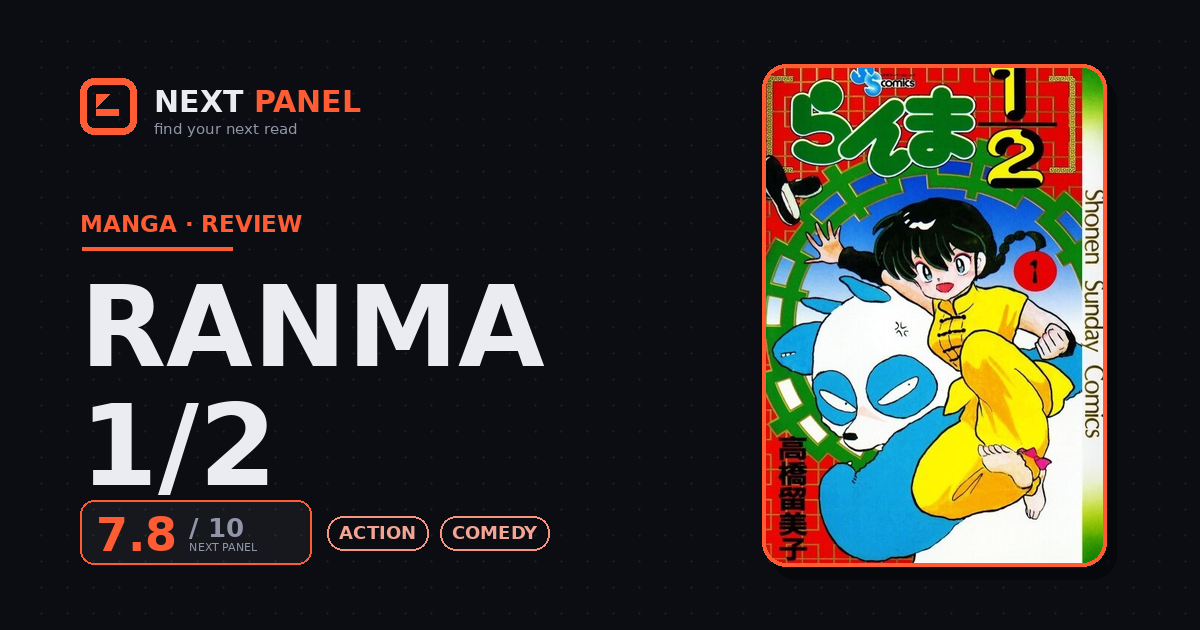
Is Ranma 1/2 Worth Reading?
Quick Answer
Worth reading to see where a huge chunk of modern gender-swap and rom-com manga tropes came from: the curse premise still generates genuine comedy and character work across nearly 40 volumes, though the episodic structure and some 1980s-90s humor show their age.
Quick Verdict
“Genre-defining classic that still holds up as some of Takahashi's best comic writing, even if its episodic structure and dated humor occasionally show their years.”
Best for: Readers who want a classic, hugely influential martial-arts rom-com with a premise that still generates real comedy hundreds of chapters in.
Not for: Readers who want steady relationship progress rather than a long, episodic plateau, or who are sensitive to dated gender-based humor.
- Type
- Manga
- Genres
- Romance, Action, Comedy
- Status
- Completed
- Author
- Rumiko Takahashi
- Publisher
- Viz Media
- Platform
- Viz Media
| Quick facts | |
|---|---|
| Format | Manga, 407 chapters, 38 volumes |
| Run | 1987–1996 · completed |
| Community score | AniList 7.8 · MangaUpdates 8.2 |
| Content | ecchi humor and gender-transformation-based fanservice, played mostly for comedy; some gags reflect 1980s-90s sensibilities |
| Where to read | Viz Media — official |
Overview
Ranma Saotome falls into a cursed spring in China and comes out with a deeply inconvenient problem: splash him with cold water and he turns into a girl, splash him with hot water and he turns back, and there's no cure in sight. His martial-artist father has an equivalent problem involving pandas. None of that stops Ranma's dad from following through on an old promise to marry Ranma off to Akane Tendo, whose family runs a dojo and whose reaction to the whole arrangement is exactly as enthusiastic as you'd expect. Rumiko Takahashi's manga ran for nearly a decade in the late 1980s and '90s, and it's still one of the most influential gender-swap comedies the medium has produced.
What it does well
The curse premise gets genuine use rather than fading into a background gimmick. Takahashi keeps finding new comedic and even character-driven angles on what it means for Ranma to navigate the world, and his own pride, as two genders, and the martial-arts choreography stays inventive across hundreds of chapters instead of repeating the same handful of moves. The ensemble, Akane, Ryoga, Shampoo, Ukyo, Kodachi, and more, keeps expanding without ever fully diluting the core dynamic, and Takahashi's comic timing, in both dialogue and panel composition, holds up as some of the best the genre has produced. It's also just reliably funny in a way that doesn't require you to already love this kind of comedy to appreciate.
Where it falls short
This is a nearly 40-volume series built on an episodic rival-of-the-week structure, and the central Ranma-Akane relationship barely moves for enormous stretches of the run by design, which will frustrate readers who want steady forward momentum rather than a very long plateau. The late-1980s and '90s sensibilities also show their age in places. Some gags lean on gender-based humor and light fanservice that reads very differently today than it did on original release, and a handful of recurring bits haven't aged as gracefully as the core premise has.
Verdict
Genre-defining classic that still holds up as some of Takahashi's best comic writing, even if its episodic structure and dated humor occasionally show their years. Worth reading if you want to see where a huge chunk of modern gender-swap and rom-com manga tropes actually came from. Go in prepared for a very long, loosely plotted ride rather than a tightly serialized story.
Strengths & Weaknesses
Strengths
- Curse premise generates genuinely new comedic and character angles across hundreds of chapters instead of going stale
- Inventive martial-arts choreography throughout a very long run
- Large ensemble cast expands without diluting the core Ranma-Akane dynamic
- Takahashi's comic timing and panel composition hold up as genre-best decades later
Weaknesses
- Episodic rival-of-the-week structure means the central relationship barely moves for long stretches
- Some gender-based humor and fanservice reflects dated 1980s-90s sensibilities
- Nearly 40 volumes of loosely connected arcs rather than a tightly serialized plot
Similar Titles
Takahashi's earlier long-running comedy for readers who want more of her specific comic voice.
A more tightly plotted, modern slow-burn rom-com if the episodic structure here isn't for you.
Where to Read Officially
| Platform | Format | Pricing | Region notes | Link |
|---|---|---|---|---|
| Viz Media | Print & Digital | Paid | Region availability varies | Open |
Frequently Asked Questions
Is Ranma 1/2 finished?
Yes, the manga is complete at 407 chapters across 38 volumes, running from 1987 to 1996.
Is there an anime?
Yes, a classic anime adaptation aired starting in 1989, plus a newer 2024 remake series.
Where can I read it in English?
Viz Media publishes it in English in 2-in-1 omnibus editions, in print and digitally.