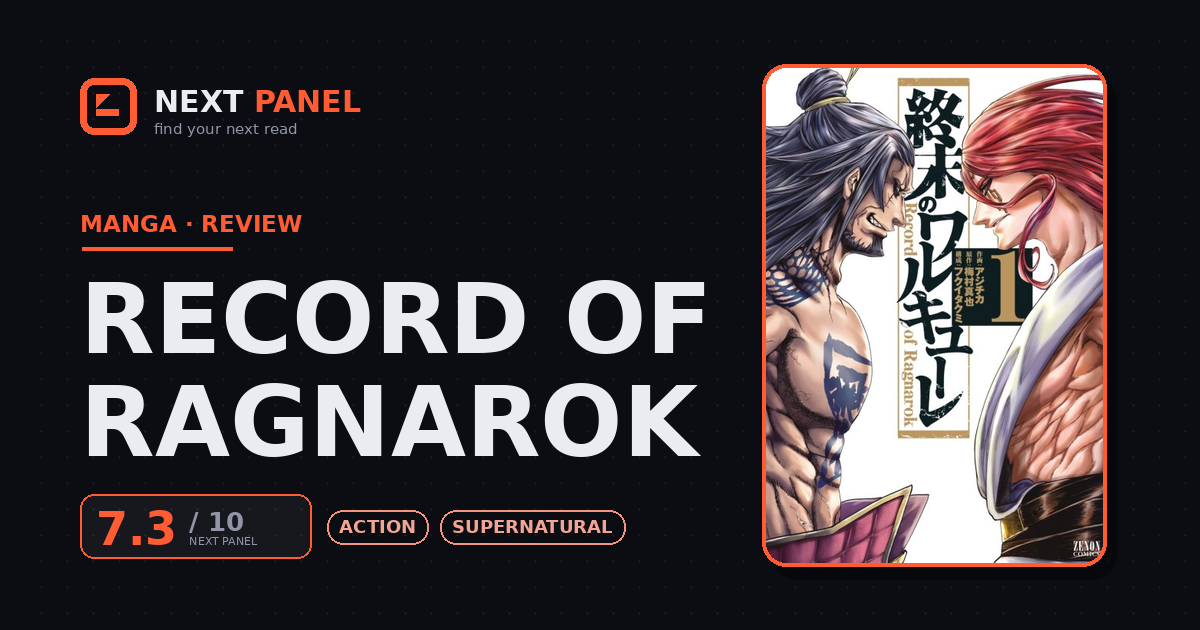
Is Record of Ragnarok Worth Reading? Review & Where to Read
Quick Answer
If the premise sounds fun, it delivers — Record of Ragnarok is a spectacle-first tournament series that treats every match as its own mini-event, with real highs when the matchup is inspired and real lulls when it isn't.
Quick Verdict
“Buddha punching a Norse god isn't a premise you get tired of quickly, and when a matchup clicks — which is often — this is some of the most purely fun spectacle fighting being published right now.”
Best for: Readers who want tournament-style, one-on-one spectacle fights with mythology and history as the toolkit, not a slow-burn character drama.
Not for: Readers who want deep characterization outside the fighter currently center stage, or a tightly plotted story instead of a match-by-match structure.
- Type
- Manga
- Genres
- Action, Supernatural
- Status
- Ongoing
- This review
- Minor Spoilers
- Author
- Shinya Umemura, Takumi Fukui
- Artist
- Azychika
- Publisher
- Coamix
- Platform
- VIZ
| Quick facts | |
|---|---|
| Format | Manga (seinen), 27 volumes |
| Run | 2017–present · ongoing |
| Community score | AniList 7.7 · MangaUpdates 7.7 |
| Content | Violence, graphic fight content |
| Where to read | VIZ — official |
Overview
Every thousand years, the gods of every pantheon on Earth meet to vote on whether humanity deserves to keep existing. This time, the vote is unanimous: extinction. Valkyrie Brunhild petitions for one last chance — Ragnarok, a best-of-thirteen tournament where history's greatest fighters face off one-on-one against the gods themselves, human survival riding on the outcome. Written by Shinya Umemura and Takumi Fukui with art by Azychika, Record of Ragnarok has been running since 2017 and is still ongoing, with the manga now well ahead of its Netflix anime adaptation.
What it does well
The premise alone does a lot of heavy lifting, and it keeps paying off. Buddha versus the death god Zerofuku, Adam versus Zeus, Jack the Ripper versus Hercules — every match is built as its own dream matchup, and the fun is watching how the writers translate a myth or a historical reputation into an actual fighting style. Sasaki Kojiro's swordsmanship, Hercules' brute-force resilience, Buddha's philosophy of restraint turned into a literal combat technique — the series treats legend as a design document rather than just flavor text, and that's a genuinely clever throughline.
The fights themselves are drawn with real scale. Azychika doesn't hold back on splash pages, and the tournament structure means the cast turns over every arc — you get a new headline matchup, a new set of stakes, and a new pair of fighters to learn roughly every couple of volumes. That rotation keeps the series from getting stale in a way a lot of long single-thread action manga struggle with; if one arc doesn't grab you, the next one is a clean jumping-on point.
Where it falls short
The structure that makes the series easy to dip in and out of is also its biggest limitation. Characters who aren't currently fighting get very little to do, and once a match ends, most participants effectively disappear from the story. There's not much of a throughline holding the cast together beyond the tournament format itself, and the scenes between matches can feel like they exist mainly to stall until the next fight starts.
The pacing inside each arc has a similar issue. Before most bouts, there's a stretch of dialogue-heavy exposition explaining exactly who this god or hero is and how their power works, and it can run long enough to blunt the momentum right before the fight it's building toward. Readers who want the spectacle to just start swinging may find themselves waiting.
Verdict
Record of Ragnarok knows exactly what it's selling — mythology and history reimagined as one-on-one spectacle fights — and it delivers on that promise more often than not. It's not interested in deep characterization or a tightly wound plot, and it doesn't need to be; when a matchup is inspired, and most of them are, that's more than enough.
Strengths & Weaknesses
Strengths
- The core hook never gets old: every match is a dream crossover, pitting figures like Buddha, Adam, Jack the Ripper, or Sasaki Kojiro against gods from Norse, Greek, Hindu, and other mythologies.
- Fights are choreographed at a genuinely huge scale, and each combatant's history or legend gets folded directly into their fighting style instead of being reduced to a generic power set.
- The best-of-thirteen structure keeps the cast rotating every arc, so the series gets a fresh lead and a fresh stakes-reset every couple of volumes instead of dragging one storyline out.
- The reinterpretations of historical and mythological figures are genuinely creative — the fun is watching how the writers turn a legend into a fighting style.
Weaknesses
- Characterization outside the two fighters in the current match is thin — most of the cast exists to have one big fight and then recede into the background.
- Because each bout is largely self-contained, the connective tissue between matches can feel like padding rather than plot.
- Pre-fight exposition explaining who each figure is and why their powers work a certain way can run long and slow the pacing right before the payoff.
Similar Titles
same appetite for larger-than-life, spectacle-first one-on-one fights
shares the over-the-top scale and gleeful excess in how fights are staged
same sense that the fate of humanity rides on one legendary fighter at a time
Where to Read Officially
| Platform | Format | Pricing | Region notes | Link |
|---|---|---|---|---|
| VIZ | Digital chapters | Print & digital volumes | Paid | Region availability varies | Open |
Frequently Asked Questions
Is Record of Ragnarok finished?
No, it's ongoing — 28 volumes have been published in Japan as of mid-2026, with Viz Media's English release steadily catching up.
Do I need to know mythology or history to follow it?
No. The manga explains each fighter's background and abilities before their match, so no outside knowledge is required going in.
Is the manga different from the Netflix anime?
The anime adapts the manga fairly closely through its early arcs, but the manga is well ahead and covers matches and arcs the anime hasn't reached yet.