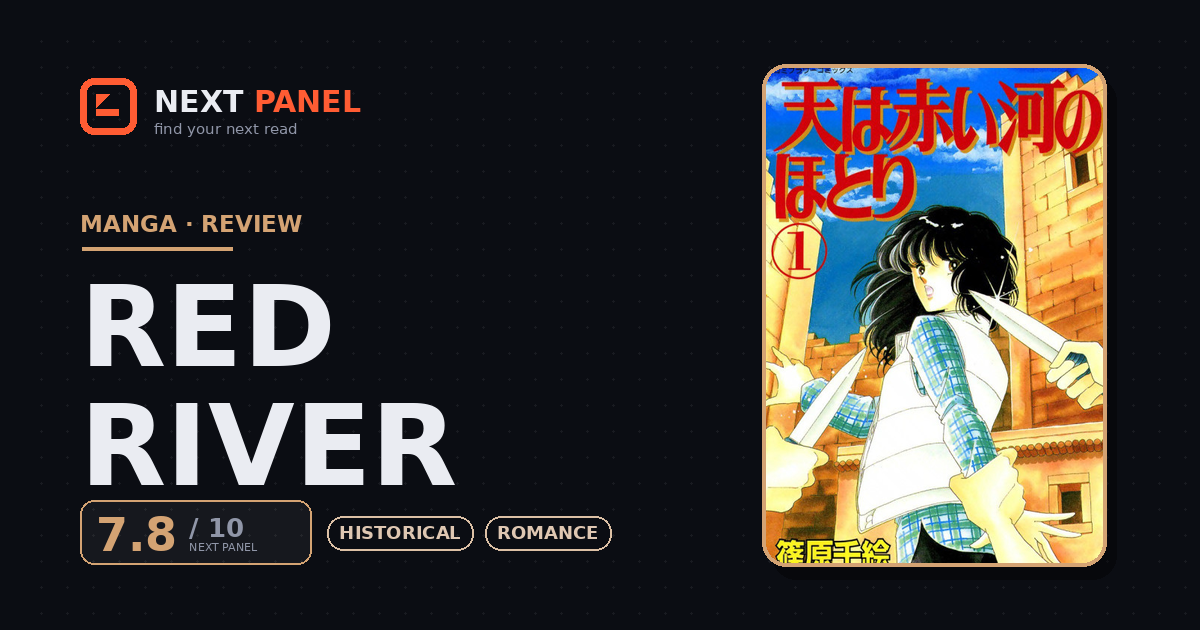
Is Red River Worth Reading? Review & Where to Read
Quick Answer
Yes — if you want a completed historical shoujo epic, Red River is one of the genre's best long hauls. The ancient Hittite setting is unique, the romance is built on real trust, and the story reaches an actual ending. Just know the plot leans on repeated kidnap-and-rescue cycles.
Quick Verdict
“Few shoujo epics commit like this — real bronze-age politics, a heroine who earns her legend, and an ending that lands. You just have to forgive how often she gets kidnapped along the way.”
Best for: Readers who want a long, completed historical epic where the romance and the politics pull equal weight.
Not for: Readers who want a fast pace, a modern setting, or a plot that doesn't keep putting its heroine in captivity.
- Type
- Manga
- Genres
- Romance, Historical
- Status
- Completed
- This review
- Minor Spoilers
- Author
- Chie Shinohara
- Publisher
- Shogakukan
- Platform
- VIZ
| Quick facts | |
|---|---|
| Format | Manga (shōjo), 99 chapters, 28 volumes |
| Run | 1995–2002 · completed |
| Community score | AniList 7.6 · MangaUpdates 8.4 |
| Content | Violence, sexual assault themes |
| Where to read | VIZ — official |
Overview
Yuri Suzuki is an ordinary fifteen-year-old in modern Japan until the water starts reaching for her. She's pulled through a fountain into the ancient Hittite Empire, summoned by Queen Nakia as a sacrifice for a curse meant to clear her son's path to the throne. Prince Kail saves her by claiming she's his concubine, and what begins as a scramble to survive and get home slowly becomes something bigger: a place in the empire's wars, its politics, and Kail's life. Chie Shinohara's series is fully complete — this is a finished epic, not an open-ended one.
What it does well
The setting does a ton of work. Nearly every shoujo epic reaches for medieval Europe or a made-up kingdom; Shinohara researched the Hittite Empire instead. Bronze-age Anatolia, the rivalry with Egypt, real figures like Ramses walking through the plot — it gives the story a texture nothing else in the genre has, and it makes the political stakes specific instead of generic palace drama.
Yuri is the other big win. She starts as a scared kid whose only goal is getting home, and the series actually lets her change. She learns the language, earns the army's respect, and grows into a figure the empire's people rally behind — and her authority is built on-page, arc by arc, rather than declared in narration. By the latter half, she's driving events, not just surviving them.
The romance holds up because it runs on trust. Kail treats Yuri as a partner: he confides his plans, respects her decisions, and the relationship survives on loyalty rather than the misunderstanding-of-the-week engine so much romance leans on. When conflict comes between them, it comes from the situation — war, duty, the question of whether Yuri should return home — not from contrived silence.
It also helps that the story ends. Shinohara paces the whole run toward a real conclusion, and the ending pays off both the romance and the historical stakes. For a series this long, that's not a small thing.
Where it falls short
The peril cycle is real. Nakia schemes, Yuri is captured or cornered, a rescue follows, and the board resets. Individual arcs are tense and well-built, but the shape repeats enough that you can predict it, especially through the middle stretch.
Sexual menace is the series' default threat. Villains establish themselves by threatening Yuri's body, and while the story takes it seriously rather than playing it for titillation, the sheer frequency reads as dated now and can wear you down.
And because Nakia is the engine of nearly all of it, her schemes start to blur together. She's a strong villain — genuinely intelligent, with her own motives — but the story keeps her in the same role for the entire run.
Verdict
Red River earns its length. The setting is one of a kind, the romance is one of the healthiest in classic shoujo, and Yuri's rise from sacrifice to legend is paid off properly. If you can roll with the repetitive capture plots and the dated threat devices, this is one of the best completed epics the genre has — and since it's finished, it's an easy series to commit to.
Strengths & Weaknesses
Strengths
- The ancient Hittite setting is genuinely researched and nothing else in shoujo covers this ground — bronze-age Anatolia, Egypt, and Babylon give the politics real texture.
- Yuri's growth from scared teenager to a leader the empire rallies behind is built on-page, arc by arc, not declared.
- The central romance runs on trust and partnership instead of manufactured misunderstandings.
- The story is complete and paced toward an actual, earned ending.
Weaknesses
- The plot leans hard on a repeating peril cycle — Yuri is kidnapped or cornered so often you can see the machinery.
- Sexual menace is the default threat device, and its frequency reads as dated.
- Nakia stays the sole engine of villainy for the whole run, and her schemes blur together in the middle stretch.
Similar Titles
Same era of sweeping 90s shoujo: war, destiny, and a heroine who becomes a symbol.
A sheltered princess forged into a leader by war and betrayal, with politics and romance in balance.
Another ordinary girl pulled into a strange world where she turns out to be the key to everything.
Where to Read Officially
| Platform | Format | Pricing | Region notes | Link |
|---|---|---|---|---|
| VIZ | Print & digital volumes | Paid | Region availability varies | Open |
Frequently Asked Questions
Is Red River finished?
Yes. The manga is complete, and VIZ has published the full series in English, including 3-in-1 omnibus editions that are easy to collect.
Is Red River historically accurate?
The bones are real — the Hittite Empire, its rivalry with Egypt, and figures like Ramses all appear — but the story is heavily dramatized romance-adventure, not a history lesson.
How mature is Red River?
It's an older-teen read. There's war violence and a recurring pattern of sexual threat toward the heroine; the story treats it seriously, but it comes up often.