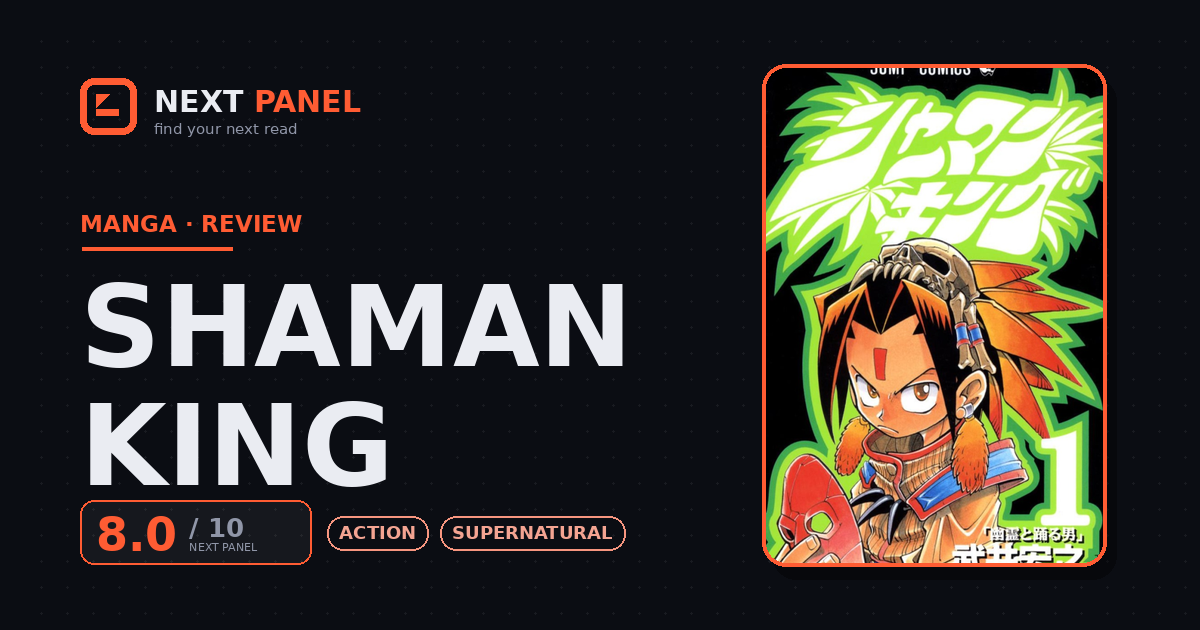
Is Shaman King Worth Reading? Review & Where to Read
Quick Answer
Yes, especially if you want a shonen tournament series with more heart and philosophy than raw power escalation. Yoh's laid-back attitude toward becoming the most powerful being alive is the whole point.
Quick Verdict
“Undercuts its own tournament stakes on purpose, and somehow that restraint is the best thing about it.”
Best for: Readers who want a shonen tournament series built around found family and quiet philosophy rather than pure power escalation.
Not for: Readers who want fast, constant power increases and high-stakes tension driving every arc.
- Type
- Manga
- Genres
- Action, Supernatural
- Status
- Completed
- This review
- Minor Spoilers
- Author
- Hiroyuki Takei
- Publisher
- Kodansha
- Platform
- Kodansha USA
| Quick facts | |
|---|---|
| Format | Manga (shōnen), 288 chapters, 32 volumes |
| Run | 1998–2004 · completed |
| Community score | AniList 7.6 · MangaUpdates 7.7 |
| Where to read | Kodansha USA — official |
Overview
Shaman King follows Yoh Asakura, a shaman who can see and communicate with spirits, as he enters the Shaman Fight, a tournament held once every 500 years to determine who becomes the Shaman King and gains the power to reshape the world. Unlike most shonen leads chasing strength for its own sake, Yoh is famously unbothered by the idea of winning, which sets a different tone for a series built around escalating tournament fights.
What it does well
The biggest strength here is Yoh himself. A shonen lead who genuinely doesn't care about becoming the most powerful being alive is a strange choice for a tournament series, and Hiroyuki Takei uses that laid-back attitude to keep the story grounded in character and philosophy rather than pure spectacle. Fights matter because of what they reveal about the people involved, not just who ends up stronger.
The cast is a major draw too. Every shaman is paired with a spirit ally drawn from history, mythology, or folklore, from samurai ghosts to Native American spirits to historical warlords, and that variety keeps the fights visually and conceptually fresh across a long run. Takei clearly did his homework, and it shows in how distinct each pairing feels.
What elevates Shaman King above a lot of its shonen peers is its willingness to slow down for real thematic weight. Death, grief, and what it means to live alongside the dead are constant undercurrents, and the manga treats those ideas seriously instead of using them as backstory dressing. The art supports this well, with an angular, distinctive style that gives even background characters real presence.
Where it falls short
The pacing has real problems, most famously in how the original serialization rushed its ending under editorial pressure, cramming what should have been a much longer conclusion into a handful of chapters. The complete digital release fixes this with previously unpublished material, but it's worth knowing going in that the story's pacing wasn't originally under the creator's full control.
Several side characters also get compelling introductions and interesting spirit allies, only to fade into the background once their initial arc wraps up, which leaves some of the huge cast feeling underused by the end. And the philosophical detours, while a strength overall, occasionally slow the tournament's momentum at moments when the story should be building tension instead.
Verdict
Shaman King earns its spot as one of the more thoughtful shonen tournament series, built on a lead who refuses to chase power the way the genre usually expects. The pacing issues around its rushed original ending are real, but the full digital release resolves most of that, and the combination of a huge, creative cast with genuine philosophical weight makes this worth reading even if tournament shonen usually isn't your thing.
Strengths & Weaknesses
Strengths
- Yoh's laid-back personality and his refusal to fight for the sake of winning gives the tournament structure a genuinely different feel from typical shonen leads.
- The huge cast of shamans, each paired with a distinct historical or mythological spirit ally, gives fights real variety in both power sets and personality.
- The manga isn't afraid to slow down for philosophical and spiritual themes about death, grief, and coexistence, which gives the story more weight than a standard tournament arc.
- Takei's art has a distinct, angular style that ages well and gives even minor characters a strong visual identity.
Weaknesses
- The pacing is uneven, especially around the notorious rushed conclusion of the original run before the story was later revised and completed.
- Some side characters and their spirit allies get introduced with a lot of potential and then fade into the background once their arc ends.
- The philosophical elements occasionally slow momentum right when the tournament structure should be building tension.
Similar Titles
Another tournament shonen blending the supernatural with a laid-back but capable lead.
Shares an interest in weighty themes like death and sacrifice underneath its adventure plot.
Where to Read Officially
| Platform | Format | Pricing | Region notes | Link |
|---|---|---|---|---|
| Kodansha USA | Digital chapters & omnibus volumes | Paid | Region availability varies | Open |
Frequently Asked Questions
Which version of Shaman King should I read?
The complete digital release from Kodansha includes the originally unpublished final arcs, so that's the most complete version of the story available in English.
Is this connected to the newer Shaman King anime?
Yes, the 2021 anime reboot adapts this manga more faithfully and completely than the original 2001 anime did.
Is the manga finished?
Yes, it's complete, and several sequel series continue the story afterward.