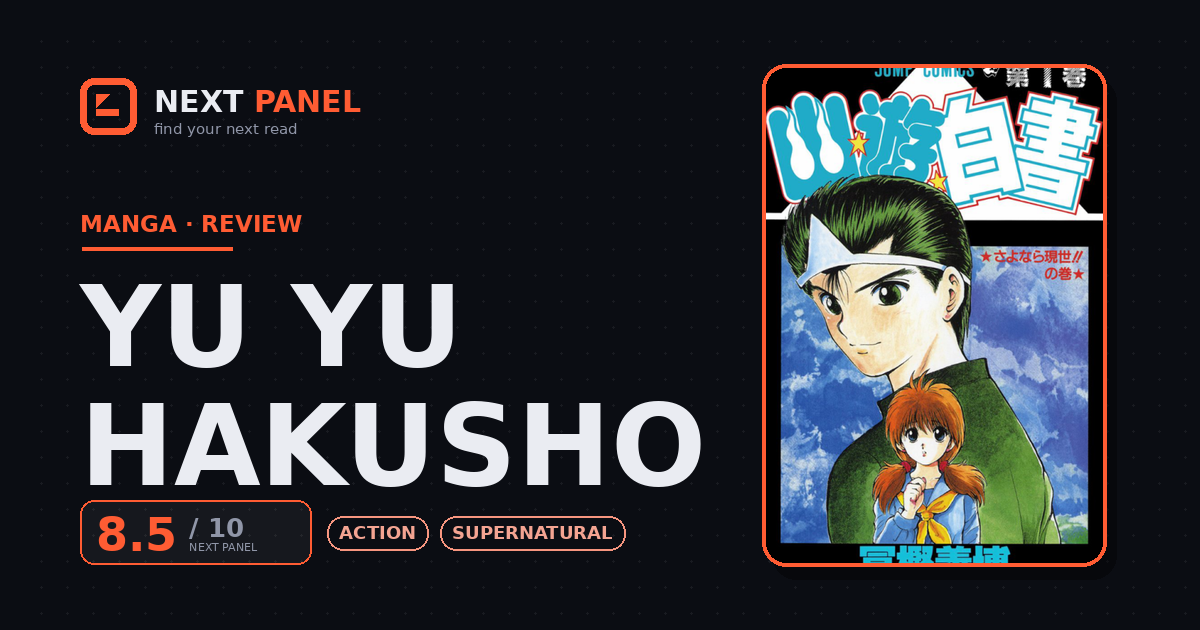
Is Yu Yu Hakusho Worth Reading? Review & Where to Read
Quick Answer
Yes — Yu Yu Hakusho is a genre landmark, especially the Dark Tournament arc. The final stretch rushes its ending, but the four-person core cast and the fight strategy carry the whole run.
Quick Verdict
“Started as a scrappy delinquent-detective comedy and turned into one of the best tournament arcs in '90s shonen — the ending rushes, but everything before it earns your patience.”
Best for: Readers who want a shonen tournament arc with real strategy and a cast that stays likable as the power level climbs.
Not for: Readers who want consistent pacing all the way through or a story that never changes tone.
- Type
- Manga
- Genres
- Action, Supernatural
- Status
- Completed
- This review
- Minor Spoilers
- Author
- Yoshihiro Togashi
- Publisher
- VIZ Media
- Platform
- VIZ Shonen Jump
| Quick facts | |
|---|---|
| Format | Manga (shōnen), 176 chapters, 19 volumes |
| Run | 1990–1994 · completed |
| Community score | AniList 8.0 · MangaUpdates 8.2 |
| Content | Violence |
| Where to read | VIZ Shonen Jump — official |
Overview
Yu Yu Hakusho starts with fourteen-year-old delinquent Yusuke Urameshi getting hit by a car while saving a kid's life, dying, and getting recruited by the spirit world as a Spirit Detective instead of being sent on to the afterlife. What begins as a monster-of-the-week detective gig turns into martial-arts tournament arcs and then a full demon-world political arc, as Yusuke and his crew -- reformed delinquent Kuwabara, fox demon Kurama, and fire demon Hiei -- get pulled into fights that matter for a lot more than closing a case file.
What it does well
Togashi is genuinely good at escalating stakes without losing the characters underneath them. Every arc raises the power level, but Yusuke, Kuwabara, Kurama, and Hiei stay recognizable, and the group dynamic -- loud rivalry between Yusuke and Kuwabara, Hiei's constant "I don't actually care" that clearly isn't true -- carries a lot of the appeal even when the plot slows down. The Dark Tournament arc in particular is one of the best tournament arcs in shonen manga: Togashi lets fights get strategic instead of just bigger, gives losing fighters real motivations, and structures the bracket so you're invested in matches that have nothing to do with the main cast. The later demon-world arcs also do something a lot of straightforward fighting manga skip -- actual politics, factions, and consequences that follow from having real power, instead of just a bigger villain waiting at the end.
Where it falls short
Togashi's well-documented health problems during serialization are visible on the page: the art gets noticeably rougher and the pacing speeds up hard in the final arc, which resolves major plot threads much faster than the earlier volumes set them up. The detective-story opening, which is genuinely fun in its own right, mostly gets dropped once the tournament arcs start, so the tone shifts pretty hard partway through the series -- readers who came for the ghost-hunting cases might be surprised how quickly it turns into a straight fighting manga. A few side characters, especially some of the human cast back in Yusuke's hometown, quietly disappear once the story moves on to bigger stakes, and a couple of tournament opponents get built up more than the plot ends up needing.
Verdict
This is a foundational shonen series, and the Dark Tournament arc alone is worth the read for anyone who likes tournament-format fighting stories. The demon-world political arc that follows is ambitious and mostly earns it, even if the final chapters resolve things faster than you'd like. If you've read Hunter x Hunter and wondered where Togashi's love of rules-based, strategic combat started, this is the answer, and it's a fun, funny, occasionally genuinely moving read on its own terms.
Strengths & Weaknesses
Strengths
- The Dark Tournament arc is genuinely one of the best tournament arcs in shonen manga, with fights that reward paying attention to strategy, not just power levels.
- The core four-person cast stays distinct and likable even as the stakes climb.
- The demon-world politics give the later arcs real stakes beyond 'a stronger enemy shows up.'
- Togashi gives even minor side characters a real moment before they're gone.
Weaknesses
- The final arc rushes hard, resolving plot threads much faster than earlier volumes set them up.
- The detective-story tone of the opening chapters mostly disappears once the tournament arcs take over.
- Some of the early human supporting cast quietly vanish once the story moves to bigger stakes.
Similar Titles
Togashi's later series, with even more emphasis on strategy and power-system rules.
A similar escalating tournament structure and a scrappy troublemaker lead who grows into a real hero.
A more modern take on the same 'ordinary teen becomes a supernatural fighter' setup.
Where to Read Officially
| Platform | Format | Pricing | Region notes | Link |
|---|---|---|---|---|
| VIZ Shonen Jump | Digital chapters | Free + Paid | Region availability varies | Open |
Frequently Asked Questions
Is Yu Yu Hakusho finished?
Yes. The manga ran 19 volumes and 175 chapters and has a complete ending, plus a short follow-up one-shot Togashi drew years later.
Should I watch the anime or read the manga?
The anime covers the story with some filler and pacing changes; the manga is tighter and handles the final stretch differently. Either is a fine entry point, but the manga is the more direct version of Togashi's story.
Is this by the same creator as Hunter x Hunter?
Yes, Yoshihiro Togashi wrote and drew both. Yu Yu Hakusho came first, and you can already see his interest in strategic, rules-based fights that he'd push even further later.