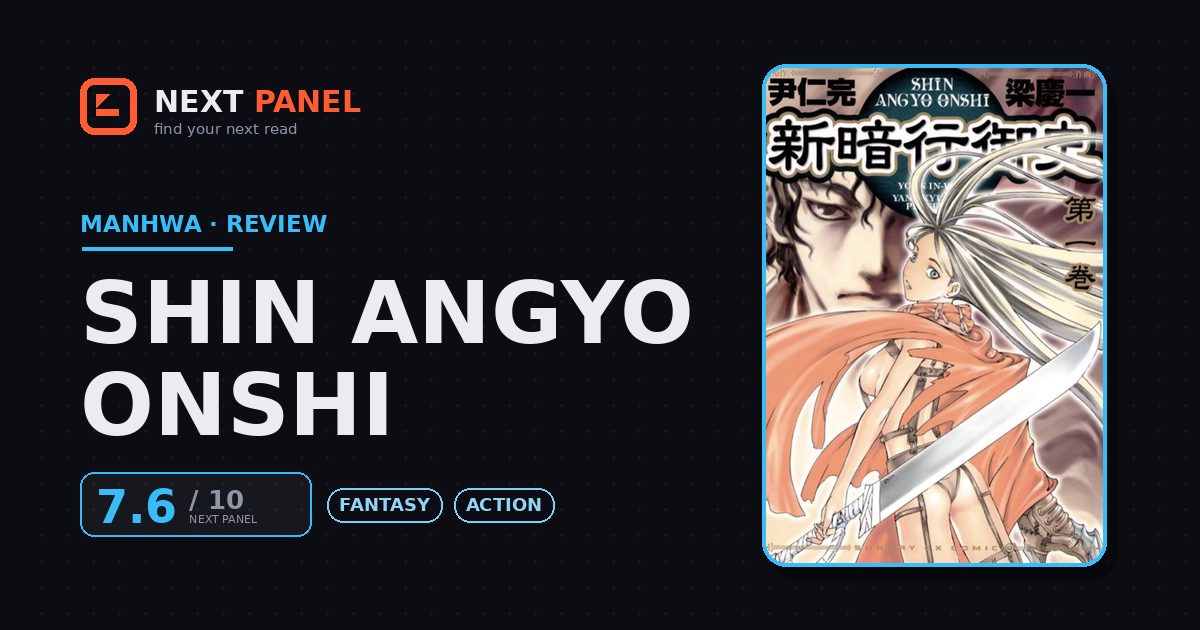
Is Shin Angyo Onshi Worth Reading? Review & Where to Read
Quick Answer
Yes, if you want a dark, violent fantasy manhwa with a strong sense of place and a wandering-swordsman structure closer to a folktale than a modern power-fantasy. It's complete, so there's no risk of it stalling out on you.
Quick Verdict
“Grim, episodic, and dripping with a folklore atmosphere most fantasy manhwa don't bother with — the plotting gets loose in the middle stretch, but Munsu himself never stops being worth following.”
Best for: Readers who like a wandering-hero structure, a bleak post-collapse setting, and violence that has real weight behind it.
Not for: Readers who want a tightly plotted single throughline or a lighter, more optimistic tone.
- Type
- Manhwa
- Genres
- Fantasy, Action
- Status
- Completed
- This review
- Minor Spoilers
- Author
- Youn In-wan
- Artist
- Yang Kyung-il
- Publisher
- Originally serialized in Korea and Japan's Sunday Gene-X
| Quick facts | |
|---|---|
| Format | Manhwa (seinen), 75 chapters, 17 volumes |
| Run | 2001–2007 · completed |
| Community score | AniList 7.7 · MangaUpdates 8.5 |
| Content | Graphic violence, war atrocities |
Overview
The world of Shin Angyo Onshi has already ended once. What's left is a broken, folklore-soaked kingdom picking through the wreckage, and Munsu — a one-eyed wanderer and one of the last surviving Angyo Onshi, the crown's secret royal inspectors — moving through it with a sword and a grudge. Youn In-wan and Yang Kyung-il's manhwa ran from 2001 to 2007 across 17 volumes plus a gaiden, and it plays less like a conventional fantasy epic and more like a string of folk tales strung along one man's search for the people responsible for his country's collapse.
What it does well
Munsu carries the whole thing. He's sardonic, tired, and clearly hiding more grief than he lets on, and that restraint makes him a much more interesting lead than the standard vengeance-driven hero. The world around him is where the manhwa really distinguishes itself — it leans hard into Korean folklore and myth, populating its ruined countryside with monsters, corrupt officials, and half-remembered legends in a way that gives the setting real specificity instead of generic fantasy wallpaper.
The episodic structure, where Munsu drifts from region to region dealing with a new local horror or injustice in each stretch, works in the manhwa's favor for readability: individual arcs largely stand on their own, so it's easy to pick up and put down without losing the thread. And when the violence lands, it lands hard — people die, plans fail, and the story doesn't flinch from the cost of the conflicts it sets up.
Where it falls short
The same wandering structure that makes it readable in chunks also lets the central mystery of what happened to Munsu's homeland go slack for long stretches — some volumes feel like pure side-quest with only a thin thread back to the main plot. A handful of side characters get real emotional investment built up only to be dropped the moment their arc wraps, which can feel like a missed opportunity rather than intentional restraint. And practically speaking, there's no active official English release right now; the old Tokyopop print run is out of print, so actually reading it takes more legwork than most titles on this list.
Verdict
Shin Angyo Onshi is a grim, atmospheric wandering-hero fantasy with a genuinely strong lead and a setting that still feels distinct almost two decades later. The plotting sags in the middle and getting hold of a copy isn't simple, but if that folklore-soaked, post-collapse tone appeals to you, it's worth the hunt.
Strengths & Weaknesses
Strengths
- Munsu is a genuinely compelling lead — weary, sardonic, and driven by grief he doesn't talk about, closer to a wandering ronin archetype than a typical shonen protagonist.
- The setting draws on Korean folklore and myth in a way that gives the world a texture a lot of generic fantasy manhwa skip entirely.
- The violence has real consequences and weight; it doesn't read as empty spectacle, and the story isn't afraid to let its cast lose.
- The episodic, region-to-region structure lets individual arcs stand almost on their own, which makes it easy to read in chunks.
Weaknesses
- That same episodic structure means the overarching plot thread about Munsu's past loses momentum for long stretches in the middle volumes.
- Some side characters are introduced with real weight and then dropped once their arc closes, which can feel abrupt.
- There's no current official English digital release — the old Tokyopop print edition is long out of print, so tracking down a copy takes real effort.
Similar Titles
Frequently Asked Questions
Is Shin Angyo Onshi finished?
Yes, it's complete — 17 volumes plus a gaiden volume, serialized from 2001 to 2007.
Is Shin Angyo Onshi related to the anime Blade of the Phantom Master?
Yes, the 2004 animated film Blade of the Phantom Master is an adaptation of this manhwa, though it only covers part of the story.
Is Shin Angyo Onshi available in English?
Tokyopop published an official English print edition years ago, but it's out of print with no current active digital license.