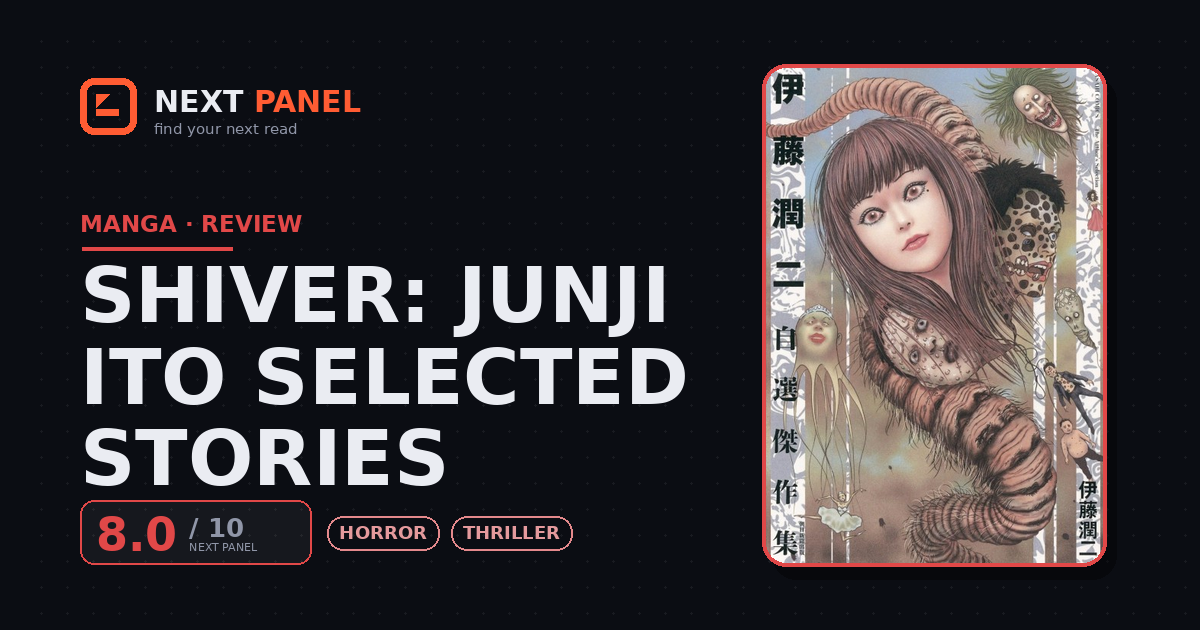
Is Shiver: Junji Ito Selected Stories Worth Reading? Review & Where to Read
Quick Answer
Yes, especially if you want a curated introduction to Junji Ito rather than committing to a full multi-volume series first. Ito picked these stories himself, and his included commentary adds real value for newcomers and longtime fans alike.
Quick Verdict
“Nine stories, one curator with unmatched judgment about his own work — this is about as reliable a horror anthology as they come.”
Best for: Readers who want a curated, self-contained introduction to Junji Ito's horror short stories.
Not for: Readers who want a single continuous story rather than a collection of standalone shorts.
- Type
- Manga
- Genres
- Horror, Thriller
- Status
- Completed
- This review
- Minor Spoilers
- Author
- Junji Ito
- Publisher
- Asahi Sonorama
- Platform
- Viz Media
| Quick facts | |
|---|---|
| Format | Manga (seinen), 10 chapters, 1 volumes |
| Run | 2015–2015 · completed |
| Community score | AniList 7.9 |
| Content | Body horror, disturbing imagery |
| Where to read | Viz Media — official |
Overview
Most horror anthologies are assembled by an editor after the fact, picking through a creator's catalog for whatever fits a theme. Shiver is different: Junji Ito picked these nine stories himself, added his own commentary on each one, and the result is a rare chance to see a horror master curate his own greatest hits rather than have someone else do it for him. It ranges from body horror to slow-building psychological dread, giving a genuinely useful cross-section of what makes his work distinct, all in a single self-contained volume.
The included stories span different points in Ito's career and different flavors of horror, from cosmic unease to more grounded, human-scale dread. Read together, they work almost like a syllabus — if you've only seen Uzumaki or Tomie referenced online and want to know what the fuss is about without committing to a multi-volume series, this is built for exactly that.
What it does well
The curation is the whole appeal here, and it delivers. Rather than leaning on one register of scare, Shiver moves between cosmic unease, grotesque transformation, and quieter, more human dread from story to story, so you come away with a real sense of Ito's range rather than one narrow slice of it. Some entries build slowly through mounting wrongness, while others go for a single, immediate gut-punch of an image — the variety keeps the collection from feeling repetitive even across nine stories in one sitting.
The commentary that follows each piece is an unexpected highlight — Ito explains where an idea came from or why a particular image stuck with him, which adds a layer of insight you rarely get from a horror collection. It's a genuinely useful window into how he thinks about his own work, and it reframes a few stories in ways that make them land differently on a re-read.
The art, unsurprisingly, is as meticulous as anything in his catalog, and several images here are the kind that are hard to shake once you've seen them. His linework has always done a lot of the horror's heavy lifting, and a best-of format means nearly every page is doing that work at a high level.
Where it falls short
Any best-of collection is going to leave things out, and dedicated Ito readers may notice the absence of a personal favorite or two — this isn't meant to be comprehensive, and it doesn't pretend to be. A couple of the included stories read as earlier or more minor work, included more for their place in his development than for how hard they land as scares, which can make the collection feel a little uneven if you're expecting every entry to hit at the same intensity.
And like any anthology, the quality isn't perfectly even — some stories linger for days, others are serviceable but forgettable next to the strongest entries. If you're already deep into Ito's full bibliography, there's a good chance you've read several of these before, since a few are among his more commonly reprinted pieces.
Verdict
Shiver is a smart, well-curated way into Junji Ito's work, made more valuable by his own commentary on his choices. It won't replace reading his longer series, and longtime fans may already know most of what's here, but as an introduction or a low-commitment sampler, it's a worthwhile read either way.
Strengths & Weaknesses
Strengths
- Ito curated this himself, and the selection shows real range — cosmic dread, body horror, and quieter psychological unease all get represented.
- The included creator commentary on each story adds context you don't usually get in a horror anthology, which is genuinely valuable for understanding his process.
- As a single volume, it's a low-commitment way to sample Ito's style before diving into his longer series.
- The art is as meticulous and unsettling as anything else in his catalog, with several stories built around genuinely unforgettable images.
Weaknesses
- Being a curated best-of, it inevitably leaves out other stories fans might consider essential.
- A few of the included pieces are early or minor work included more for historical interest than pure scares.
- As with most anthologies, the quality varies story to story, so not every entry hits as hard as the strongest ones.
Similar Titles
Where to Read Officially
| Platform | Format | Pricing | Region notes | Link |
|---|---|---|---|---|
| Viz Media | Print & digital (hardcover) | Paid | Region availability varies | Open |
Frequently Asked Questions
What stories are included in Shiver?
The collection includes nine stories hand-picked by Junji Ito himself, including "Used Record," "Fashion Model," "Hanging Balloons," and the title story "Shiver," each with the author's own commentary.
Is this a good starting point for someone new to Junji Ito?
Yes — because it's a curated, self-contained anthology rather than a long-running series, it's one of the easier ways to sample his range before committing to something like Uzumaki or Tomie.
Where can I read Shiver in English?
Viz Media released an official English hardcover edition, available in print and digitally through Viz's platforms.